The Nile has always been more than a river; it is a geopolitical spine whose control has repeatedly been transmuted into imperial advantage. What began in the late nineteenth century as a set of tactical choices to secure the Suez lifeline hardened into a legal and technical architecture designed to privilege downstream stability over upstream development. That architecture did not expire with decolonization, its legal echoes, treaties, and institutional habits have remained potent levers of influence.
The most recent iteration of that dynamic is the renewed U.S. offer to mediate the Nile dispute in January 2026, a diplomatic intervention framed in Cairo’s preferred language of “water-sharing” and coordinated management; its contours, and the speed with which downstream capitals embraced it, suggest not merely mediation but the risk of re-entrenching an older downstream-centric order.
The British strategic calculus that set this pattern in motion was simple and ruthless: control the Nile, secure Egypt, and thereby protect imperial lines to India. After the opening of the Suez Canal British policymakers confronted a new vulnerability, Egypt’s centrality to imperial communications, and responded by treating the river not as a transboundary common but as a strategic artery requiring political guardianship.
Across the closing decades of the nineteenth century and into the early twentieth, a web of bilateral understandings and protocols, among them the Anglo-Italian accords of the 1890s and the sectoral maneuvers that culminated in the 1906 tripartite understandings, began to translate hydrology into geopolitics. These arrangements were not neutral technical instruments, they reflected a foundational assumption that downstream security could trump upstream sovereignty.
The 1902 Anglo-Ethiopian treaty exemplifies how legal instruments encoded that assumption while also leaving room for interpretive contestation. The widely circulated English text appears to require Ethiopia to seek British consent before undertaking works on the Blue Nile, Lake Tana, or the Sobat, but scholars who have examined the multiple language versions demonstrate a more complicated picture in the Amharic and Italian texts and in contemporaneous diplomatic notes.
Careful readings by legal historians show that the Amharic phrasing, what Menelik’s court actually signed and understood, has been read by Ethiopian jurists as prohibiting a total stoppage of flow rather than forbidding all forms of development or regulation. That linguistic slipperiness has been the basis for persistent Ethiopian contestation of downstream claims rooted in century-old documents.
The later bilateral accords of the twentieth century consolidated downstream primacy into formal allocations and operational prerogatives. The 1929 arrangements and, most consequentially, the 1959 Nile Waters Agreement between Egypt and Sudan allocated the lion’s share of the river’s flow to downstream beneficiaries and created de facto veto powers over upstream projects.
Those instruments were negotiated in a geopolitical environment in which upstream voices were marginalized, and they served as legal anchors for downstream anxieties that would persist long after Britain’s empire had receded. The technical and legal rigidity of those accords helped produce a zero-sum frame, any upstream gain was, by definition, presented as a downstream loss, which has complicated cooperative management ever since.
Behind those diplomatic texts lay an alternative technical vision, one that the early British hydrologist Harold H. E. Hurst and his contemporaries advanced: the “Century Storage” idea. Hurst’s work emphasized the Nile’s extreme interannual variability and argued that over-year highland storage, strategically located in the cooler, higher-elevation Ethiopian headwaters, would minimize evaporative losses and maximize reliable downstream yields.
From a hydro-engineering standpoint this blueprint was sound: storing and regulating at altitude, closer to the hydrological source, reduces surface area evaporation and produces more efficient multi-year regulation than conglomerated lowland reservoirs. But that rational technical design collided with political imperatives, national control, territorial legibility, and the desire of downstream states to keep the “valve” within their borders.
The political choice to favor lowland control was institutionalized in the Aswan High Dam, a project chosen and celebrated for its political symbolism as much as for its engineering returns. Located deep inside Egypt’s territory, Aswan gave Cairo a visible mastery over the river, even while it introduced long-term ecological and hydrological penalties.
Evaporative losses from Lake Nasser have been repeatedly estimated in the scientific literature at roughly 10–16 billion cubic meters per year; over the fifty-plus years since Aswan’s impoundment, those annual losses accumulate to several hundred billion cubic meters of forgone water. Framing the trade-off in that way matters, the choice to centralize storage downstream was not simply a technical judgment but a political strategy with profound intergenerational consequences.
The mid-century balance of power also produced a pattern of financial and diplomatic containment aimed at preventing upstream capital accumulation. Ethiopia’s engagements with external funders during the Haile Selassie era, most notably the United States Bureau of Reclamation’s extensive Blue Nile studies between the late 1950s and 1964, produced blueprints for hydropower and irrigation, but translating those blueprints into financed projects proved politically fraught.
Downstream states used diplomatic influence, and international financial institutions often acted cautiously where regional politics made projects controversial; the net effect was an extended period in which Ethiopia could not mobilize the external capital and political leeway required to realize highland regulation at scale.
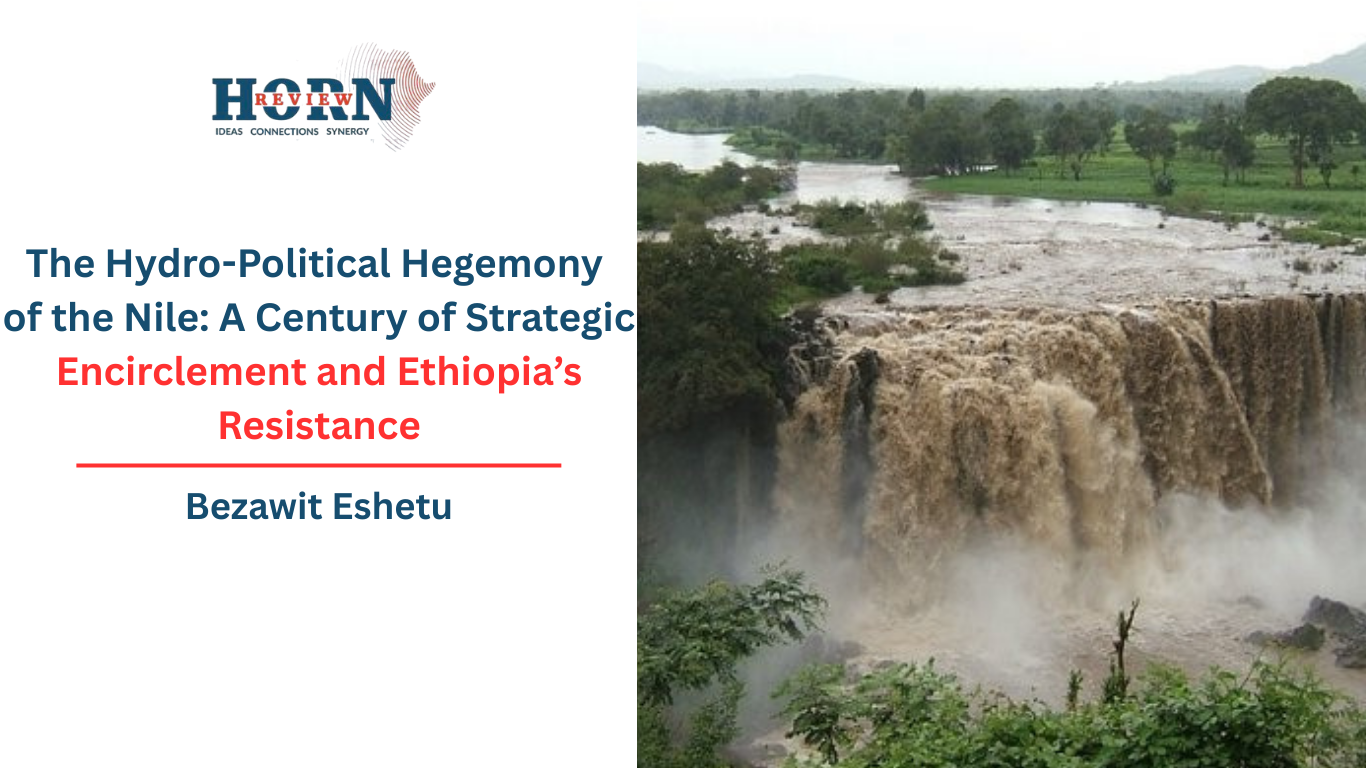
Ethiopia’s decision to proceed with the Grand Ethiopian Renaissance Dam (GERD) after 2011 therefore represents a decisive rupture, technically consonant with Hurst’s logic and politically defiant of downstream vetoes. By relying primarily on domestic financing mechanisms and phased engineering works, Addis Ababa produced a geopolitical fait accompli: a highland reservoir that materially alters the distribution of hydrological control in the basin.
The dam’s generation capacity, reported at roughly 5.15 gigawatts when commissioned, changes Ethiopia’s developmental trajectory and recasts the Nile as a source of electricity and industrial growth rather than only a downstream lifeline. That shift has been profoundly unsettling to Egypt and has recalibrated regional alignments.
If GERD’s construction transformed the basin’s facts on the ground, downstream strategies adapted, diplomatic pressure, legal claims, and regional alliances were reconstituted to constrain Ethiopia’s leverage. Cairo’s effort to internationalize the dispute has included seeking legal guarantees, cultivating partners in the Horn and the Gulf, and using security pacts to shape the regional environment.
The MoU that Ethiopia signed with Somaliland in January 2024, granting Ethiopian access to the Red Sea in exchange for economic and political concessions, was cast by Cairo as a provocation and was immediately weaponized in diplomatic narratives; in turn, Egypt’s security cooperation with Mogadishu and its reported deployments to Somalia in 2024 underscore the ways in which hydropolitics spill into military and maritime domains. These alignments convert water disputes into questions of maritime access and regional force posture, and make any Nile settlement contingent on a broader security bargain.
That is why the January 2026 U.S. mediation offer matters so much, the proposal’s framing, promising strong external supervision, predictable drought releases, and a role for Washington in coordinating operations, resonates with long-standing downstream preferences for veto and outside oversight. For critics in Addis Ababa, the move reads like a revival of colonial scripts, it risks subordinating Ethiopian sovereign development to externally imposed constraints justified by downstream existential narratives.
Cairo and Khartoum’s swift endorsement signals that Egypt and Sudan favor a paradigm treating the Nile as a shared resource subject to externally verified constraints, with Egypt pushing to revive a colonial-era veto to lock in downstream primacy.
The deeper policy implication is straightforward, durable basin governance requires replacing unilateral or bilateral historical bargains with an institutional architecture that balances technical coordination and political equality. The Nile Basin Cooperative Framework Agreement (CFA) and the newly emerging Nile River Basin Commission (NRBC) are attempts to institutionalize such balance by asserting principles of equitable and reasonable use and creating a basin body with legal personality.
Their entry into force in recent years, after a long contest over signatures and ratifications, offers a legal foundation for a genuinely multilateral governance regime. But law alone cannot substitute for political trust, for the NRBC to function it will need transparency, joint data systems, and dispute resolution mechanisms that upstream and downstream parties accept as impartial.
History warns against expecting simple technical or legal fixes to prevail where power asymmetries remain. The century of Nile hydro-politics teaches that engineering choices are political, that treaty texts are instruments of influence as much as law, and that outside mediation can either neutralize or reinforce existing imbalances depending on its terms and legitimacy.
A future that stabilizes the Nile basin will not be produced by returning to downstream veto politics or by imposing external supervisors, it will be produced by an architecture that embeds Ethiopian developmental rights within reciprocal, transparent, and enforceable arrangements, an order where the technical efficiency of highland storage and the political legitimacy of shared governance are not in competition but in constructive alignment. The immediate test for states and mediators now is whether they will treat the basin’s history as a series of constraints to be replicated or as a set of mistakes to be corrected.
In the end, the Nile’s future is a choice between two narratives: one that frames water as an existential zero-sum to be protected by historical privilege and external enforcement, and another that treats the river as the locus of cooperative development where rights are balanced through institutions that elevate both equity and efficiency.
If international actors truly want a stable Nile basin, they must affirm that safeguarding downstream livelihoods and upholding Ethiopia’s sovereign right to develop its water resources are complementary political goals, not competing technical problems. Stability will come from building trust, sharing data, and creating legally credible institutions that respect Ethiopia’s developmental needs and domestic legitimacy instead of repeating colonial-era encirclement; only then can the Nile be a platform for shared prosperity rather than a theater of containment.
By Bezawit Eshetu, Researcher, Horn Review