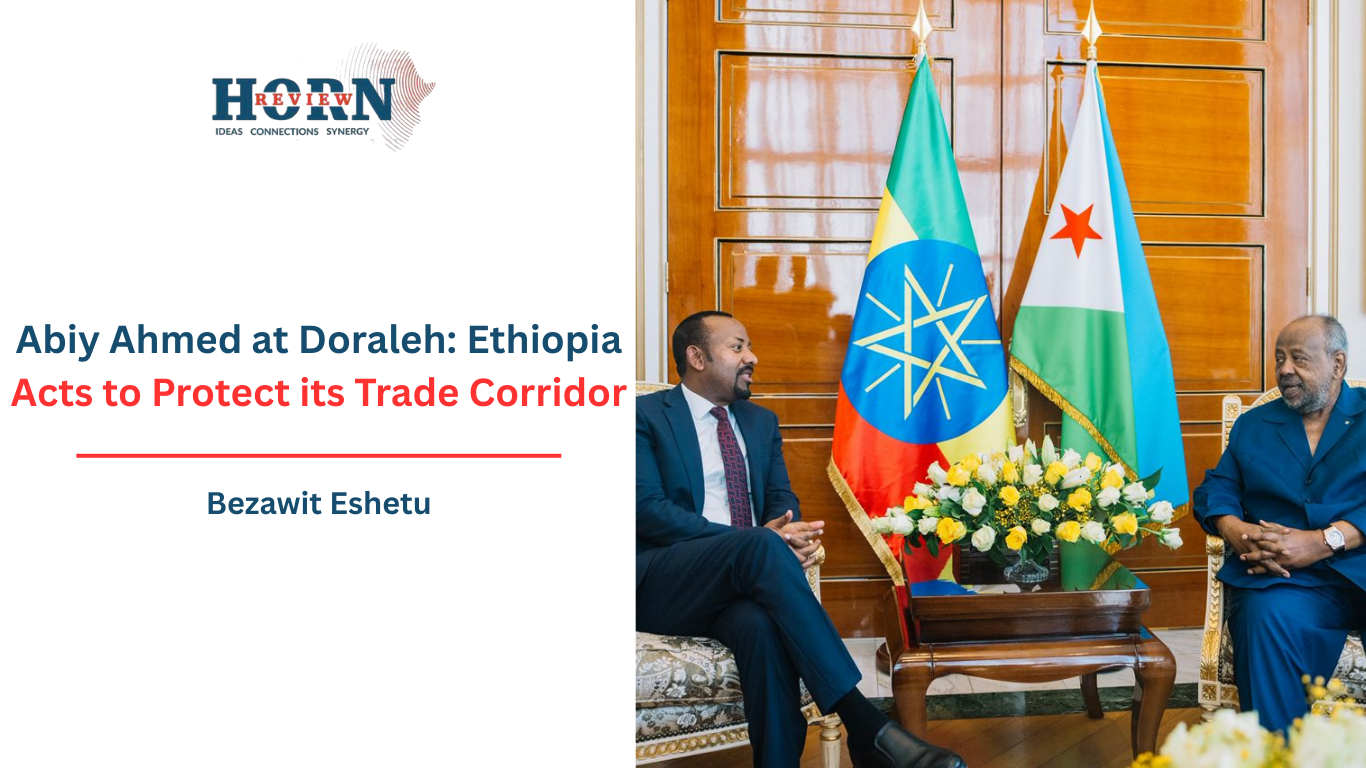
On January 11, 2026, Prime Minister Abiy Ahmed arrived in Djibouti accompanied by a senior, security- and economy-focused delegation that included State Foreign Minister Birhanu Tsegaye, Finance Minister Ahmed Shide, and National Intelligence Service Director Redwan Hussein, underscoring the strategic weight of the visit. Coming only weeks after Egypt’s assertive entry into Djibouti’s infrastructure and energy sectors, the trip reflects mounting geopolitical pressure on a relationship vital to Ethiopia’s access and regional stability. This is not a ceremonial engagement, but a consequential moment for a partnership facing calculated external efforts to exploit geography and fracture aligned interests.
Historically, the Ethio-Djiboutian partnership was forged in the geopolitical vacuum created by the 1998-2000 war between Ethiopia and Eritrea. Prior to this conflict, Ethiopia relied heavily on the ports of Assab and Massawa. The abrupt severance of these routes transformed Djibouti from a secondary transit point into Ethiopia’s primary maritime lung. This historical shift necessitated a rapid expansion of infrastructure, most notably the 753-kilometer standard-gauge railway, which serves as the physical manifestation of their mutual survival. Over the subsequent two decades, this arrangement matured into a “logistics monopoly” where Ethiopia provided the volume and Djibouti provided the gateway. This historical context created a foundational alignment where political stability in one nation became a prerequisite for economic viability in the other, establishing a precedent of non-interference and deep cooperation that has characterized their interactions for a generation.
Today, this alignment is underpinned by statistics that illustrate an almost absolute economic co-dependency. Ethiopia remains the most populous landlocked country globally, and its reliance on Djibouti is nearly total, with over 95% of its maritime trade transiting through Djiboutian facilities. In 2023, Ethiopia exported nearly $128million worth of goods to Djibouti, primarily agricultural commodities such as vegetables ($79.6 million), lettuce, and onions. Conversely, Djibouti’s economy is anchored by its larger neighbor; port fees generated from Ethiopian cargo contribute significantly to a national GDP of approximately $4.1 billion. In 2023, Djibouti exported $206 million to Ethiopia, dominated by palm oil ($191 million) and scrap iron. Beyond trade, the integration extends to essential utilities: Djibouti imports over 65%- 70 % of its electricity from the Ethiopian grid and relies on cross-border pipelines for its freshwater supply. This “infrastructure-for-access” model has, until recently, been the stabilizing force of the region.
However, the regional equilibrium was disrupted in late December 2025 when Egypt initiated a sophisticated diplomatic and economic foray into Djibouti. Led by Kamel El-Wazir, Egypt’s Deputy Prime Minister for Industrial Development and Minister of Industry and Transport, an Egyptian delegation finalized three major cooperation agreements on December 28. These deals include the development of a multipurpose container terminal in partnership with Djibouti’s Great Horn Investment Holding and the establishment of a regional logistics center at the Khor Ambado Free Zone. Of particular strategic significance are the energy agreements: the inauguration of a solar power plant in the Arta region and the development of a 23-megawatt solar project at the Doraleh Container Terminal by the Egyptian firm Elsewedy Electric. These projects are designed to supply energy exclusively to the port, fundamentally altering the power dynamics of the corridor.
Egypt’s sudden investment in Djibouti’s energy and port sectors is often seen as a “Logistics Denial Doctrine” aimed at landlocked Ethiopia. By assisting Djibouti in achieving energy redundancy using solar power, Egypt is gradually weakening Ethiopia’s main non-monetary asset: the supply of electricity. For Cairo, currently engaged in a lengthy dispute with Addis Ababa over the Grand Ethiopian Renaissance Dam (GERD), establishing a presence at the Doraleh port provides significant leverage. If Egypt influences or controls the terminal that manages nearly all of Ethiopia’s trade, it can introduce “security reviews” or logistical obstacles that could harm the Ethiopian economy during times of political tension. This “maritime pincer” strategy, which reportedly includes similar upgrades in Eritrea’s Assab, seeks to turn Ethiopia’s geographic vulnerability into a permanent state of containment.
The potential negative effects of this strained relationship on both Ethiopia and Djibouti are significant and go beyond regional rivalries. For Ethiopia, any loss of guaranteed, unrestricted access to Djibouti’s ports would result in immediate inflation spikes and a collapse of its industrial export strategy. For Djibouti, the danger of “sovereignty auctioning” (hosting competing foreign interests that threaten its main economic partner) is a risky gamble. If Djibouti allows an Egyptian presence that endangers Ethiopian national security, it risks a retaliatory “corridor diversification” by Addis Ababa. Ethiopia has already indicated its plans to shift cargo to the Berbera port in Somaliland and the Lamu corridor in Kenya. A major drop in Ethiopian trade would be disastrous for Djibouti, where port revenue underpins fiscal stability. The erosion of trust over recent weeks has thus placed both nations in a fragile situation where short-term tactical moves by Djibouti could lead to long-term abandonment by Ethiopia.
In direct response to these events, Ethiopia initiated a high-level diplomatic counteroffensive to restore the importance of their bilateral relationship. Before the Prime Minister’s visit, a strong delegation was sent to Djibouti, including Adem Farah, Vice President of the Prosperity Party; Alemu Sime, Minister of Transport and Logistics; and Ambassador Hadera Abera, State Minister for Foreign Affairs. The makeup of this group was strategically important: Adem Farah provided political influence, Alemu Sime focused on the technical stability of the transit corridor, and Hadera Abera handled the diplomatic messaging. Their goal was to confirm that the Ethio-Djiboutian partnership is a sovereign priority that cannot be overshadowed by third-party investments. These talks laid the groundwork for Prime Minister Abiy’s visit today, ensuring that discussions centered on practical ways for economic integration rather than just assurances of peace.
The Prime Minister’s visit to the Doraleh Port this morning, just weeks after the Egyptian-Djiboutian agreements, was a deliberate show of “corridor ownership.” By being physically present at the terminal, the Ethiopian leadership conveyed a clear message to Cairo and the global community: the Doraleh port is an extension of the Ethiopian economy, and managing it is a matter of Ethiopian national security. The outcome of the visit, emphasized by both President Guelleh and Prime Minister Abiy, was a commitment to boosting trade, logistics, and development. This indicates that while Djibouti may continue to welcome Egyptian investment, it has been reminded of the critical importance of its partnership with Addis Ababa. The visit effectively reduced the immediate risk of a diplomatic break, though it did not resolve the underlying tensions caused by Egypt’s presence in the maritime arena. Ultimately, the relationship between Djibouti and Ethiopia is marked by a “co-dependency trap” that neither can escape without severe consequences. The “exemplary” nature of their partnership is not based on shared beliefs but on the hard realities of geography.
Djibouti’s strategic importance relies entirely on its role as Ethiopia’s gateway; without the Ethiopian market, Djibouti’s world-class ports would be underused symbols of a lost monopoly. On the other hand, Ethiopia’s growth depends on Djibouti’s stability. The involvement of external actors like Egypt introduces a zero-sum dynamic into what has historically been a beneficial relationship. To navigate this new situation, both countries must formalize their integration, possibly moving from basic transit agreements toward shared ownership of crucial infrastructure and combined security protocols.
The future of the Horn of Africa is significantly influenced by whether the Addis-Djibouti corridor remains a bridge for regional integration or becomes a front for external containment. The diplomatic actions of early 2026 show that while outside parties may promise appealing investments in solar energy and logistics, they cannot replace the decades-long ties shared by Ethiopia and Djibouti. The challenge for the next decade will be for these two nations to build a strong enough relationship to withstand the pressures from global and regional rivals, ensuring that their shared economic and security interests drive their foreign policies. Stability in the Red Sea cannot be achieved by surrounding regional powers, but rather by strengthening the natural economic corridors that have historically supported the people of the Horn.
By Bezawit Eshetu, Researcher, Horn Review