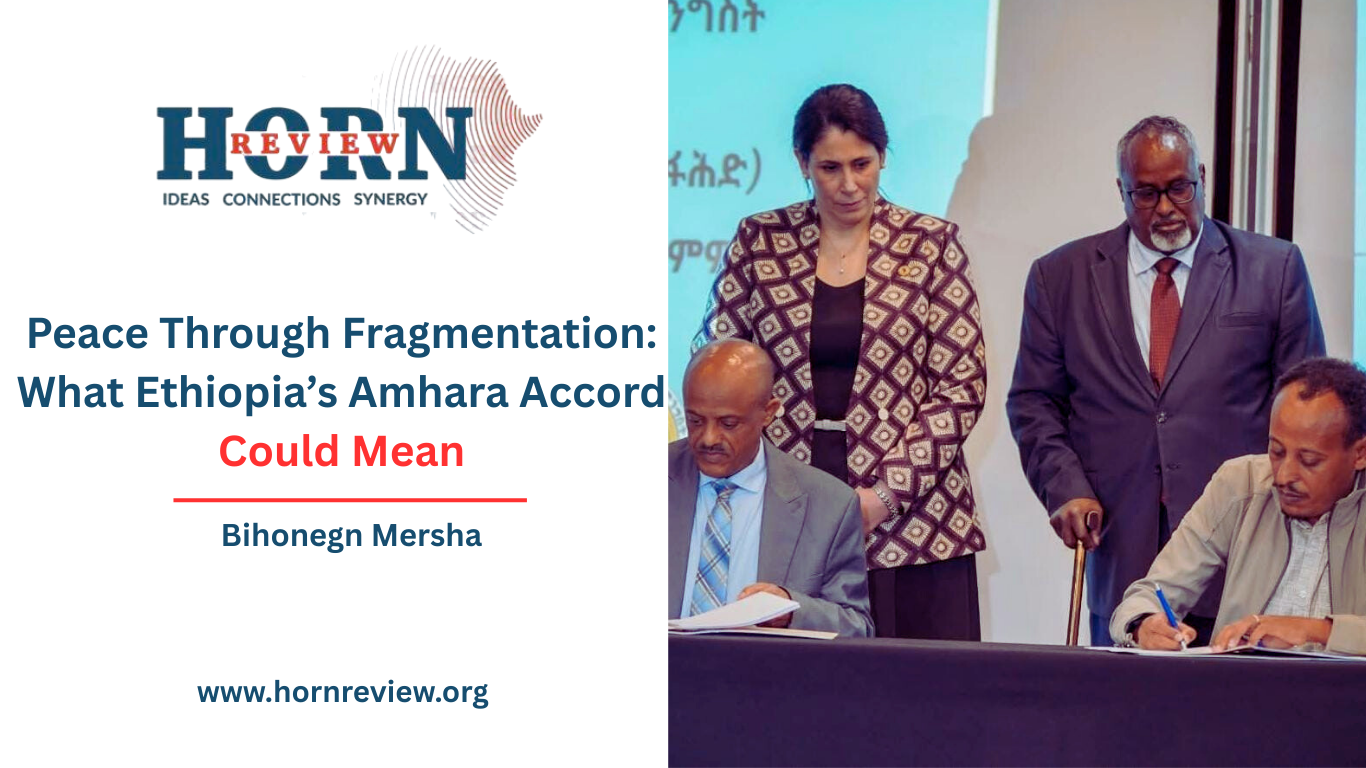
Ethiopia currently occupies a delicate juncture in its contemporary political trajectory, where the pursuit of peace must negotiate the weight of history, fragmentation, and protracted conflict. The recent accord between the Amhara Regional State Government and a faction of the Amhara Fano Popular Organization marks a significant milestone, emerging from over a year of sustained negotiation. Both parties invested in specialized committees dedicated to dialogue and reconciliation, demonstrating a serious commitment to systematically address contentious issues. The African Union, through the Deputy Chairperson, maintained direct communication with senior AFPO figures, including Eskinder Nega and Geta Asrade, alongside those who would ultimately proceed to formalize the agreement with the government. IGAD’s active engagement further reinforces the credibility of the process, reflecting a deliberate multilateral effort to stabilize a region long subjected to cycles of insecurity.
The AFPO exemplifies the broader structural complexity of Fano. It is neither a monolithic force nor a centralized organization but a constellation of autonomous militias, local defense networks, and politically engaged actors, whose alignments are fluid and whose internal dynamics are often contested. The historical leadership of Eskinder Nega fragmented when Nega and Geta Asrade chose strategic engagement with the TPLF and external actors, including Eritrea and Egypt, a decision that diverged sharply from the faction of the AFPO committed to negotiation with the regional government. Captain Masresha Setie, AFPO’s External Affairs Director, Mesfin Kefelegn, Chief of Intelligence and Security Services, and other senior officials maintained a principled commitment to dialogue and facilitated the peace agreement. This divergence underscores how internal differentiation, far from being peculiar to AFPO, characterizes the broader Fano movement, illustrating that even within a single faction, strategic choices and responsibilities are carefully weighed, and the capacity for principled decision-making can shape pathways toward stability.
Beyond the AFPO, Fano remains deeply fragmented. The Amhara Fano National Force, led by Zemene Kassie, as well as Gondar Fano under Habte Wolde, Wollo Fano under Mihretu “Mire” Wodajo, Shewa Fano under Meketaw Mamo, and other semi-autonomous battalions, continue to operate independently of the current peace initiative. While these groups have occasionally coordinated, competition for territorial control, resources, and symbolic legitimacy remains pronounced. Certain alignments with external actors complicate the security environment, making localized militarized action less a mechanism of protection than a factor in broader instability. Most, if not all, have aligned with the TPLF and Eritrea, with some leaders traveling to Mekelle and Asmara to receive training, weaponry, and logistical support.
Adding nuance to this complex landscape is the dismissive and at times obstructionist stance of figures such as Eskinder Nega, and other actors who have derived political or material advantage from the prolonged conflict. Many of these individuals, including external actors and activists aligned with Eritrea’s PFDJ interests or the TPLF, position themselves rhetorically as Amhara Fano supporters, yet their agendas often prioritize strategic leverage or external influence over the welfare of local communities. By casting skepticism or outright opposition toward negotiation, these actors undermine the authority of AFPO leaders who have chosen dialogue and, in doing so, perpetuate cycles of insecurity and humanitarian distress. Understanding this dynamic is crucial: where fragmentation, personal ambition, and external manipulation intersect, the pursuit of peace becomes contested terrain, and local populations bear the disproportionate cost of strategic maneuvering by elites and proxies. Recognizing and addressing this pattern is essential for ensuring that the peace process remains grounded in public interest rather than opportunistic objectives.
The prolonged conflict of the past two years has further exacerbated vulnerabilities in the Amhara region, which remains in recovery from the extensive destruction wrought during the TPLF’s incursions between 2020 and 2022. Schools, hospitals, and essential infrastructure were damaged or destroyed, civilians were displaced, and humanitarian crises were precipitated across multiple localities. This historical context demonstrates that the perpetuation of armed contestation, even when framed as defense, rarely translates into durable political outcomes and often deepens social fragility, highlighting the urgency of a negotiated settlement that can address both governance and security needs.
In this light, the African Union and IGAD’s mediation efforts must be recognized as critical contributions to the prospects of peace. Their engagement facilitated an agreement that prioritizes dialogue over conflict, underscoring that international and regional institutions can act as stabilizing actors when local parties demonstrate the willingness to negotiate in good faith. Yet the current accord, while historically significant, represents only a preliminary step. The government must continue its inclusive outreach, extending dialogue to all Fano factions, including those still outside the agreement, to ensure that the process evolves from a bilateral accord into a comprehensive framework capable of sustaining long-term stability.
This moment also reflects a broader cultural shift: a growing willingness among Ethiopian actors to set aside pride and personal ambition in favor of collective security and governance. Peace, in this sense, is an exercise in political maturity and patience, requiring deliberate cultivation of trust, the tempering of individual aspirations, and recognition of shared vulnerability. Maintaining the momentum of reconciliation will demand consistency, institutional oversight, and continuous engagement with all relevant stakeholders.
Ultimately, the only sustainable path forward for Amhara and Ethiopia as a whole is the disciplined, inclusive, and principled pursuit of peace. History has demonstrated that fragmentation, regardless of its rhetorical justification, yields devastation rather than durable security. Those who align with actors implicated in prior destruction risk undermining both collective recovery and the legitimacy of local communities. The current agreement, rooted in meticulous negotiation and supported by credible regional institutions, offers a foundation for rebuilding governance, restoring human security, and reimagining political possibility. Peace must be expanded, deepened, and institutionalized; it cannot remain symbolic or provisional.
By acknowledging the commitment of AFPO leaders who chose dialogue, alongside the deliberate facilitation provided by the AU and IGAD, the accord signifies a genuine, if tentative, opportunity for stabilization. Yet the broader challenge persists: to transform this fragile alignment into durable institutional arrangements, to integrate all Fano factions into the peace process, and to cultivate a culture in which negotiation and collective interest take precedence over fragmentation and armed contestation. The future of Amhara, and indeed of Ethiopia, hinges upon the capacity of its actors to choose systemic reconciliation over division, and enduring cooperation over episodic confrontation.
By Bihonegn Mersha, Senior Researcher in Political Violence and Armed Conflict