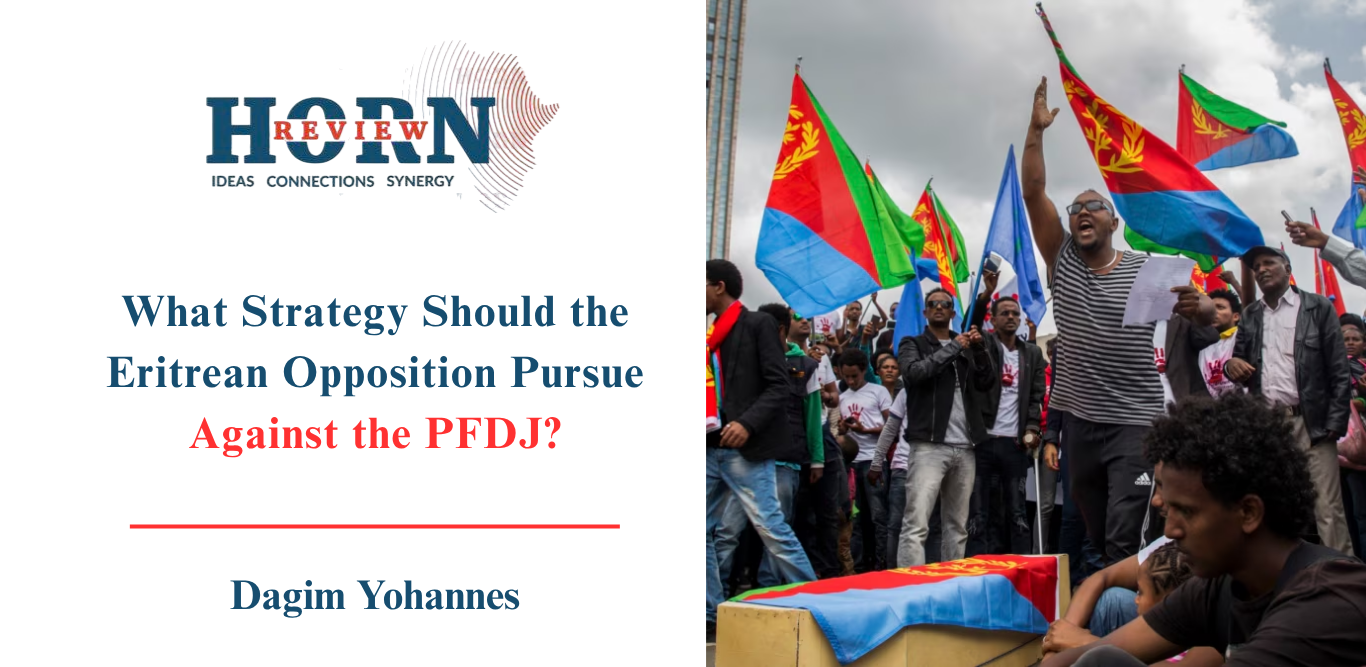
In September 2026 a Haaretz feature described Brigade Nhamedu as an Eritrean diaspora movement with “new faces, new voices and also new methods,” planning a democratic revolution and eventual return. It is the oldest claim in Eritrean opposition politics. Every generation of exiles has announced that this time will be different, and every one has left Isaias in place.
Isaias has ruled since 1993 without a national election, an implemented constitution or independent media, and through indefinite national service that a UN commission of inquiry found reasonable grounds to describe as enslavement. Families are punished for the young people who flee. A regime that holds its own conscripts hostage has no claim to permanence, and Eritreans have every reason to want it gone. The question is how, and on that question the opposition has been wrong for thirty years.
Its answer has been that a better-organized diaspora, a sharper message and the right foreign patron will eventually build enough pressure from outside. Conferences, rival organizations, social-media declarations and appeals to host states have produced visibility abroad and almost no leverage inside. But the deeper error is the assumption underneath: that a quick, cheap route exists, and that pressure applied from exile will at some point break a system built to withstand it. There is no such route, and an opposition that keeps searching for one keeps postponing the harder work. This is not a complete blueprint. It is an attempt to name the strategic habits that have kept the opposition ineffective and to point toward the few shifts that have never been seriously tried.
A personalist regime does rarely fall to its opponents. It usually falls when the men who run its coercive core conclude that the ruler has become a greater danger to them than his removal. In Eritrea that means a small circle of military and security officers who owe Isaias their positions and fear what follows him. No opposition document treats these men as an audience. They are simply condemned as the enemy. That gives them no reason to move and every reason to close ranks.
The opposition’s most useful product would be a credible offer: published, specific terms on what happens to the security services, to officers’ positions, to prosecution and to property after a transition. That means, for example, a public commitment that mid-ranking officers who facilitate a transition will retain rank and pensions, that blanket prosecutions will be ruled out in favor of a limited, transparent process, and that private property acquired under the old order will not be seized by decree. Opposition transition plans are written as moral statements for foreign observers. They should be built as instruments, guarantees designed to make defection safer than loyalty.
A Caesarist order is held together by the dependence of a relatively small group of military and security officers on the ruler. When that group concludes that the ruler has become a greater danger to their own positions and safety than his removal, the system becomes brittle. The decisive variable is not the volume of diaspora protest but whether those inside the apparatus can see both a coordinated path and a survivable outcome. The opposition can influence those calculations in only a few concrete ways. It can publish clear, limited guarantees on what happens to the security services after a transition, including retention of rank and pensions for mid-ranking officers who facilitate change. It can rule out blanket prosecutions in favor of a transparent, selective process. It can commit publicly that private property acquired under the old order will not be seized by decree. And it can make these terms known inside the country, not only to foreign audiences.
Without such offers, the rational choice for most officers remains loyalty or passive waiting. With them, the cost-benefit calculation can shift. That is the work that has never been seriously tried.
The implication is uncomfortable. The figure who ends Isaias’s rule will probably come from inside the ruling party and the army, not from a conference hall in Stockholm or Washington. An opposition that refuses in principle to deal with such a figure has chosen exile in perpetuity. Its real choice is between shaping the terms of an insider succession and watching one happen. Many exiles will read this as surrender or collaboration. It is neither. It is the only position from which the opposition can extract enforceable commitments on elections, a constitution and an end to indefinite service, rather than applaud a palace reshuffle that leaves the system intact and the victims unaddressed. The goal is not to wash the past clean; it is to make the next chapter possible. The common assumption that the ruling party would simply dissolve without him also deserves scepticism, because the liberation front’s networks and nationalist legitimacy are not tied to one man.
The opposition’s favorite historical analogy needs correcting too. It holds that the independence struggle succeeded because it built power inside the territory, and that exiles should return to doing the same. The EPLF did build inside, but it won in 1991 as the Derg was collapsing and losing its Soviet backing, a condition no opposition can manufacture. Calling for organizing inside Eritrea today, under a surveillance state that punishes families, asks conscripts to carry a risk that leaders abroad do not share. Any strategy that depends on people inside acting must say what protects them and what they gain, or it is a request for sacrifice.
External sponsorship is another blind spot. The regime’s oldest legitimacy myth is that it is permanently besieged by hostile neighbors, and it has rebuilt its authority on that claim again and again. A change that looks manufactured by any long-standing adversary hands loyalists a ready-made reason to defend the system. For that reason, distance from any single neighbor is not a diplomatic nicety, it is a condition for being heard inside the country.
This does not mean external actors have no stake. A more stable and less militarized Eritrea would reduce a persistent source of regional insecurity, and governments that have long managed the costs of the current order have a rational interest in seeing it change. Support from such states can be useful, but only if it remains secondary and discreet. The moment the opposition appears as a proxy, the regime’s oldest narrative is reinforced rather than undermined.
The one lever that is cheap, legal and available now is money. The regime funds itself in part from Eritreans abroad, through the 2 percent diaspora tax that the UN Security Council in 2011 told Eritrea to stop collecting through extortion and intimidation, and through fundraising events that double as surveillance. The opposition draws on the same community and competes for the same wallets. Contesting the regime’s revenue before host-country courts, tax authorities and parliaments does not require a single person to enter Eritrea, and it strikes the system where it is weakest. An opposition serious about pressure would make this its main campaign, not a side item beneath the conferences.
The strongest objection is that insiders have moved before and failed. The Forto mutiny of January 2013 collapsed within a day; the G-15 dissidents of 2001 were arrested and disappeared. Those failures, however, do not prove that insider action is impossible. They prove that it fails when participants cannot see who else will move and cannot see a survivable aftermath. Both of those conditions are ones an opposition can influence, but only by making credible, public commitments in advance. That is exactly what it has not done.
The honest answer to how the opposition can remove Isaias quickly and cheaply is that it cannot. The search for a shortcut has itself become part of the failure. For thirty years the diaspora has announced new methods, new faces and new urgency, only to discover that visibility abroad does not translate into leverage inside. What remains possible is slower and less dramatic: stop performing for foreign audiences, speak directly to the people who actually hold the system together, cut the regime’s money where it is most vulnerable, and prepare offers concrete enough that a change of ruler becomes safer than the status quo. That approach will not produce an overnight revolution. It will not satisfy those who want a dramatic rupture. It is, however, the only path that treats the regime as it actually exists rather than as the opposition wishes it to be. Thirty years of announced revolutions have left Isaias in place. The version that ends differently will be the one that abandons the fantasy of a cheap external solution and does the harder work of making internal change survivable. This is an argument about political strategy, not force. None of it requires violence. A movement that continues to stake its future on the quick and cheap version will simply repeat the last thirty years.
Dagim Yohannes, Researcher, Horn Review