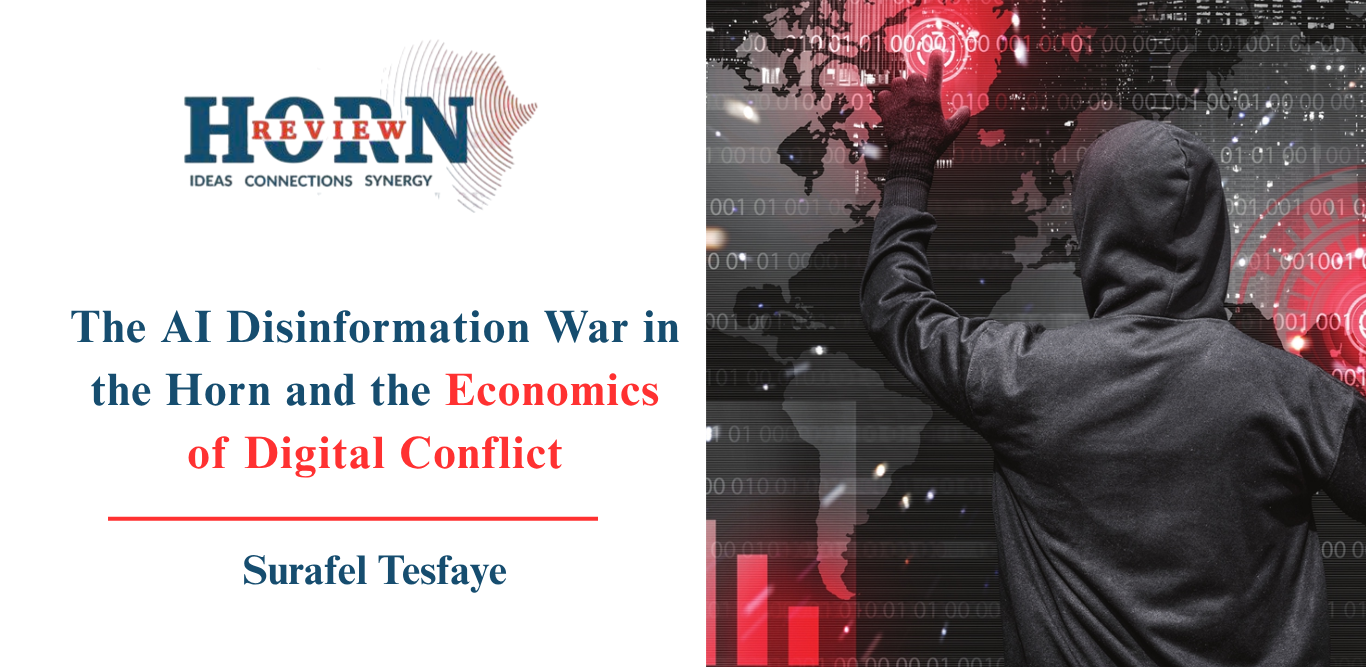
In September, Marc Owen Jones, an Associate Professor of Media Analytics at Northwestern University in Qatar, published an investigation that should concern every policymaker working on the Horn of Africa. Jones, whose work on digital authoritarianism has tracked influence operations across the Middle East and Africa, uncovered a network of websites and social media accounts operating under the banner of the “Red Sea Axis.” The network’s purpose is straightforward: to shape public perception across Sudan, Somalia, Ethiopia, the United Arab Emirates, and the wider Horn of Africa. Its methods are less straightforward, and its implications are significant.
The mechanics of the operation are worth examining closely because they reveal how cheap and scalable information warfare has become. The website redseaaxis.com went live on August 18, 2026. Within five weeks, it had published sixty-six long-form articles totaling roughly forty-seven thousand words. When Jones ran the entire text corpus through AI detection tools such as GPTZero, every article returned a verdict of fully AI-written. The platform carries no human metadata. All content is attributed to a single, vague “Editor,” which masks the automated assembly line producing the material. There is no newsroom, no editorial process, and no accountability.
To create the appearance of a functioning journalistic outlet, the site maintains a “journalists” page featuring four Western-presenting personas: Elise Laurent, Elena Rossi, Lucas Meyer, and Arthur Dubois. Reverse-image searches conducted by Jones revealed that every photograph was stolen from a real person with no connection to the platform. The persona Elise Laurent used a photograph belonging to an academic at the University of St Andrews, while Elena Rossi used an image belonging to an employee at RTL Deutschland. These are not minor details. They are the building blocks of fabricated credibility, and they demonstrate how easily the trappings of legitimate media can be manufactured.
The social media layer of the operation is equally instructive. Rather than creating new accounts, the network repurposed old ones. The account @jggz26, rebranded as “Clara Becker,” was originally a Spanish-language account registered in Bogotá in 2012. Another account, @nataniataieb operating as “Elena Garcia,” was a hijacked French ophthalmology account from the same year. These accounts carry the appearance of organic user history, which makes them harder to flag as inauthentic. The network also relies on high-yield amplifier nodes. The most notable is @kenyaaxis, a verified account with over 116,000 followers that was previously a Kenyan travel handle called @Moseax. Amplifier accounts of this kind allow AI-generated content to be distributed directly into East African political feeds without triggering the suspicion that new accounts would attract.
The editorial line of the Red Sea Axis is uniform across its entire output. It is consistently supportive of Türkiye, of the Sudanese Armed Forces under General Abdel Fattah al-Burhan, and of the Federal Government of Somalia under Hassan Sheikh Mohamud. It is critical of the United Arab Emirates, Ethiopia, Israeli influence, and Somaliland’s independence claims, which it frames as a hostile and destabilizing alignment. The consistency of this messaging is itself a signal. Automated content production tends to produce volume without nuance, and the Red Sea Axis output follows that pattern precisely.
Attribution remains the most difficult question. Jones and other open-source analysts have been careful not to assert direct state sponsorship without evidence. However, independent observers have noted a distinct Turkish digital footprint in the ecosystem surrounding the network.
Auxiliary bot accounts that feed into the Red Sea Axis network, such as @deeqaabdullah, frequently interact with and are amplified by high-ranking Turkish diplomats, state-run media figures, and regional researchers. Jones himself has pointed to this pattern without declaring a definitive conclusion. The operation fits the profile of computational propaganda designed to advance Turkish interests in the Horn, particularly regarding military basing arrangements in Somalia and diplomatic positioning on Sudan. Whether that reflects direct state direction or an ecosystem of sympathetic actors operating in alignment with state priorities is a question that requires further forensic work.
What makes the Red Sea Axis significant is not that it is unique. It is the latest example of a broader trend that analysts describe as Disinformation-as-a-Service. The same tactical playbook is being deployed across the region by different actors with different objectives. In the Bab el-Mandeb corridor, a network known as Saba News has emerged with a Houthi-aligned editorial line. It uses fake local information hubs to validate maritime blockades, shape opinion in Djibouti and Eritrea, and criticize opposing naval coalitions. Saba News operates on the same blueprint as the Red Sea Axis, generating rapid-fire, regionalized AI reporting to simulate public consensus where none exists.
Closer to the Addis Ababa and Mogadishu diplomatic rift, coordinated regional platforms and domestic bot farms produce localized AI-generated content aimed at heightening ethnic tensions and amplifying anxieties over port access disputes. Independent African monitoring organizations have documented structured campaigns targeting prominent Horn politicians with manipulated deepfake images and coordinated smear operations intended to influence local peace talks. Meanwhile, militant groups such as Al-Shabaab are exploring automated text and video manipulation tools to target grievances among vulnerable demographics in Somalia and Kenya, embedding synthetic propaganda within legitimate political commentary.
The common thread across all these operations is cost. This is where the economics of conflict become relevant, and it is the most important analytical point to grasp. Traditional warfare is expensive. A conventional military campaign requires personnel, equipment, logistics, and months or years of preparation. Even a sophisticated cyberattack targeting infrastructure demands significant technical capability and resources. AI-generated influence operations are different. A state actor or a hired digital mercenary firm can now field what amounts to a cyber army of thousands of autonomous news sites and writers for a fraction of the cost of a traditional cyberattack. The marginal cost of producing one more article, one more fake persona, or one more amplifier account is close to zero.
This shift has consequences that go beyond the specific case of the Red Sea Axis. Military doctrines in the United States, NATO, and among their adversaries now treat the information environment as a formal domain of warfare alongside land, sea, air, and space. The fake journalist platforms uncovered by Jones are not simply political arguments. They are deployed instruments designed to degrade an adversary’s influence, shape strategic outcomes, and create the appearance of organic public support where none exists. When the cost of manufacturing consensus falls to near zero, the threshold for launching an influence campaign falls with it. Actors who could never have afforded a traditional propaganda operation can now sustain one indefinitely.
For journalists, policymakers, and citizens across the Horn, this creates a verification problem that cannot be solved by technology alone. The Red Sea Axis demonstrates that high-volume, coherent online media no longer indicates human authorship or authentic public support.
A website with dozens of articles, a polished layout, and a team page can be assembled in weeks by a single operator with access to generative AI tools and a handful of stolen photographs. The traditional markers of credibility, such as longevity, volume, and apparent editorial structure, have been decoupled from the reality of who is producing the content and why.
The appropriate response is not alarm but discipline. Continuous verification is the only reliable defense. Readers and analysts need to check sources directly rather than inferring legitimacy from presentation. Policymakers need to treat influence operations as a permanent feature of the regional environment rather than a temporary anomaly. Researchers need to continue the kind of forensic work that Jones has done, because the networks will adapt as detection methods improve.
Jones offered a concise warning at the conclusion of his investigation that deserves to be repeated. Always look past the layout and investigate the source itself. In a region where the Red Sea, the Gulf of Aden, and the East African hinterland are all contested by competing powers, the battle for influence will be fought as much through algorithms and automated text as through ports and naval vessels. The economics of that battle now favor whoever can produce the most content at the lowest cost. Understanding that reality is the first step toward resisting it.
Surafel Tesfaye, Researcher, Horn Review