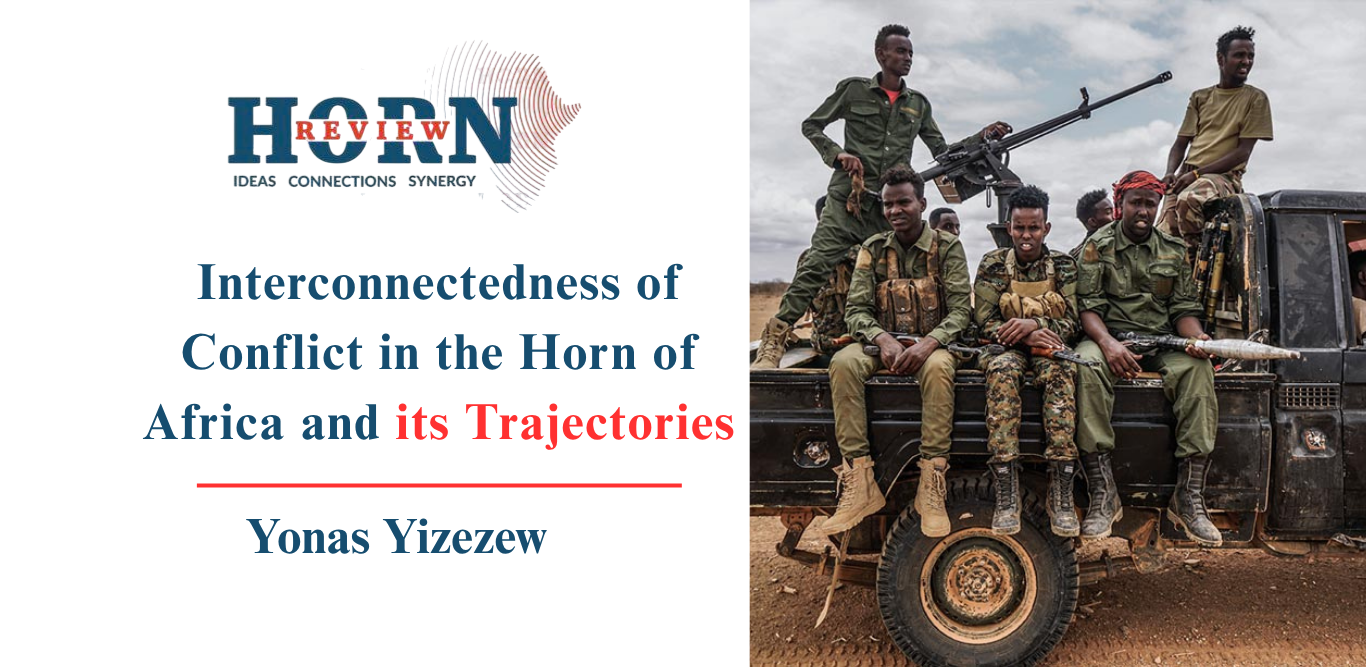
The recent intense fighting erupted at Sherarina near the Sudanese border on August 1, marked one of the most serious breaches of the 2022 Pretoria Agreement. Ethiopian National Defense Forces clashed with Tigray People’s Liberation Front units, including the formation known as Army 70.
Having long operated within Sudanese Armed Forces campaigns against the Rapid Support Forces in a quasi-mercenary role, Army 70 reportedly crossed from Sudanese sanctuary into Ethiopian territory. What had been an internal Ethiopian confrontation thus became a cross-border incident, drawing Khartoum into the equation from the outset.
Three weeks later, the Sudanese Armed Forces pursued and struck a Rapid Support Forces supply convoy deep inside Chad, near the Sudan-Libya-Chad triangle. Chadian authorities accused Sudanese aircraft and drones of violating their sovereignty, while Khartoum framed the action as necessary interdiction of logistics routes originating in Libya and ultimately linked to external patrons. The incident illustrates a broader regional pattern in which domestic wars increasingly generate pressures beyond national borders.
The conflicts of the Horn of Africa operate through reinforcing mechanisms that span the domestic, regional, and global levels simultaneously. What emerges is a spillover dynamic that demonstrates the deep interdependence of the security situation among the region’s states. Almost every conflict in the Horn since the 1970s has had primarily internal origins, yet each was amplified by a persistent pattern of mutual intervention, in which governments sought to manage their own internal crises by supporting insurgencies in neighboring states. The result is a self-perpetuating logic in which instability generated within one state is deliberately projected outward, only to return in altered form to destabilize its source.
This tendency to spill across sovereign borders is the defining structural feature of the region. The long-running conflict in Somalia has repeatedly destabilized its neighbors, most notably Kenya and Ethiopia, while the wars in Sudan reverberate through South Sudan and Ethiopia and beyond. Tellingly, most of the region’s zones of armed conflict and instability are concentrated near border areas, where cross-border drivers, interests, and actors converge and where the risk of escalation is highest. The geography of violence is therefore inseparable from the geography of the state system itself.
The character of conflict in the Horn has itself transformed substantially, and no region beyond the Middle East is better placed to examine that transformation. Wars here have long been transnational, crossing state boundaries through covert and overt interventions, proxy arrangements, and external state support to domestic armed groups. What has changed is the intensity and fluidity of these linkages. Non-state armed groups now contribute ground forces to belligerents across the region—whether as mercenaries or through political deals—in Libya, Sudan, South Sudan, and Yemen, binding the Horn’s conflicts into a wider network of violence.
Two developments have accelerated this shift. The first is the transformation of the technology of war, particularly the proliferation of drone warfare across the Horn, which allows states to externalize violence into their peripheries at diminishing fiscal and political cost while reducing the need for sustained ground deployments or political bargaining with restive peripheries. The second is the surge of extremist and militant activity that has flourished in the space opened by these conflicts. In Somalia, for instance, the Islamic State has built an increasingly significant hub for its global operations, even as al-Shabaab remains the dominant non-state armed group, locked in a protracted struggle with federal forces, allied clan militias, and African Union troops while expanding its operations into Kenya’s border counties.
The Horn’s geostrategic significance has made it an arena of intense competition among extra-continental and regional powers. Over the past two decades it has emerged as a strategic arena for Gulf states seeking to extend their power beyond the Arabian Peninsula. While these states justify their involvement in terms of conflict intervention, a more critical analysis reveals the extension of their regional supremacy rivalries, economic and security imperatives, and strategic interests as the true motivating factors. The Horn and the Gulf are geographically proximate regions with such deep security interdependence that their national security concerns cannot meaningfully be analyzed or resolved in isolation.
This Gulf rivalry has shaped conflict dynamics by influencing local actors, deepening internal divisions, and complicating the chances of amicable resolution in the region’s fragile states. The rivalry between Saudi Arabia and the United Arab Emirates has been especially consequential, reshaping political alliances through military engagements and economic investments. Beyond the Gulf, the presence of extra-regional security actors competing for military and political footholds, the spillover effects of violence in Yemen, and the Iran-Israel and Israel-Turkey power rivalries together condition the security of the Horn. The regionalization of politics has drawn the Horn into the tumult of the Arabian Peninsula and beyond, transforming the region into a violent, zero-sum arena of rivalrous external powers. The role of Middle Eastern states in providing external support to conflict parties in the Horn has therefore hugely increased, and the involvement of these actors intensifies the interconnectedness of conflicts as their interests overlap and intersect in various countries of the region.
Egypt’s strategy of containment and encirclement against Ethiopia further exacerbates this interconnectedness. Its involvement in the Sudan war creates a western pressure point along Ethiopia’s Sudanese frontier, while its expanding geopolitical alignment with Eritrea establishes another pressure point along Ethiopia’s northern border. To the east, Egypt’s growing military alignment with Somalia provides access to a third theatre along Ethiopia’s eastern flank. Collectively, these overlapping engagements create a broader strategic arc around Ethiopia, linking the Sudanese battlefield, Eritrea’s military position and Somalia’s security landscape. This in turn would have the potential to reinforce military and political pressures in the others.
Sudan now functions as the fulcrum of an interconnected conflict complex that ties the Horn both westward to the Sahel and eastward to the middle-power rivalries of the Arabian Peninsula and the Red Sea. On one side of this system sits a rough Türkiye-Saudi-Egypt-Qatar bloc that has thrown its weight behind the SAF in Khartoum and its allies in Eritrea and Somalia (mostly the federal government). This Gordian knot of vying foreign interests intersects with and accentuates already-present tensions within the Horn and beyond, whether the Ethiopia-Egypt dispute over Nile waters or Somalia’s perennial centripetal-centrifugal dynamics. Concerns of a renewed conflict in Northern part of Ethiopia earlier this year partially stemmed from the understanding that it would be impossible to contain any such war, given the stakes and investments of a broad array of states.
The war economy has intensified alongside these dynamics, and the struggle of more coherent middle powers will continue to intersect with the murky networks of the Red Sea economy. In various countries of the region, successive phases of civil conflict, competition for power, external intervention and intra-ethnic disputes have added to the violence and instability. In Ethiopia, tensions in the north involving the TPLF, Fano, and others compound strained relations with Eritrea and the Sudanese Armed Forces. In Sudan, a conflict that characterizes the region as a whole is engulfed by numerous actors and spillover effects, stretching from the Sahel to the Red Sea. In Somalia, federal-state tensions, the insurgencies of al-Shabaab and Islamic State, and the involvement of many external actors converge. South Sudan’s internal tensions likewise produce spillover effects of their own, and Egypt’s drive to counter Ethiopia’s influence—through expansion into Eritrea and Somalia and direct involvement in the Sudanese war—further fuels the interconnectedness of any conflict that arises.
The complex and dynamic nature of these conflict drivers, coupled with the involvement of multiple external actors with competing interests, has made the situation very difficult to manage, both for the Horn countries themselves and for regional organizations such as IGAD. Coordination and consensus-building on peace initiatives becoming difficult when multiple players are involved, each with different interests and allegiances. The effectiveness of mediation organizations such as the African Union and IGAD has grown more passive, increasingly replaced by alternative frameworks such as the QUAD, whose effectiveness and membership structure remain open to criticism. Compared to previous decades, external support for conflict and alliance formation in the Horn has become more volatile and fluid, tracking how multilateral and institutionalized approaches to conflict management have given way to transactional and personalized policies backed by informal arrangements at the leadership level.
What the Horn of Africa demonstrates is a broadly recognizable logic that has nonetheless been transformed by scale and interconnection. Armed movements once had definable political goals in Eritrea, Ethiopia, and Sudan, and violence was broadly oriented toward achieving them; today those movements operate within a web of regional and external interests that has made every local conflict a proxy for larger rivalries. The characteristics that identify the region as a coherent subsystem—geographic proximity, the regularity and intensity of interaction among actors, and external recognition of the group of states as a distinctive area—are precisely what make its conflicts so resistant to resolution. The interconnectedness of conflict in the Horn is the defining condition of its security, and any durable peace will require addressing the region as the single, reinforcing system it has become.
Yonas Yizezew, Researcher, Horn Review