By Ambassador, General Bacha Debele
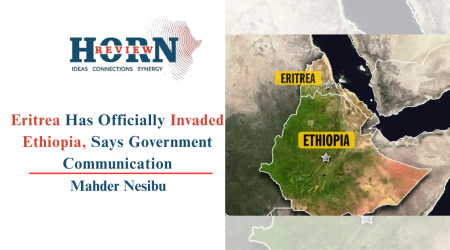
On the 3rd of August 2026, senior military commanders of the Eritrean Government crossed into Ethiopian territory, entering the border town of Zalambesa in a highly publicized display accompanied by the overt projection of Eritrean state symbolism, including the visible flying of the Eritrean flag. Their unauthorized presence on Ethiopian soil was not concealed; rather, the incident unfolded openly, with videos rapidly circulating across social media platforms, bringing the episode to widespread public attention. This act constituted a direct violation of Ethiopia’s sovereignty and territorial integrity, and sovereignty and the fundamental principles governing relations between sovereign states.
The incident did not occur in isolation. Rather, it emerged as the culmination of a pattern of both covert and overt coordination between elements of the TPLF hardliner faction and the Eritrean regime. Recent reports further indicate that Eritrean military assets, including tanks and heavy weaponry, were deployed into northern Ethiopia, specifically the Tigray region, on 6 August 2026. Operating under the banner of an alliance referred to as “Tsimdo,” the Eritrean Government and TPLF hardliners have embarked upon an increasingly open and violent campaign directed against the Government of the Federal Democratic Republic of Ethiopia.
Senior figures within the TPLF hardliner splinter group have publicly declared their readiness to launch military offensives against the Federal Government. They have openly celebrated their external alliances, portraying foreign backing by Ethiopia’s regional and historical adversaries as a guarantor of their political survival, while declaring their intention to secure their future at the expense of the Ethiopian state and the constitutional order thereof, established under Ethiopia’s federal system. At the same time, they have intensified practices of forced conscription and have increasingly adopted the authoritarian, militarized, and coercive methods historically associated with the Eritrean Government’s model of totalitarian political control.
Hence its only legitimate to argue that any sovereign government, particularly a democratically elected and internationally recognized government exercising legitimate authority over its territory, possesses the inherent right to respond to any form of armed threats against the state – as it is the primary guarantor of the constitutional order and national security of the Ethiopian state. Besides, an insurgency supported, directed, or enabled by a hostile neighboring state constitutes a grave security threat and provides a clear basis for the exercise of a state’s inherent right of self-defense under international law.
Ethiopia has, thus far, exercised considerable strategic restraint in the face of these unceasing provocations for the past two or more years post Pretoria peace deal. As a responsible regional actor, conscious of the interconnected security challenges confronting both the international system and the broader Horn of Africa, Ethiopia has sought to avoid actions that could further destabilize an already fragile environment. Its policy has therefore been one of measured restraint and strategic de-escalation. Despite repeated and serious violations of its territorial integrity and sovereignty, as well as intolerable provocations directed against its national security, Ethiopia has chosen not to pursue a broader military response – which in ess3nce are with in the bounds of its inherent right to self-defense. Its actions have therefore remained deliberately calibrated and proportionate, reasonably confined to the repulsion of specific incursions and offensive operations launched by TPLF hardliners in coordination with the Eritrean regime, while consciously avoiding any broader escalation for as long as – and to the greatest extent – that restraint has remained possible..
However, this policy of strategic restraint, which has lasted for more than two years, is predicated on the assumption that the international community would exert sufficient pressure on these rogue actors to pull back from their unnecessary military adventurism. The statements issued by the European Union, as well as the sanctions imposed against TPLF hardliners by the United States, are steps in the right direction. But so far, these statements and limited sanctions have not resulted in any change in behavior or actual conduct, either in Asmara or among its proxies in Tigray. The Ethiopian Government, thus, cannot logically be expected to continue a policy of restraint for much longer while its national security, sovereignty, and territorial integrity are being trampled so recklessly.
The Government of Ethiopia cannot indefinitely maintain a posture of restraint while its sovereignty, territorial integrity, and national security are subjected to repeated and deliberate violations. It also carries a constitutional and moral responsibility to protect the fundamental rights and security of Ethiopian citizens, primarily ethnic Tigrayans – who are being sold as mercenaries to fight the war in Sudan, subjected to forced conscription and exploited as instruments of conflict by radical TPLF actors pursuing destabilizing political objectives.
The Government of Ethiopia has repeatedly expressed its willingness to engage in dialogue with the Eritrean Government. It has pursued diplomatic channels through intermediaries and has gone further by issuing a direct and public appeal for dialogue through a letter written by the Minister of Foreign Affairs of the Federal Democratic Republic of Ethiopia in February 2026. These efforts have been consistently rejected by Asmara. The Eritrean Government’s conduct has demonstrated not only a persistent unwillingness to engage in mature and responsible diplomatic conduct, but also a disregard for the fundamental principles of sovereignty and territorial integrity that underpin relations between states. Rather than pursuing constructive engagement with its neighbor, Asmara’s actions have reflected a deliberate determination to pursue policies aimed at destabilizing Ethiopia, revealing a troubling disregard for the sovereignty, territorial integrity, and political stability of a neighboring state.
President Isaias Afwerki has not abandoned what appears to be his longstanding strategic ambition: the weakening, fragmentation, and political subordination of Ethiopia into a condition in which it could be treated as an arena of influence and exploitation. Such a vision represents not merely a bilateral dispute but a dangerous attempt to reshape the political architecture of the Horn of Africa through coercion, instability, and the manipulation of internal divisions.
History demonstrates that such reckless strategic delusions and unrealistic ambitions often generate consequences beyond those anticipated by their architects. President Isaias’s pursuit of a broader regional reconfiguration,one involving the destabilization of governments and the redrawing of political realities, carries risks that extend far beyond Ethiopia and Eritrea. He would therefore be well advised to consider that political ambitions pursued through destabilization can produce outcomes fundamentally different from those intended.
If the Eritrean regime continues along this trajectory, Ethiopia may understandably be compelled to exercise its legitimate right to self-defense and undertake necessary measures to safeguard its sovereignty, territorial integrity, and national security. The consequences of such an escalation could be profound, potentially contributing to severe instability within Eritrea itself, including the risk of state collapse and large-scale migration flows in multiple directions. Managing such consequences would impose significant humanitarian, political, and security burdens not only on Ethiopia but also on regional and international actors invested in maintaining peace and stability in the Horn of Africa, the the safe navigation of the Red Sea waters.
The international community must recognize that continued inaction in the face of such violations carries its own risks. The Eritrean Government must immediately withdraw any forces operating on Ethiopian territory and end all forms of interference in Ethiopia’s internal affairs. Failure to do so would not only constitute a continued breach of the principles governing relations among sovereign states, but would also risk accelerating a dangerous cycle of escalation with consequences extending far beyond the borders of Ethiopia and Eritrea. Those who persist in undermining Ethiopia’s sovereignty and territorial integrity must be held accountable for the instability and humanitarian consequences that may follow.