
Geography & Digital Power in the Horn of Africa
Strategic analysis of the Red Sea usually focuses on visible forms of power: ports, naval bases, commercial shipping, military deployments, and control of the Bab el Mandeb Strait. Yet another system of growing strategic importance lies beneath the same waters. Submarine internet cables carry financial transactions, government communications, cloud services, business data, and much of the everyday internet traffic connecting Africa with Europe, Asia, and the Middle East.
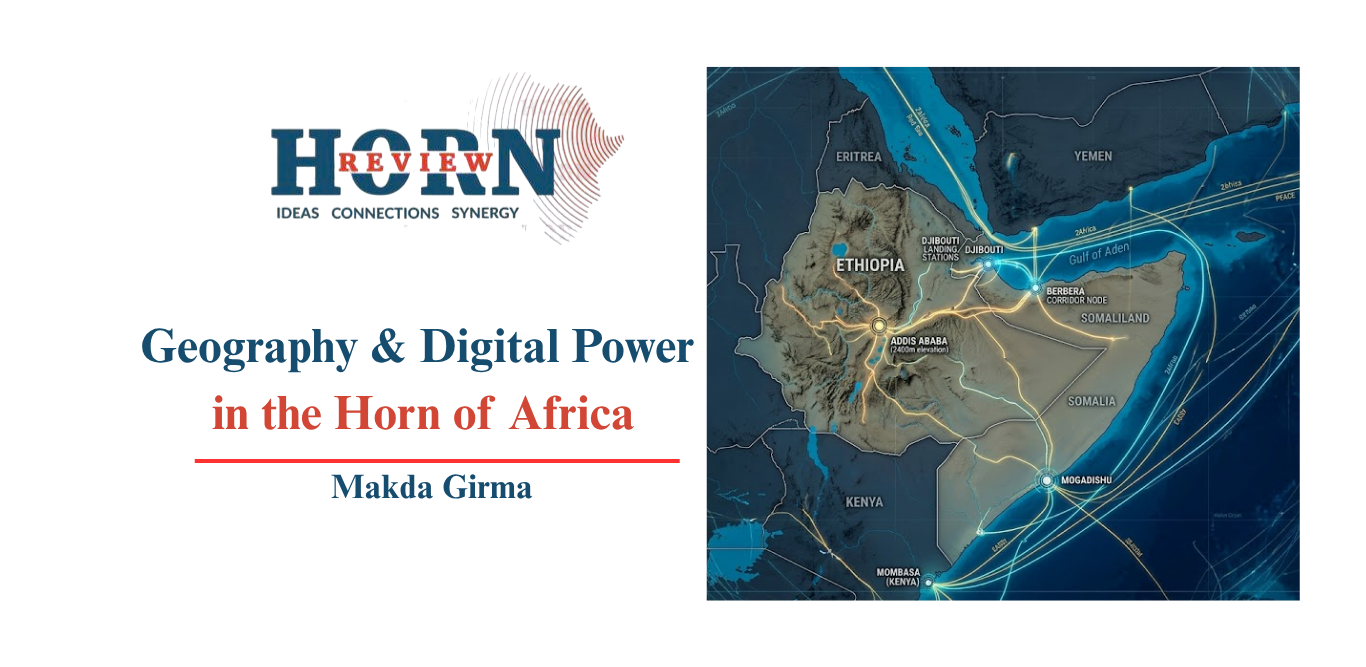
Djibouti has become the Horn of Africa’s main gateway to these global networks. Several major submarine cables land on its coast, giving it a central position in the region’s digital infrastructure. Berbera has also gained international cable connections, while Kenya’s coast provides access to a larger East African digital market. At first glance, the growing number of cables appears to provide the region with greater choice and security. However, the number of cables reaching the coast does not by itself determine which country possesses digital power.
Submarine cables have little value to inland countries unless their capacity can be carried across borders, through difficult terrain, and into major population and economic centres. For Ethiopia, which has no coastline, international connectivity always depends on infrastructure located partly outside its territory. Digital sovereignty in the Horn is therefore no longer defined simply by which country hosts a submarine cable. It is increasingly shaped by who controls the inland routes, border connections, data centres, and commercial agreements that carry information from the coast into the region’s interior.
Djibouti’s influence comes from more than its geographical location. It possesses one of the largest concentrations of submarine cable connections in the region, but its telecommunications system has also historically been dominated by the state owned Djibouti Telecom. This has given the Djiboutian state considerable influence over how international internet capacity enters the country and reaches neighboring markets. Ethiopia may purchase access to several international cables, but much of that access still passes through infrastructure connected to Djibouti Telecom.
This creates an important political imbalance. Ethiopia possesses a much larger population, a growing digital economy, and wider regional ambitions, yet its principal connection to the global internet has traditionally depended on infrastructure controlled from another country. Djibouti’s leverage therefore comes not only from hosting the cables, but also from controlling the first stage of the route that carries their capacity inland.
The development of independent data centres in Djibouti may gradually change this relationship. Companies such as Wingu Africa and PAIX are building facilities where telecommunications companies, internet providers, and international technology firms can connect directly with one another. These facilities are described as carrier neutral because they are not designed exclusively for one telecommunications operator. In practical terms, a company using such a facility may be able to choose among several network providers rather than depending on a single state backed operator.
For Ethiopia and other regional markets, this could create more competition, reduce costs, and weaken the ability of one company to control every connection. It could also encourage international technology companies to store services and content closer to users in the Horn. When companies can connect directly in Djibouti, information no longer needs to travel through distant international centres before returning to nearby users.
However, the rise of independent facilities does not mean that the Djiboutian state is losing its influence. The Djibouti Sovereign Fund, which is involved in the PAIX project, also owns Djibouti Telecom. The state therefore remains connected to both the older monopoly system and the emerging independent data centre market. Djibouti is not withdrawing from the sector. Instead, it is attempting to preserve its central position while creating a more open commercial environment around it.
This may ultimately strengthen rather than weaken Djibouti’s regional role. A country that combines many submarine cable connections with competitive data centres may attract more international companies than one that controls access too tightly. Djibouti’s challenge is therefore to open its digital market enough to attract investment while preserving the strategic advantages created by state ownership.
Once internet capacity leaves the Djiboutian coast, however, the political question becomes closely tied to the physical geography of Ethiopia. Addis Ababa is located more than 2,300 metres above sea level. Connections coming from Djibouti must cross dry lowlands, fault zones, border areas, and rising terrain before reaching Ethiopia’s main political and economic centres.
Much of the existing fiber network follows roads, railways, and electricity lines. This approach reduces construction costs and makes maintenance easier because these routes already provide transport access and legal rights of way. Yet the same arrangement creates a serious vulnerability. When roads, power lines, railways, and internet cables follow the same corridor, one flood, landslide, accident, or security incident can affect several systems at once.
A country may appear to have several connections, but those connections provide limited protection when they cross the same bridge, follow the same road, or enter through the same border area. This is where geography creates political leverage. Djibouti’s power does not come only from hosting submarine cables. It also comes from controlling the coastal and border infrastructure through which Ethiopian traffic must pass.
For Addis Ababa, digital independence therefore requires more than purchasing additional international capacity. It requires separate routes through different neighboring countries. The physical environment makes this expensive. The route between the coast and the Ethiopian Highlands passes through areas affected by earthquakes, volcanic activity, floods, and erosion. Even when the location of damaged infrastructure can be identified quickly, reaching the site and completing repairs may take much longer.
The political lesson is straightforward. Ethiopia’s digital vulnerability is not simply a technology problem. It is connected to roads, border security, regional stability, access to land, and the ability of governments to coordinate repairs during emergencies. A cable may carry digital information, but its security depends on traditional state capacities.
It is within this wider search for alternative routes that Berbera becomes strategically important. International cables have already reached the Somaliland coast. From Berbera, internet capacity could move through Hargeisa and Wajaale toward Jigjiga and the rest of Ethiopia. The route would give Addis Ababa access to another coastline, another set of operators, and another political corridor.
The value of Berbera is not that it avoids all difficult terrain. Infrastructure must still rise from the coast, cover a long distance, and cross areas where maintenance capacity may be limited. Its real value lies in diversification. If the Djibouti corridor is disrupted, a separate Berbera connection could provide an alternative route that does not depend on the same landing stations, border crossings, or political agreements.
Such an alternative would also strengthen Ethiopia’s negotiating position. A country dependent on one coastal gateway has limited bargaining power. A country connected to Djibouti, Berbera, Kenya, and potentially Sudan can compare prices, redirect traffic, and reduce its exposure to pressure from any single partner. Route diversity therefore produces not only technical security but also diplomatic leverage.
Berbera, however, presents a political problem that does not exist in the same form in Djibouti or Kenya. Somaliland operates as a separate political authority, but it is not formally recognized by Ethiopia or by most of the international community. Somalia continues to regard Somaliland as part of its territory. This complicates agreements between Ethio Telecom and Somaliland based operators.
A normal cross border infrastructure agreement could be interpreted as recognition of Somaliland’s sovereignty. At the same time, avoiding such agreements limits Ethiopia’s ability to use the Berbera route. Addis Ababa must therefore seek the economic and strategic benefits of the corridor without turning every telecommunications agreement into a formal statement on Somaliland’s political status.
Commercial companies are taking on part of the role normally played by governments. Telecommunications contracts, infrastructure investments, and service agreements can create a working relationship even when formal diplomatic recognition remains absent. Private investment is, in effect, becoming a diplomatic bridge.
This does not remove the political risk. A commercial agreement may still be affected by tensions between Ethiopia and Somalia, disagreements between Hargeisa and Mogadishu, or changes in Ethiopia’s wider regional strategy. The Berbera corridor is therefore both an opportunity and a political test. It could reduce Ethiopia’s dependence on Djibouti, but it could also draw digital infrastructure into the wider dispute over Somaliland’s status.
While Berbera offers political diversification, Kenya provides a different kind of advantage. The route through Kenya is longer, but Kenya offers something that Djibouti and Berbera currently provide on a smaller scale: a larger and more developed digital economy.
Nairobi hosts major data centers, international technology companies, internet exchange facilities, and locally stored digital content. This means that information reaching Kenya does not always need to continue onward to Europe or the Middle East. An Ethiopian user accessing a popular video, business service, or cloud platform may connect to information stored in Nairobi rather than to a server located thousands of kilometers away.
The Kenyan route therefore cannot be judged only by measuring the distance between Ethiopia and the coast. A longer route can still provide a faster or more reliable service when the information being requested is already stored nearby. Kenya’s advantage is not simply that it has submarine cables. It has built a wider digital environment around them.
For policymakers, this distinction is critical. The value of digital infrastructure does not come only from cables. It also comes from attracting companies that store data, provide cloud services, operate financial platforms, and connect directly with regional networks. Cables bring information into the country, but the surrounding business environment determines how much economic value remains there.
Kenya’s position shows why Ethiopia cannot become a regional digital centre merely by constructing transit lines. Addis Ababa would also need dependable electricity, competitive internet prices, predictable regulation, modern data centres, and rules that allow different companies to connect with one another easily. Without these conditions, Ethiopia may carry regional traffic through its territory while the more profitable digital activity remains concentrated in Nairobi.
The Horizon Fiber Initiative represents Ethiopia’s attempt to move beyond the position of a dependent, landlocked customer. In February 2026, Ethio Telecom, Djibouti Telecom, and Sudan’s Sudatel announced plans for a major terrestrial connection linking Djibouti, Ethiopia, and Sudan. The project is intended to connect submarine cable systems on the Djiboutian and Sudanese coasts through an inland route crossing Ethiopia. It also forms part of Ethio Telecom’s Next Horizon 2028 strategy.
The timing is significant. Cable damage in the Red Sea during 2024 and 2025 disrupted internet connections across parts of Africa, the Middle East, and Asia. These incidents demonstrated that several cables can be damaged at the same time when they pass through the same narrow maritime area. Building more submarine cables along similar routes does not necessarily remove the vulnerability.
Horizon is therefore not simply another commercial infrastructure project. It is partly a defensive response to the growing vulnerability of the Red Sea. By creating a land route between Djibouti and Sudan, the project could allow operators to redirect traffic when one coastal route or submarine cable system is disrupted.
It would not remove all dependence on the sea, because information would still need to reach other continents through coastal landing points. However, it could allow countries to avoid a particular damaged section and shift traffic toward another coast. Its purpose is not to replace submarine cables, but to reduce reliance on a single maritime corridor.
For Ethiopia, the initiative has a larger strategic purpose. Addis Ababa wants to transform the country from a buyer of international internet capacity into a seller of regional transit services. Data moving between Djibouti, Sudan, and the African interior could pass through Ethiopian territory, generating revenue and strengthening Ethiopia’s regional influence.
This would provide Ethiopia with a new form of geopolitical leverage. Coastal states gain influence by controlling ports and maritime access. A landlocked state can gain similar influence by controlling important inland transit corridors. Ethiopia’s geography, which has traditionally been seen as a limitation, could therefore become a strategic asset.
Yet this opportunity also brings responsibilities. Regional operators will not rely on Ethiopia as a transit state unless its infrastructure is stable, politically protected, and available on predictable commercial terms. Ethiopia would need reliable electricity, rapid repair services, physical security, and clear cross border rules. It would also need to reassure partners that digital traffic would not be restricted or interrupted during political disputes.
Horizon could strengthen Ethiopia’s sovereignty, but only if other governments and companies trust Ethiopia enough to depend on it. Regional transit power is built not only through control of territory, but also through confidence in the state controlling that territory.
The emerging digital geography of the Horn therefore involves several different forms of power. Djibouti possesses the strongest concentration of submarine cable landings and has built a state centred telecommunications system around them. Its growing independent data centre sector may allow it to remain the region’s main gateway while attracting more private investment.
Berbera provides a possible second eastern route for Ethiopia. Its strategic value comes from diversification, but its development is constrained by Somaliland’s disputed political status. Kenya possesses the region’s strongest digital business environment, combining international cables with data centres, locally stored content, technology companies, and a larger market for digital services.
Sudan offers Ethiopia another route toward the Red Sea and forms an essential part of the Horizon initiative. Yet continuing instability inside Sudan could affect the reliability and commercial attractiveness of that corridor. A route may be strategically valuable on a map while remaining difficult to use in practice when the state responsible for protecting it is facing internal conflict.
Ethiopia occupies the geographic centre of these emerging routes. Its population, market size, and location give it the potential to become a major regional transit hub. But geography alone will not guarantee success.
Ethiopia’s state dominated telecommunications model may protect national control, but it can also discourage competition and private investment. International technology companies generally prefer markets where they can choose between several providers, negotiate clear contracts, and connect directly with local networks.
The policy challenge is therefore to balance sovereignty with openness. Too much dependence on foreign operators can weaken national control. Too much state control can prevent the competition and investment needed to build a regional digital centre.
The Horn’s governments should no longer treat submarine cables, inland fiber routes, data centres, electricity systems, and border agreements as separate policy areas. They form one connected strategic system. A resilient network requires access to several coastlines, but it also requires inland routes that do not all follow the same roads, bridges, or electricity lines.
Governments also need cross border agreements that clearly define repair responsibilities, emergency access, and the conditions under which traffic can be redirected during a crisis. Without these agreements, infrastructure diversification may exist physically while remaining politically unusable.
Commercial arrangements must also be understood as part of foreign policy. A cable agreement with Somaliland, a data centre partnership in Djibouti, or a transit arrangement with Sudan may affect wider regional relations. Decisions that appear technical can influence recognition disputes, economic dependencies, diplomatic alliances, and state sovereignty.
The contest will therefore not be decided solely by which country hosts the most submarine cables. It will be decided by which country can combine coastal access, secure inland routes, competitive commercial conditions, and political trust.
By Makda Girma, Researcher, Horn Review

RELATED
Posts
8
Oct
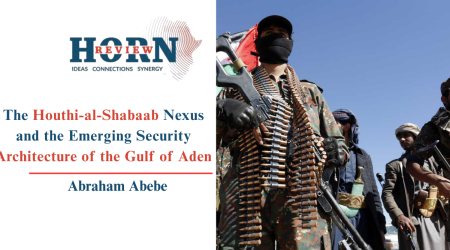
The Houthi-al-Shabaab Nexus and the Emerging Security Architecture of the Gulf of Aden
The growing relationship between Yemen’s Houthi movement and Somalia’s al-Shabaab...

7
Oct
“Decaffeinated Sovereignty”: Eritrea’s One-Way Street with Ethiopia
There is a peculiar contradiction at the heart of Eritrea’s...

7
Oct
Leaked Documents Allege Sudanese Army Weapons Pipeline to TPLF-Aligned Forces as Tigray War Reignites
Leaked documents alleging a Sudanese army weapons pipeline to TPLF-aligned...
7
Oct
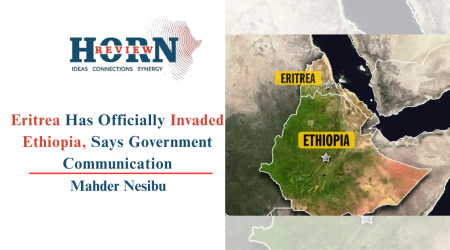
Eritrea Has Officially Invaded Ethiopia, Says Government Communication
Ethiopian Government Formally Condemns Eritrean Territorial Incursion as Its Forces...
7
Oct
Turkey, Somalia and the Transactional Reading of Alamein
The Alamein Declaration functions less as a coherent framework...

7
Oct
Somalia's Alamein Signature and the Costs of Diplomatic Alignment
The Alamein Declaration between Egypt, Sudan, Eritrea and Somalia...
6
Oct
Egypt's Nile for All, the Red Sea for Some - Except Ethiopia
The contradiction was laid out almost perfectly at El Alamein....
6
Oct
Isaias Afwerki has Long Wanted to Rule Ethiopia, Why He will Never
President Isaias Afwerki is among the most enduring figures in...

6
Oct
Egypt Cannot Be Sudan's Mediator and Patron at the Same Time
Abdel Fattah el-Sisi received Abdel Fattah al-Burhan in New...

6
Oct
Afwerki Calls for Non-Interference in Sudan as Eritrean Soldiers Continue Fighting for SAF
At the New Alamein summit in October 2026 Eritrean...