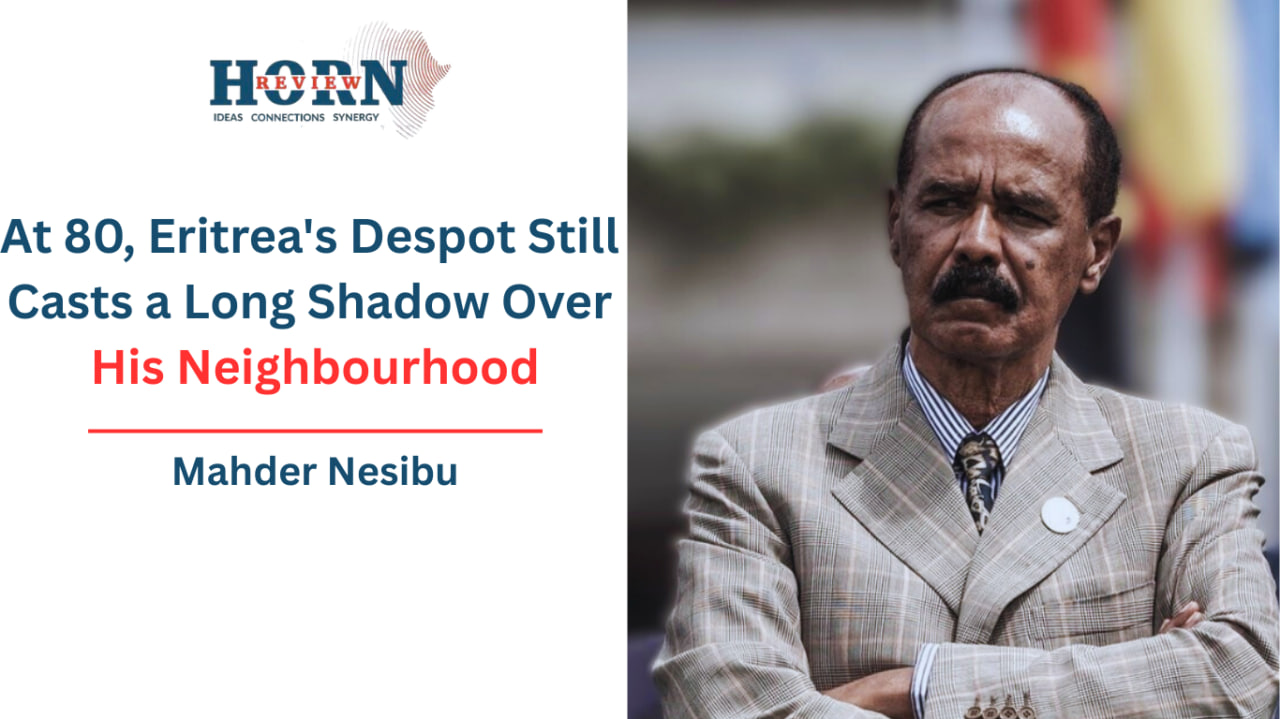
Much speculation has been raised about Isaias Afewerki’s succession in recent years as the long-time President continues to advance in age. Eritrea’s neighbours, long wary of Isaias’s regional conduct, speak of a “post-Isaias Eritrea” as a near-future possibility, bringing with it a chance for a fresh start in relations with the small but troublesome neighbour. However, President Isaias recently celebrated his 80th birthday and, despite his advancing age, the seasoned dictator retains a level of control over Eritrea largely consistent with that of his earlier tenure. In a similarly unfortunate development for his neighbours, his militaristic foreign policy has regained significant foothold.
Isaias has been the undisputed ruler of Eritrea since the country’s creation. Even before assuming the role of head of state, he had presided over the rebellion movement that fought against a highly capable Ethiopian Army. His organisation, the Eritrean People’s Liberation Front, was able to defeat the Ethiopian government in part due to the movement’s organisational culture, which consisted of draconian discipline and hierarchy, and high levels of secrecy.
After secession, Eritrea entered statehood opening fire in all directions. President Isaias, a veteran of a rebellion that lasted thirty years, responded to state disputes by resorting to military solutions. Eritrean soldiers fought with their Sudanese, Djiboutian, and Yemeni counterparts before finally facing Ethiopia in 1998, in what would become one of the harshest conflicts the world witnessed after the end of the Cold War. Isaias, despite launching the war with some form of victory in mind, suffered a defeat. The Ethiopian advance on Asmara, Eritrea’s capital, was only halted by a ceasefire, followed by a peace agreement signed in Algeria.
At home, the authoritarian tendencies of Isaias were becoming increasingly visible. The devastating loss in the war with Ethiopia, which Isaias had overseen, reportedly against the counsel of Eritrean generals whose competence he had long overshadowed, compounded the domestic pressures on his rule. A year after the war’s end, Isaias faced an internal challenge. His comrades, the senior leadership of the EPLF and later the PFDJ, had grown increasingly frustrated by his authoritarian trajectory. The democratic vision they held for Eritrea was being gradually eroded, and in the Horn of Africa, Isaias was turning Eritrea into a pariah state, a spoiler of regional peace and consensus.
Frustrated by their leader, the EPLF’s most senior officials and the country’s elite pushed for change. The attempt to limit the President’s power, or remove him entirely, was met with a harsh response. Senior ministers and EPLF figures, collectively known as the G-15, faced the full wrath of the President. In his reaction, Isaias hollowed out the Eritrean state and established unchallenged rule.
The President’s assault on Eritrea’s democratic future, alongside his militaristic foreign policy, eventually prompted a response at the international level. The international community began to shun Isaias, the man whom the West had, in the early days of Eritrean statehood, dubbed a “renaissance leader”.
The harshest measures against Isaias, however, came after Eritrea’s regional behaviour reached an all-time low. In response to the 2006 Ethiopian intervention against the Islamic Courts Union, the UN found that Isaias had been providing support to armed groups in Somalia, most notably Al-Shabaab. On that basis, the UN imposed an arms embargo on the country.
In addition, Isaias opted in 2008 to confront Djibouti militarily over a disputed territory. Eritrean troops crossed into the contested Dumera region, resulting in small-scale fighting that nearly triggered a broader war. Between these actions and a UN finding of a planned bomb attack on the African Union, the international community’s position on Eritrea hardened further, reinforced by Isaias’s increasingly harsh treatment of his own people.
Eritrea’s isolation took its toll on the country, curtailing Isaias’s foreign policy options and rendering direct military action impractical and costly.
Eritrea nonetheless continued to be a burden for its neighbours. Isaias resorted to alternative means of projection, investing heavily in opposition movements. Drawing on Eritrea’s extensive militarisation, he trained and armed rebel groups working primarily to destabilise the Ethiopian government. From the Ginbot 7 movement to the Oromo Liberation Front, these groups were granted refuge and a kind of operational staging ground in Asmara. For Isaias, who had exhausted Eritrea’s capacity for direct conflict, these proxies became the central instrument for challenging his long-time adversary.
In addition, Isaias cultivated ties with like-minded states, largely from the Gulf and the Middle East, who leveraged Eritrea’s strategic positioning for their own ends and through whom Eritrea was able to partially mitigate its isolation through economic and, at times, military arrangements.
Eritrea’s pariah status was eventually lifted when Isaias made peace with Ethiopia, brokered by Gulf powers Saudi Arabia and the UAE, and driven above all by the ascent of Abiy Ahmed to the premiership in Addis Ababa. The lifting of sanctions removed the arms embargo and the constraints on Isaias’s ability to operate beyond Eritrea’s borders. Some analysts have speculated that for Isaias, the removal of sanctions opened the possibility of rearmament and the revitalisation of the Eritrean Army. Regrettably, the lifting of sanctions did not translate into new avenues for development, but rather into the revival of a militarist foreign policy and Isaias’s return as a spoiler in the Horn of Africa.
For Isaias, the first theatre of intervention was Ethiopia. By 2020, the TPLF had fallen out with the federal government in Addis Ababa and entrenched itself in Tigray. The dispute presented an opportunity to settle old scores: the TPLF, in his reckoning, had been responsible for Eritrea’s losses in the 1998-2000 war and the architect of nearly a decade of isolation. The Eritrean approach was severe. The Tigray region and its people bore the weight of Isaias’s retribution, with the Eritrean Army widely considered to have committed war crimes and ethnically targeted killings, with some accounts characterising the conduct as amounting to ethnic cleansing.
After peace was established in Tigray, Isaias turned his attention to Sudan, which descended into civil war in 2023. Isaias committed Eritrea to one side of the conflict, extending military and diplomatic support to the Sudanese Armed Forces (SAF), including training, logistical assistance, and the facilitation of arms transfers. For Isaias, Sudan now serves as a gateway into the broader Middle Eastern geopolitical arena. Through General Al-Burhan, the leader of the SAF, he has secured greater access to a constellation of powers sharing broadly aligned interests.
More significantly, Isaias’s entanglement with Ethiopia did not conclude with the peace in Tigray. Dissatisfied with the conflict’s outcome, the President exploited Ethiopia’s deepening internal security crises to undermine the federal government, with which Eritrea had fallen out following an end to fighting with the TPLF. Isaias’s current posture toward Ethiopia differs markedly from that of 2020, though the underlying militarism remains constant. Extensive proxy mobilisation is now its defining feature, with Isaias presiding over a fragile coalition of convenience, drawing together several non-state actors in Ethiopia, all operating at the expense of the federal government.
In both Ethiopia and Sudan, Isaias’s interventionism is now in full force, mimicking the early years of Eritrean statehood. Far from appearing worn down by a long career, the President seems emboldened by a changed international environment, one he is acutely aware of and openly welcomes. This new order is partly indifferent to his conduct and partly incapable of constraining it.
As the Horn of Africa contends with a congestion of geopolitical competition and overlapping crises, the countries of the region must reckon with these pressures alongside Isaias’s destabilising brand of foreign policy. And as the President advances in age, a post-Isaias reality remains inevitable. Yet the aged dictator appears untroubled by the prospect. If anything, the prevailing regional dynamics and the permissiveness of the current world order have rendered him more proactive and interventionist than before, increasingly comfortable dictating security and political arrangements well beyond Eritrea’s borders.
By Mahder Nesibu, Researcher, Horn Review