
10
Apr
The Hostage Waters: Rewiring Diplomacy and Security in the Horn and Gulf Region
Overview
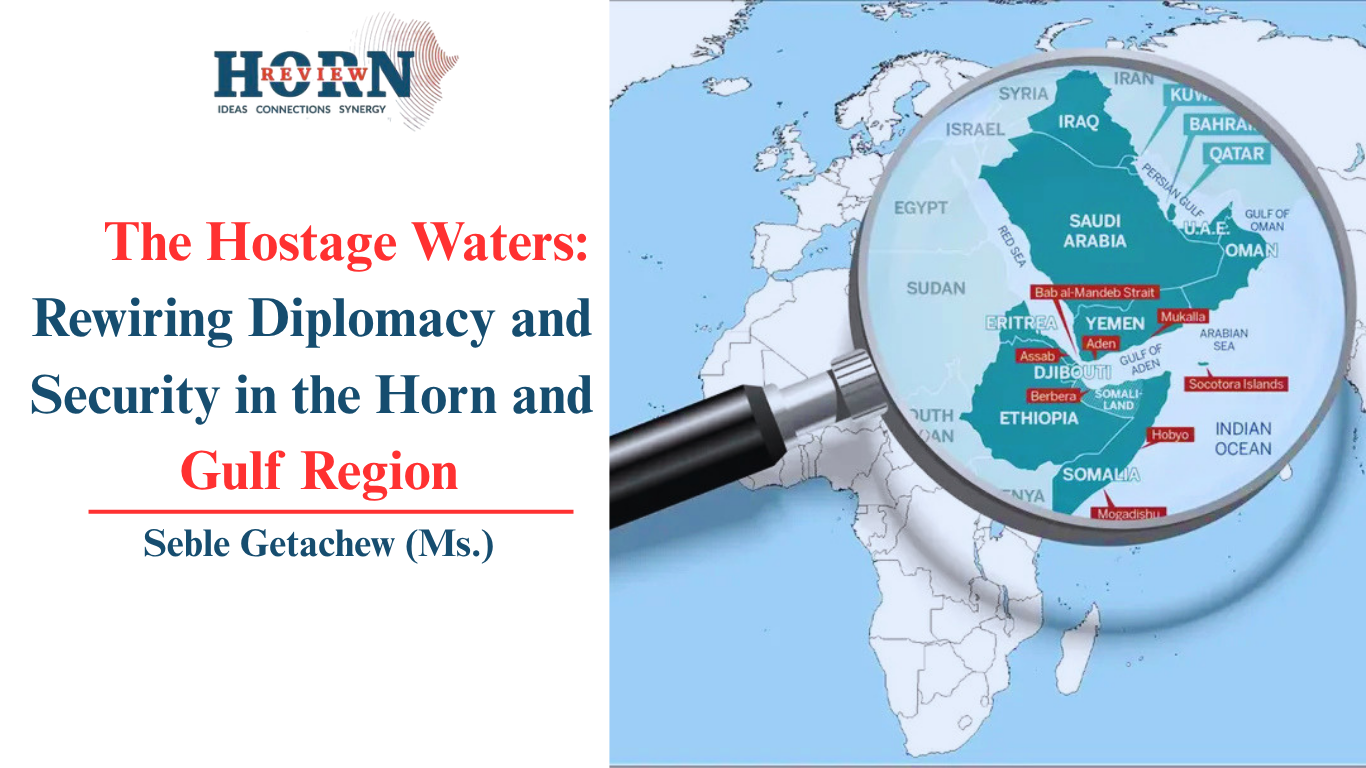
The unfolding Gulf crisis has become a defining moment in contemporary international politics, revealing not only the fragility of global interdependence but also the limits of multilateral governance. What initially appeared to be a maritime confrontation in the Strait of Hormuz has, over time, evolved into a structural shock that is reshaping diplomatic behavior, economic security, and regional power dynamics across multiple continents. In this analysis, it is highlighted that the global economy is increasingly being held hostage by this crisis, and states are responding not through collective mechanisms but through a marked turn toward bilateral and transactional diplomacy. Consequently, this shift signals a profound transformation in the norms and practices that have long underpinned the international order.
As tensions in the Middle East persist, states are no longer relying on multilateral institutions to guarantee access to critical maritime corridors. Instead, they are negotiating directly with powerful actors to secure safe passage through chokepoints. In this emerging pattern, access and security are no longer treated as global public goods but as privileges obtained through case‑by‑case agreements. This trend reflects a broader diplomatic realignment reminiscent of the explicitly transactional approach associated with Donald Trump, whereby immediate national interests override collective frameworks. As a result, even traditionally open international waters are becoming arenas for quid‑pro‑quo bargaining, revealing the erosion of long‑standing norms governing freedom of navigation.
Moreover, this transformation is evident in the decline of mini-lateral arrangements that once offered flexible platforms for managing sensitive issues such as borders, ports, and sovereignty, particularly in the Horn of Africa and the Gulf. Although these coalitions had provided alternatives to rigid multilateralism, they are now being overshadowed by more direct bilateral engagements. Thus, the crisis marks not only a geopolitical rupture but also a normative one, as states recalibrate their diplomatic strategies in response to a more fragmented and uncertain global environment. The consequences of this shift are most acutely felt not in the Gulf itself but across the Red Sea and the Horn of Africa, where institutional fragility intersects with intensifying global power competition. Indeed, the crisis is not a simple maritime dispute; rather, it represents a structural turning point in the global order. The US proposed truce which could not reopen the Strait of Hormuz, offers only partial de‑escalation and it may buy diplomats time. The underlying drivers of instability and remain firmly in place. Meanwhile, the Horn of Africa experiences immediate and severe repercussions, including disrupted supply chains, rising fuel and consumer prices, stalled humanitarian deliveries, and expanding foreign military footprints. For instance, Houthi attacks in the Red Sea have forced major shipping companies to reroute vessels, dramatically increasing freight and insurance costs. Djibouti faces mounting pressure as external powers consolidate their presence; Eritrea is increasingly exposed to spillover from Houthi‑controlled areas; and Somalia and Ethiopia confront economic shocks that threat the population. Consequently, the Red Sea has ceased to be a peripheral concern for Africa and has instead become a central axis of continental security. In the Middle East, the human and environmental costs are staggering, desalination plants and critical infrastructure have been destroyed, leaving millions vulnerable to water shortages. Toxic compounds from bombed industrial sites drift across coastal communities, and (UN/OCHA ) warns of a “rapidly deteriorating humanitarian situation” in southern Lebanon. Environmental damage, including potential uranium contamination will reverberate across generations. Yet environmental agreements and humanitarian law are being sidelined as the crisis deepens, revealing the extent to which legal and normative frameworks are being overwhelmed by geopolitical realities.
Intersecting Theories and Perspectives Explaining the Current Crisis
Understanding this moment requires a multidimensional analytical lens. World Systems theory situates the crisis within a global system in decline (Wallerstein, 1974), where the United States, as the traditional “core,” struggles to enforce order. The closure of Hormuz disrupts energy flows, raises global fuel prices, and deepens the economic vulnerability of import‑dependent African states. These states lack the buffers available to wealthier economies and thus experience the crisis as a direct assault on their people, fiscal stability, and political legitimacy. Furthermore, geo‑economic statecraft reinforces this dynamic, as global powers use ports, shipping lanes, and energy corridors as instruments of leverage. The Horn becomes a bargaining arena where external actors compete for influence, reshaping domestic political incentives and often privileging external strategic priorities over local development needs. At the same time, non‑state actors like the Houthis exploit systemic vulnerabilities, transforming maritime chokepoints into instruments of leverage. This is, therefore, a world of ‘multipolarity without multilateralism’, where power is dispersed but rules are eroding. Constructivist insights further illuminate how identity and narrative shape state behavior. Iran’s insistence on respectful diplomatic treatment is rooted in decades of perceived humiliation, while the United States frames the crisis as a test of global leadership; Gulf Cooperation Council (GCC) states cast Iran as an existential threat and Israel situates the conflict within a broader struggle for survival. These narratives harden positions and transform technical disputes into identity‑laden confrontations, thereby complicating diplomatic resolution.
Similarly, economic and infrastructural lenses capture the material pathways through which the shock travels. Keohane and Nye’s approach explain how the closure of Hormuz disrupts global supply chains, raising freight costs and delaying shipments that the Horn of Africa depends on for fuel, wheat, and fertilizers (Keohane and Nye, 1977 ). These disruptions translate into inflation, social stress, and political pressure on governments already struggling with debt, climate shocks, and internal conflict. The Hormuz crisis is not a discrete event but part of a broader pattern of transboundary risks that outpace regional governance capacities. For Horn states, this means absorbing the consequences of decisions made elsewhere, with limited agency in shaping the response. Stephen Graham’s work helps us to see chokepoints not just as narrow passages on a map, but as deeply political spaces where power, vulnerability, and global trade intersect. His analysis shows that these infrastructures are always exposed during geopolitical tension, because even a small disruption can ripple across the entire shipping system. In this sense, the pressure on the Strait of Hormuz makes it likely that Bab‑el‑Mandeb becomes the next stress point, reinforcing Graham’s argument that when one chokepoint is strained, others inevitably absorb the shock. As seen in the region, infrastructures in the Hormuz–Red Sea–Horn corridor are never neutral rather, they are political spaces shaped by power, vulnerability, and militarization. This perspective clarifies why the Horn of Africa absorbs every shock that begins in Hormuz, since the region is embedded within a global logistical system that magnifies its exposure to external crises.
The Horn’s Search for Strategic Space and Emerging Regional Blocs
These structural dynamics are reshaping state behavior in the Horn of Africa as well. Countries with competing strategic interests are becoming more cautious about entering conflicts while simultaneously seeking to consolidate their strategic autonomy by envisioning what works best for them. However, the transactional diplomacy presents both risks and opportunities. On one hand, it may deepen fragmentation as external actors leverage bilateral deals to influence port access, maritime control, and territorial arrangements. On the other hand, carefully structured bilateral agreements can help states secure immediate economic and strategic gains without being constrained by slow and procedural multilateral processes. If calibrated effectively, transactional diplomacy can become a deliberate policy tool that strengthens autonomy without locking states into asymmetric dependencies.
As regions navigate this complex global political and economic landscape, new regional architectures are taking shape. For instance, the Hexagon Alliance proposed by Israel represents a new geopolitical bloc involving India and several unnamed Arab, African, and Asian states. According to analysts the objective is to counter radical groups in the Middle East or to collectively stand against the “Shia Axis.” Should this regional arrangement becomes the dominant post‑Iran‑crisis framework, the Horn of Africa could gain opportunities to articulate its position on sea‑lane governance, and participate more meaningfully in regional security arrangements.
In summary, the closure and militarization of the Strait of Hormuz must be understood not as an isolated maritime dispute but as a systemic shock that reverberates through global structures, regional security systems, economic interdependencies, and political narratives. Its most destabilizing effects are cascading across the Red Sea and the Horn of Africa, where institutional fragility, economic dependency, and geopolitical competition intersect. In an increasingly fragmented international order, states in the Horn may find that selectively engaging in transactional diplomacy is not merely reactive but a necessary strategy to safeguard their interests and shape outcomes in their favor.
Policy Implications
The Gulf crisis and Red Sea disruptions require Horn of Africa states to rethink how they manage diplomacy, security, and economic exposure. As global powers increasingly rely on transactional rather than multilateral engagement, countries such as Ethiopia need stronger negotiation capacity to avoid asymmetric deals that could affect sovereignty, port access, or long‑term economic leverage. Ethiopia’s dependence on stable maritime corridors despite being landlocked makes this shift especially consequential.
The growing vulnerability of chokepoints like Bab‑el‑Mandeb underscores the need for a coordinated regional maritime security approach. Even without a coastline, Ethiopia is directly affected by Red Sea instability and therefore has a strategic interest in supporting joint surveillance, information‑sharing, and regional naval cooperation through IGAD and the AU. In addition, the Economic shocks from disrupted supply chains highlight the urgency of diversifying import routes, alternative energy sources, expanding fuel reserves, and strengthening transport corridors. For Ethiopia, this includes securing reliable port access arrangements and integrating geopolitical risk into national planning. At the same time, the expanding military presence of external powers in the Red Sea region raises the risk of proxy confrontation. A Horn‑led security framework is essential to ensure regional priorities are not overshadowed by external rivalries, and Ethiopia’s diplomatic weight positions it to play a constructive role.
Finally, emerging regional blocs such as the Hexagon Alliance show that new security orders are forming. The Horn of Africa and Ethiopia in particular must proactively articulate its interests in these evolving arrangements to avoid being sidelined. Preventive diplomacy and conflict‑sensitive economic planning will be critical as the region navigates a more fragmented and volatile global landscape.
References
Graham, S., & Marvin, S. (2001). Splintering urbanism: Networked infrastructures, technological mobilities and the urban condition. Routledge.
Keohane, R. O., & Nye, J. S. (1977). “Power and interdependence: World politics in transition”. Little, Brown.
Tilly, C. (2003). “The politics of collective violence”. Cambridge University Press.
UN OCHA. (2026). “Situation report: Lebanon humanitarian update”. United Nations Office for the Coordination of Humanitarian Affairs.
Wallerstein, I. (1974). “The modern world‑system I: Capitalist agriculture and the origins of the European world‑economy in the sixteenth century”. University of California Press.
Wendt, A. (1999). “Social theory of international politics”. Cambridge University Press.
By Seble Getachew (Ms.)

RELATED
Posts
9
Apr
The AU’s Strategic Diplomacy in the Horn–Red Sea Corridor
The African Union’s appointment of a High Representative for...
9
Apr
How Deep Is Egypt in Sudan’s War? The Shift from Support to Battlefield Involvement
Egypt’s military role in Sudan has steadily moved from discreet...
8
Apr
El sisi’s recent rhetoric on GERD
On April 4, 2026, Egyptian President Abdel Fattah el-Sisi used...
2
Apr
Hormuz vs. Bab el-Mandeb: The Yom Kippur Precedent and Closing the Gates of the Sea
How 1973 Yom Kippur War Proved That Bab el-Mandeb...
2
Apr
The New Security Reality of the Horn of Africa and Middle East
For a long time, political analysis treated the Middle East...
2
Apr
Somalia’s Blue Economy Deal with Turkey
The 2026 launch of SOMTURK marks a significant shift...
2
Apr
Egypt’s Somalia Strategy and the Rising Pressure on Ethiopia
As federal Somali National Army units, equipped with armor and...
2
Apr
How Israel’s Red Sea Foothold Turns the Horn into an Active Front in the Iran War
Two weeks on from the joint U.S.-Israeli strikes that hit...
30
Mar
Egypt’s Boomerang Effect: The Collapse of the Counter-Terrorism Consensus in Somalia
How Egypt’s arming of Somalia Has Become a Direct...
30
Mar
‘Chad’ The Strategic Link Driving Pressure from the East to West
There is a tendency to read Africa’s conflicts as if...