Will the Axis of Resistance Survive Itself?
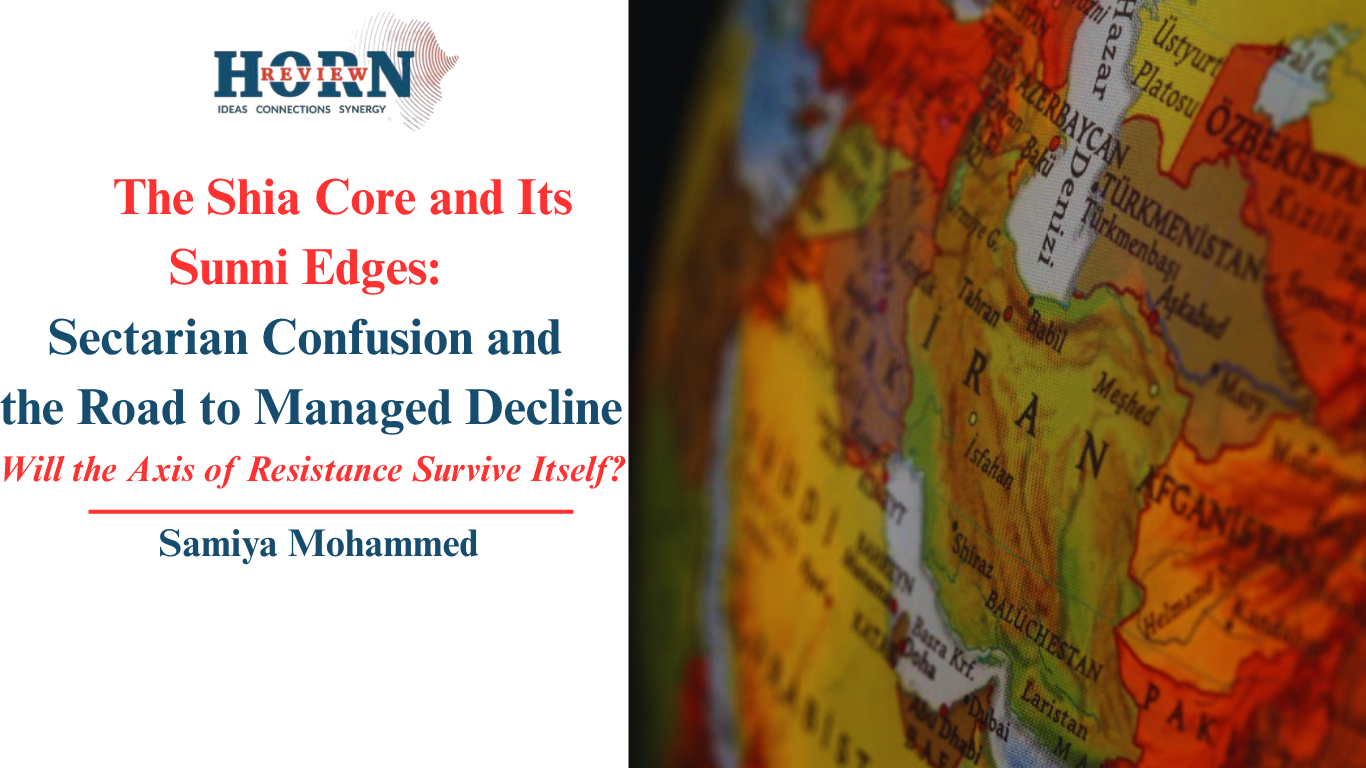
For nearly two decades the Axis of Resistance has been depicted by both its proponents and its adversaries as a coherent and ideologically driven bloc unified primarily however a closer examination of the alliance’s internal composition reveals a complicated picture one defined by persistent sectarian confusion. This confusion is not just a analytical shortcut but a genuine structural feature of the Axis implanted in the tension between its predominantly Shia core and its inclusion of Sunni and Zaydi elements. While shared geopolitical goals have often overridden doctrinal purity, the sectarian growth fixed in the alliance creates built in tensions that undermine long term cohesion, limit broader appeal and invite counter-alliances.
The core of the Axis of Resistance is unmistakably Shia organized around the Islamic Republic of Iran’s conception of Shia religious authority and revolutionary governance. Iran’s Islamic Revolutionary Guard Corps has spent decades cultivating allied militias and political parties that share its theological and institutional DNA with Lebanon’s Hezbollah, numerous Popular Mobilization Forces units in Iraq and the Assad regime’s Alawite‑dominated security apparatus which while not shia operates within a Shia aligned orbit. These actors genuinely prioritize Shia religious identity, clerical leadership and the memory of Karbala as mobilizing symbols. This is not a cynical façade but the rituals, charitable networks and leadership structures of Hezbollah and the major Iraqi militias are saturated with Shia jurisprudence and symbolism. To deny the authentic religious dimension would be to misunderstand how these groups sustain recruitment and loyalty at the grassroots level.
However, the Axis has consistently demonstrated cross‑sectarian pragmatism when strategic necessity demands it. Iran has long supported Sunni Palestinian factions most notably Hamas and Palestinian Islamic Jihad providing weapons, training and diplomatic backing despite the theological gulf between Shia clerical rule and Sunni Islam. Similarly the Houthi movement in Yemen while often labelled generically as Shia belongs to the Zaydi branch which differs substantively from Shia theology on questions of imamate and religious authority. The Houthis’ alliance with Tehran has therefore been one of convenience rather than doctrinal kinship. In both cases shared opposition to States combined with Iranian desire to open multiple fronts against regional rivals has overridden any demand for theological uniformity. This is why the sectarian confusion exists with the Axis is neither a purely Shia enterprise nor a genuinely pan‑Islamic coalition but an unstable hybrid where geopolitical strategy constantly negotiates with religious identity.
The validity of the sectarian confusion argument lies in its ability to expose real structural weaknesses and potential fractures within the Axis. These weaknesses are not hypothetical but they have manifested repeatedly. The most obvious tension emerges between the alliance’s branding as an anti‑imperialist resistance front and the perception among many Sunni populations that the Axis is in fact a Shia crescent designed to expand Iranian hegemony. When Iranian‑backed militias in Iraq and Syria are accused of forcibly displacing Sunni civilians or desecrating Sunni mosques as occurred during the fight against the Islamic State the pan‑Islamic narrative collapses. For the average Sunni in the Gulf, the sight of Hezbollah flags alongside Iranian Quds Force commanders does not evoke cross sectarian solidarity but rather a reminder of centuries of Shia‑Sunni violence and political subordination.
This historical mistrust fixed in the Safavid‑Ottoman rivalry. Furthermore the inclusion of Sunni groups like Hamas and PIJ has always been conditional and reversible. Following the outbreak of the Syrian civil war in 2011, Hamas broke with the Axis of Resistance because it refused to support the Assad regime’s crackdown on Sunni rebels. Iran and Hezbollah never forgot that defection. Although ties have been partially repaired in the wake of the October 7, 2023 attacks and subsequent Israeli war on Gaza the underlying mistrust persists.
These sectarian changes severely limit the Axis’s broader appeal and actively invite counter alliances. When major Sunni populations or their state actors view the Axis as a Shia crescent threat they gravitate toward balancing strategies that directly undermine Iran’s project. The most prominent example is the normalization of relations between several Arab states and Israel under the Abraham Accords. The United Arab Emirates, Bahrain, Morocco, and Sudan all normalized ties with Israel between 2020 and 2023 explicitly citing shared concerns about Iranian backed militias and Shia expansionism.
The Axis of Resistance is unlikely to return to its peak strength from approximately 2012 to 2017. During those years, the alliance enjoyed territorial contiguity Iran, Iraq, Syria, and Lebanon were effectively linked via ground lines of communication and a string of victories including the survival of the Assad regime and the defeat of the Islamic State in Iraq. Several factors have permanently eroded that position. In the medium term spanning the next five to ten years the Axis of Resistance will likely present a diminished but persistent threat to regional stability. It will remain less capable of large scale, coordinated cross front campaigns than it was at its zenith. Instead it could be expected a more fragmented and unpredictable pattern of operations.
The deeper question is whether the Axis of Resistance will ever evolve beyond its current form. The sectarian confusion argument suggests that the alliance’s internal contradictions are not temporary growing pains but permanent structural features. So long as the Axis remains anchored to a Shia core, it will never achieve the pan‑Islamic legitimacy it rhetorically claims. Every inclusion of a Sunni or Zaydi actor will be overshadowed by the historical memory of Shia‑Sunni sectarian violence and the modern reality of Iranian power projection. Opponents will continue to legitimately argue that the Axis is exposed as more of an Iranian power projection tool than a pure Islamic resistance front. This critique is strongest when it exposes long term fragility and hypocrisy in the alliance’s branding. It explains why the Axis struggles to expand its membership to include major Sunni non‑state actors beyond the Palestinian factions and why it fails to convert military gains into sustainable political coalitions across the region.
One can legitimately question whether the Axis is going anywhere beyond managed decline and periodic spasms of violence. It is not likely to disappear entirely however Iran has invested too much political capital and financial resources in its network of proxies to abandon them. Likewise, Hezbollah, the Iraqi militias and the Houthis have become entrenched domestic political actors in their respective countries with or without Iranian support. However, persistence is not the same as effectiveness. The Axis of Resistance in 2034 will probably resemble a set of loosely aligned local power centers each pursuing its own survival and parochial interests only occasionally coordinating under an Iranian flag. That is a far cry from the revolutionary vanguard that once promised to redraw the Middle East’s geopolitical map. The sectarian confusion argument therefore is not just an academic observation and it is the most accurate lens for understanding why an alliance built on both genuine religious identity and cynical strategic pragmatism will never achieve the coherence or expansion its founders envisioned.
By Samiya Mohammed, Researcher, Horn Review