Egypt’s military role in Sudan has steadily moved from discreet support to a far more visible and consequential form of involvement. What began as an effort to reinforce the Sudanese Armed Forces from behind the scenes has increasingly unfolded through reported air operations, battlefield coordination, the circulating reports of deployment of personnel close to active front lines, and casualties among Egyptian officers. As a result, the distinction between indirect assistance and direct participation has become increasingly difficult to sustain.
At the outbreak of war on April 2023, Egypt was already deeply connected to Sudan through long standing security ties with Khartoum and a broader interest in preserving a stable and controllable authority along its southern border. Egyptian military aircraft and personnel were stationed at Merowe Airport at the time, officially as part of joint training with SAF. When the Rapid Support Forces seized the facility, they captured a number of Egyptian soldiers and circulated footage that immediately placed Cairo in a difficult position. Egyptian officials insisted that the personnel were trainers rather than combatants, yet the incident strongly suggested that Egypt was already operating much closer to one side of the conflict than it publicly admitted. Their later release, through mediation involving the United Arab Emirates and coordination with the International Committee of the Red Cross, reduced the immediate tension but did not erase the political implications.
For much of the following year, Egypt’s role remained largely indirect, but not insignificant. Cairo continued to support SAF through logistics, intelligence, and military equipment while publicly calling for restraint and a ceasefire. That position became harder to maintain as the war escalated. In October 2024, the commander of RSF, Mohamed Hamdan Dagalo, known as Hemedti, accused the Egyptian Air Force of striking his positions near Jebel Moya in Sennar State. He described the attacks as sustained and effective, and said they helped force his forces back from an important strategic area. Egypt denied the accusation and challenged him to provide evidence, but the episode reinforced the growing perception that Cairo was no longer merely a concerned neighbor. It was becoming a party with a clear military interest in the outcome.
That perception intensified in 2025 as the balance of the conflict shifted. The fall of El Fasher in October marked a major turning point. After a prolonged siege, the RSF captured the Sudanese army’s last major position in Darfur, strengthening their territorial hold and raising the possibility of a fragmented Sudan.
For Egypt, this was more than a battlefield loss for its ally as it was a strategic warning. A western Sudan dominated by a hostile militia would alter the regional security environment in ways Cairo could not ignore. Moreover, The RSF’s capture of the Sudanese section of the triangle region, along with el Fasher, has placed key trade and smuggling corridors linking Sudan to Libya and Chad under its control. Egypt has profited from gold smuggling out of Sudan during the war and does not want an uncontrollable force in charge of these routes.
The urgency of the situation for Cairo was reflected in the rapid diplomatic and military engagements of its senior leadership. In the meantime, Egyptian army’s chief of staff Ahmed Fathi Khalifa undertook two high-level visits within a span of 24 hours, first to Saudi Arabia and then to Port Sudan, which serves as the seat of Sudan’s army-aligned administration at the time.
Egypt’s concern was also shaped by developments along the border triangle linking Egypt, Libya, and Sudan. When the RSF gained control of that corridor in mid-2025, they secured a vital route for weapons movement and cross border logistics. Reports then emerged that Egyptian aircraft had targeted supply convoys linked to the Rapid Support Forces, including operations near al Kufra in Libya. A later investigation by The New York Times reported the existence of a secret drone facility at East Oweinat, close to the Sudanese border, from which Turkish made Bayraktar Akinci drones were said to be operating against RSF targets. Satellite imagery and flight data reportedly showed sustained activity from the site through late 2025 and into early 2026. These developments pointed to a much deeper level of military engagement than Cairo had publicly acknowledged.
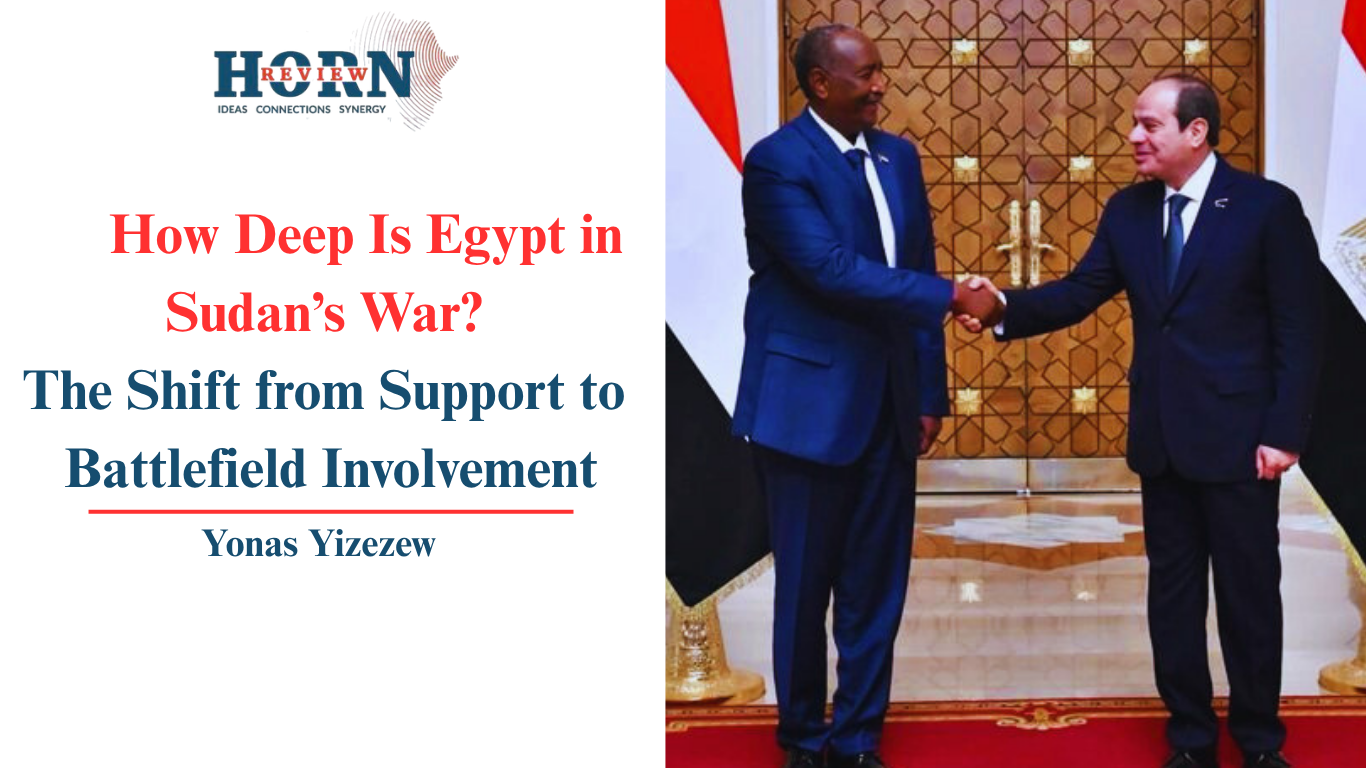
Egypt also expanded its coordination with SAF at the operational level. Following General Abdel Fattah al Burhan’s visit to Cairo in December 2025, a joint operations room was reportedly established in North Kordofan, with another hub later created in el Obeid to support coordination over recaptured towns, supply corridors, and battlefield intelligence. Egyptian officers were also said to have made repeated field visits to align logistics, targeting, and warning systems with their Sudanese counterparts. This reflected a broader regional shift. States that would normally compete are working in parallel to shape the direction of the Sudanese war. Then also on 24 January 2026, Egypt’s GIS chief, Major General Hassan Mahmoud Rashad, visited Port Sudan for talks with Sudanese leader General Abdel Fattah al-Burhan.
These intelligence-level and presidential visits reflect Egypt’s shift toward more structured coordination with the SAF. They often coincide with battlefield developments and serve both diplomatic and operational purposes.
The escalation became more direct and costly in early 2026. In March, RSF drone strikes on Kosti in White Nile State reportedly killed an Egyptian brigadier general and at least three other Egyptian officers or personnel who were embedded with the Sudanese army. Available reporting suggests that this represents one of the clearest indications to date that Egyptian personnel were not confined to support roles, but were increasingly exposed to direct combat risks. It also weakened Cairo’s long standing claim that its role was limited to training and advisory functions.
The most alarming development came later that month, when reports emerged that a large Egyptian unit, said to consist of hundreds of personnel, had been surrounded in the Sali area of Blue Nile State by forces linked to the Sudan Founding Alliance, or TASIS. The unit was reportedly operating in support of SAF, while also being tied to resource related activity near the Ethiopian border and the wider GERD zone. As TASIS forces advanced and captured strategic localities, Egyptian officers reportedly sought safe passage toward Damazin, but the request was rejected and unconditional surrender was demanded. Although corroborating evidence remains limited, the episode reportedly marks another major shift. Egypt, which had sought to influence the war from a distance, found its own troops trapped in a direct confrontation on Sudanese soil and near Ethiopian border.
The incident gains added gravity given Eritrea’s parallel role near the Ethiopian border. Asmara has trained and supplied pro-SAF militias in eastern Sudan, including Beja groups and other eastern factions, while sharing Egypt’s strong anti-Ethiopian stance on the GERD and Red Sea matters. Asmara has also reportedly facilitated arms transshipment, logistical support, and even drone-related activities through its territory and airfields. This convergence is reinforced by high-level coordination of affirming identical views on Sudan and Ethiopia.
The broader significance of this deepening involvement can also be understood through Egypt’s preference for a predictable and controllable political order in Sudan. Beyond immediate security concerns, Cairo has consistently favored a governing structure in Khartoum that remains broadly aligned with its strategic priorities and responsive to its regional interests. Such an arrangement reduces uncertainty along Egypt’s southern frontier and allows it to retain influence over critical files, particularly those linked to the Nile Basin.
When political developments in Sudan move outside this preferred framework, Egypt has historically relied on a combination of pressure, recalibration, and the cultivation of alternative channels of influence within Sudan’s political and military landscape. This includes reinforcing its positions on sensitive bilateral issues, adjusting diplomatic engagement, and strengthening ties with actors it considers more aligned with its strategic outlook. At the regional level, Cairo has also worked through diplomatic platforms and partnerships to limit trajectories in Sudan that it perceives as unfavorable.
This pattern reflects a consistent strategic logic. Egypt’s objective is not only to prevent instability, but to ensure that Sudan’s political direction remains within a range that it can influence and anticipate. A fragmented or adversarial Sudan, particularly one shaped by actors outside Cairo’s sphere of influence, would significantly constrain that ability and introduce a level of strategic uncertainty that Egypt has traditionally sought to avoid.
The problem lies less in Egypt’s assessment of the threat than in the method it has chosen to address it. By moving from indirect support to more direct military involvement through weapons, drones, intelligence, joint command structures, and exposed ground personnel, Egypt has risked becoming part of the conflict it originally sought to shape. The more visible its role becomes, the harder it is to preserve the image of neutrality or mediation. That has weakened its standing as a potential peacemaker and reinforced the view that Cairo is pursuing influence through force rather than diplomacy.
The result is strategic exposure without strategic closure. Egypt may gain some short term advantages from a Sudanese army that remains dependent on its support, but the deeper it becomes embedded in the war, the greater the risk of retaliation, escalation, economic crisis and long term entanglement.
By Yonas Yizezew, Researcher, Horn Review