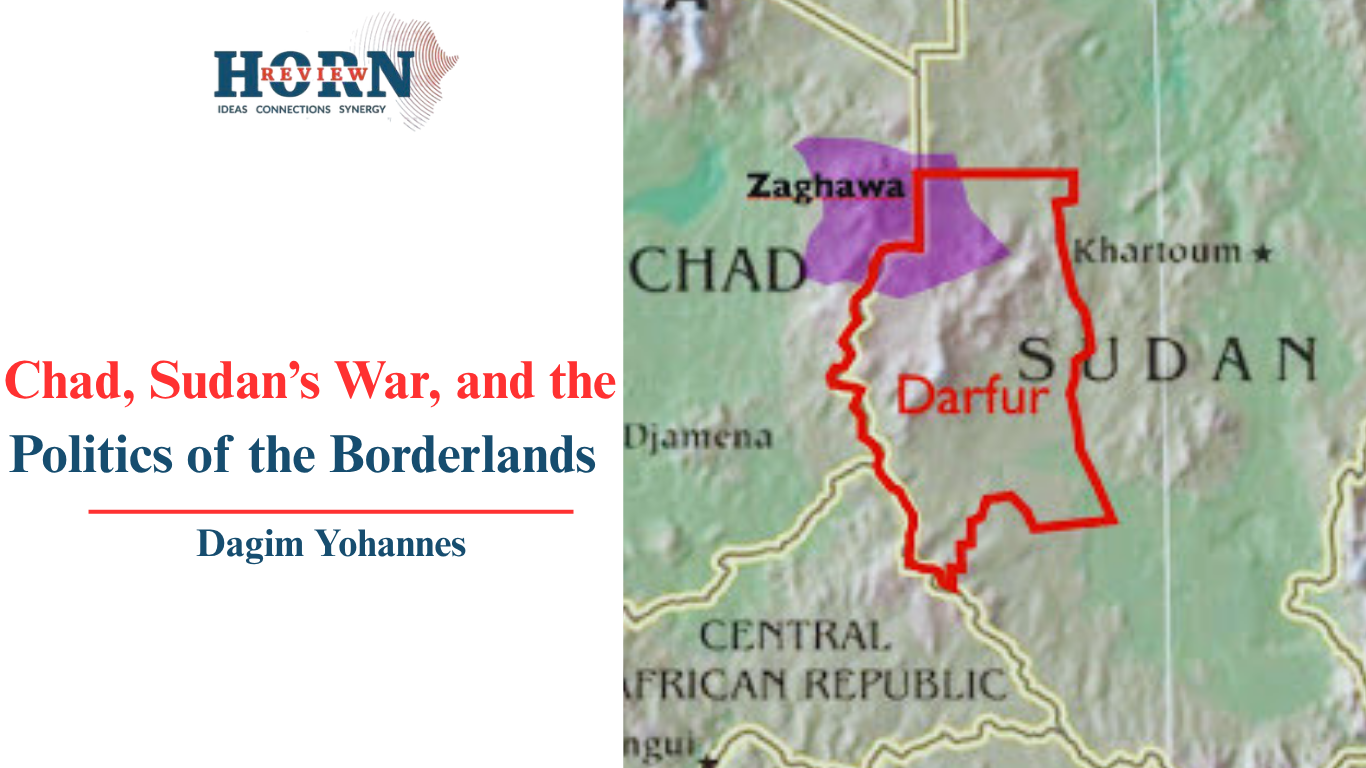
Chad and Sudan’s relations have never been confined by cartography,their long and porous border is socially intertwined through communities such as the Zaghawa and Masalit who straddle both sides,while armed movements have historically navigated the frontier in much the same way.Today as the war in Sudan grinds on, N’Djamena finds itself gradually being dragged to a conflict it insists it does not want. And the new geopolitical landscape is one not to be ignored.
The late president Idris Déby, better known as Itno, led Chad for most of its post-independence era. Itno came to power marching from his constituency in Zaghawa communities that straddle on the border between both nations. Ties between N’Djamena and Khartoum were initially good, as both Omar al-Bashir and Déby were in their rookie years as head of State. Under Idris Déby, Chad maintained strategic influence in its dealing with Sudan, grounded in ethnic and political ties between Chad’s Zaghawa and the Zaghawa population in Darfur, in early 2000s, tensions between Arab and non-Arab groups in Darfur grew increasingly violent, with Khartoum backing the Arab-identifying groups against the African inhabitants.
The Zaghawa were among those who fell out of favor with Khartoum. Déby didn’t automatically back the Zaghawa based on shared ethnicity. Rather, he supported Khartoum’s measures, even involving militarily quelling the rebels. However, this position became increasingly difficult for Déby over time, as members of his own Zaghawa group, including family members and others with ethnic ties across the border, sympathized with their kinsmen in Sudan. What followed was support for the Zaghawa in form of money and weapons from Chad’s military and society, prompting a response from Khartoum, the result was the emergence of the militia groups, most notably the Janjaweed, which later evolved into the Rapid Support forces (RSF).
Not like father, not like son. However, Mahamat Idris Déby, better known asKaka, has taken a different path in the 2023 Sudan war. Since assuming power after his father’s death in 2021, Kaka aligned Chad with the very forces his father fought against – the RSF, but why did Kaka tilt toward the Rapid Support Forces in the early stages of the war? The answer lies less in ideology than in a convergence of geopolitical pressure, financial incentives, and domestic political calculations. Chad’s initial alignment with the RSF cannot be fully understood without the growing influence of the United Arab Emirates.
Abu Dhabi has deepened economic and strategic ties with N’djamena, in 2023 alone, the two countries agreed on loans worth approximately $1.5 billion, a significant sum for Chad’s fragile economy, in return Chad has allegedly functioned as a logistical corridor, since the war began in April 2023,At least 86 flights from the UAE have headed for an airstrip at Amdjarass in eastern Chad, with allegations that the fights have Ammunitions to be supplied to the RSF.UN expert reports described a potential “air bridge” linking Emirati airbases with Chad. But both the UAE and Chadian authorities have denied that military equipment was transported insisting that the flights were humanitarian in nature.
Another justification for Kaka is that at the early stages of the war, much of Darfur which is a border to eastern Chad quickly fell under the RSF control, making engagement with the dominant armed force across the border a pragmatic security calculation. But the border economy that underpins mobility and trade in the east has also become a logistical hinterland for Darfur’s armed actors, as rival coalitions try to disrupt one another’s access. Violence has followed the smuggling and supply corridors that feed the war. Beyond geopolitical pressures, Chad’s borderlands themselves have become deeply embedded in the war’s logistical economy.
The Chad-Sudan border frontier functions less as a rigid political boundary and more as a movement economy in which control over routes and crossings generates revenue.so the growing cross-border violence is not only a question of sovereignty but also a contest over who controls the logistical corridors and the profit they produce. The violence escalated on 21 February when clashes between forces aligned with the Rapid Support Forces and the Sudanese Armed Forces in the border town of Tiné spilled into Chad, killing five Chadian soldiers and three civilians. In response, N’Djamena indefinitely closed its eastern border, citing repeated incursions linked to Sudan’s war.
The incident followed earlier cross-border attacks and drone strikes by the RSF against Chadian border forces in late 2025, signaling a shift from accidental spillover to a more deliberate projection of violence into Chadian territory. This growing violence is linked to the expansion of cross-border networks that function as supply lines for competing armed actors, with freelance fighters escorting convoys and stabilizing transport routes as front lines shift.
As anti-RSF coalitions began targeting the Amdjarass-Darfur corridors through Zaghawa-led units and SAF-aligned factions,ambushes increased in border towns.Subsequently RSF changed the supply route close to Libyan border. The fuel trade illustrates the scale of this cross-border economy,as formal fuel supplies collapsed during the war, the value of this trade increased significantly by 2024, an additional corridor connecting southwestern Libya, northern Chad, and Darfur had emerged to maintain supply lines and bypass interdictions along eastern Chad’s border. These same pathways have now become flashpoints of violence, illustrating how economic competition over smuggling corridors is drawing frontier regions directly into the conflict.
The war has also generated a regional market for armed labor. Shortly after the conflict began, Chadian fighters, including former rebels, crossed into Sudan to earn money, obtain weapons, and establish new patronage networks. These assets can later translate into political leverage or coercive power inside Chad’s own security landscape. Among those joining the fighting were individuals from Arab and Gorane networks, communities that have historically competed with Zaghawa-dominated security structures in both Chad and Sudan. In this way, the war economy converts longstanding grievances into revenue streams, access to arms, and new political influence across the border.
The Tiné clashes and the border closure that followed represent a new and more dangerous pattern along the Chad–Sudan frontier. Closing the border signals resolve, but it also reflects the growing difficulty N’Djamena faces in containing a conflict that increasingly spills across its eastern boundary. What once appeared as sporadic cross-border instability now carries the characteristics of a sustained security challenge tied to the wider dynamics of Sudan’s war.
For Chad, the response illustrates a broader strategy of controlled engagement: projecting firmness along the frontier while avoiding direct entanglement in Sudan’s internal conflict. Yet the pressures shaping this posture, from regional alliances and economic dependencies to the war economy that now links Darfur with Chad’s borderlands, are unlikely to recede soon.
In this sense, Chad’s policy toward Sudan is less about choosing sides than about managing exposure to a conflict that is steadily redrawing the political and economic landscape of the Sahel–Sudan corridor. Neutrality remains the official stance, but as the violence around Tiné suggests, maintaining that neutrality is becoming increasingly difficult.
By Dagim Yohannes, Research Intern, Horn Review