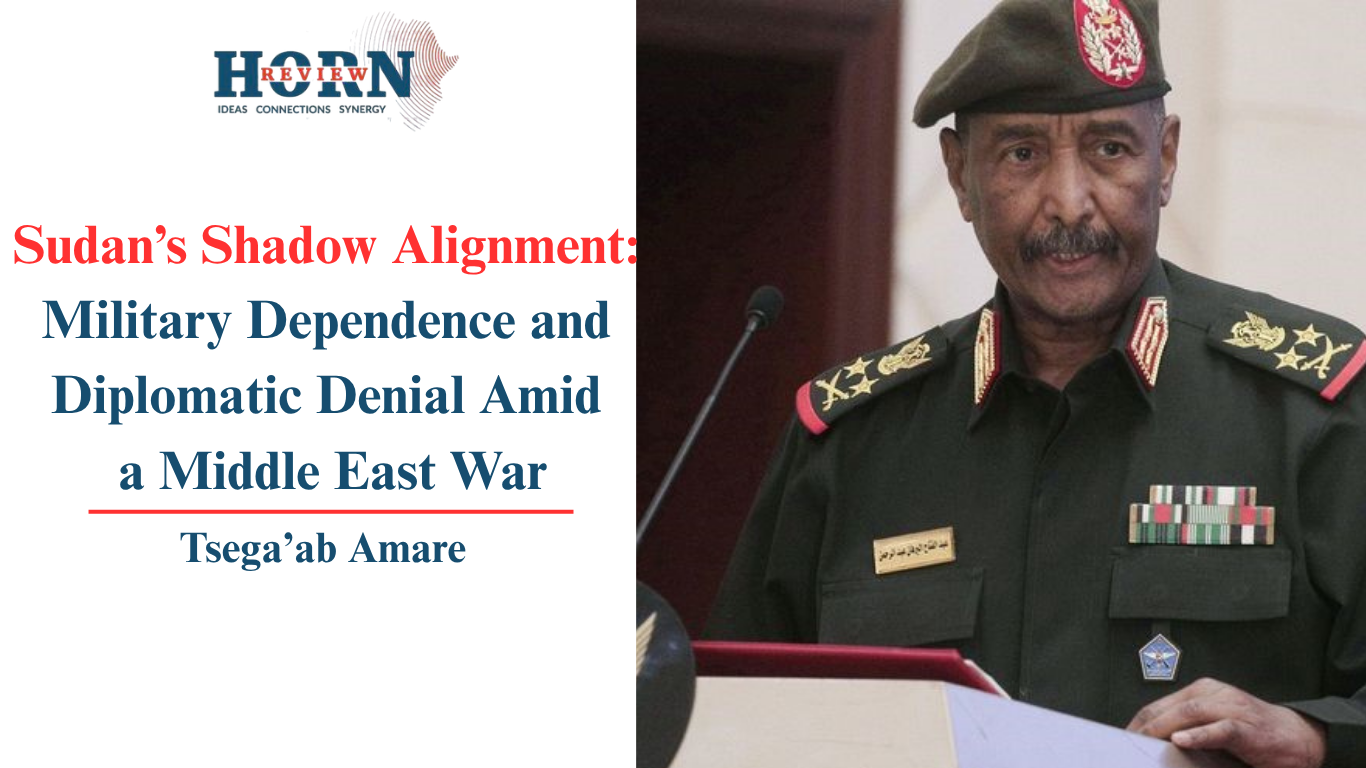
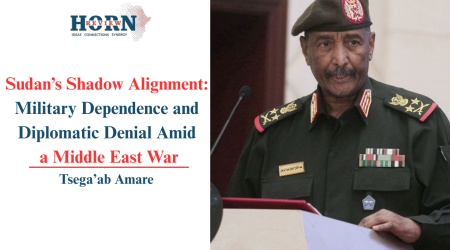
The geopolitical orientation of the Sudanese Armed Forces (SAF), under the leadership of Abdel Fattah Al-Burhan, reveals a significant paradox; as the military efficacy of the SAF on the battlefield has come to be heavily reliant on Iranian military equipment, while al-Burhan has simultaneously moved to aggressively distance his administration from Tehran’s regional agenda. This paradox has been most acutely demonstrated by the recent arrest of General Al-Naji Abdullah and the denouncement of the Islamist groups within the auxiliary forces of the SAF.
Rather than a sign of rhetorical confusion, this posture represents a layered strategic recalibration. In the context of the Iran-Israel/US war, Sudan is performing a dual-track survival strategy: maintaining a covert military lifeline while performing a public purge to avoid regional isolation and Western retaliation.
To understand Sudan’s current behavior, one must move beyond the view of the state as a unified actor. Sudan currently exists in what can be conceptualized as a ‘Zombie State’ condition, where it is internationally recognized as a sovereign entity but domestically hollowed out, having lost its monopoly over both diplomacy and coercion. In this environment, sovereignty is not an absolute fact but a convertible asset that is repeatedly used to secure external patrons.
The SAF functions as a multi-layered power structure with different factions pursuing different external alignments. Its desire for legitimacy through alliance with Saudi Arabia and Egypt contrasts with the views of the ‘Kizan’ the Islamist networks that are deeply embedded in the system since the Bashir era view Iran as a natural ideological ally. The difficulty for al-Burhan lies in navigating this fragmented sovereignty without allowing rogue factions to engineer a catastrophic external intervention. In a theatre of acute conflict, in the wake of Operation Roaring Lion, an alliance with Iran cannot be viewed as only symbolic; rather, it represents a commitment that can be met with immediate kinetic reactions from Israel or the United States.
The SAF’s reliance on Iranian support stems from a practical requirement of tactical support which has then played a significant role in halting RSF advances in the Khartoum tri-city area. Since 2024, Iranian Mohajer-6 and Ababil-3 drones have been decisive in reversing RSF gains in the area. These systems provide the SAF with the precision and endurance necessary to combat the RSF’s decentralized urban warfare. The logistics of this relationship operate through a ‘Shadow Alliance’ involving Eritrea. Satellite imagery has documented Iranian-linked cargo aircraft, such as Fars Air Qeshm 747s, landing in Massawa to deliver disassembled UAVs and munitions, which are subsequently transited to Port Sudan.
However, the recent escalation in the Middle East has fundamentally shifted the risk-reward calculus of this cooperation. The joint US-Israeli decapitation strategy against Tehran, which eliminated Supreme Leader Ali Khamenei and de facto leader Ali Larijani has destroyed the “mechanism of ambiguity” that previously allowed regional actors to hedge their bets. For al-Burhan, the Iranian drones are a lifeline, however the potential of being perceived as an ally of Iran has become a political liability.
The recent arrest of General Al-Naji Abdullah serves as the definitive expression of al-Burhan’s distancing strategy. Abdullah who is a prominent Islamist commander of the Al-Baraa bin Malik Brigade, publicly vowed, in military uniform, to send fighters to defend Tehran against any US-Israeli ground invasion. By arresting Abdullah and disavowing his militia, al-Burhan was performing messaging discipline intended for a global audience.
This move was necessitated and followed, the US State Department’s March 9, 2026, designation of the Sudanese Muslim Brotherhood and the Al-Baraa bin Malik Brigade as Specially Designated Global Terrorists. Washington’s explicit link between these groups and the IRGC created an existential threat to the SAF’s international standing. Al-Burhan’s response in a way can be seen as a form of sovereignty preservation: he sought to demonstrate that the professional military command retains control over its auxiliary elements, thereby preventing the RSF from successfully branding the entire SAF as an Iranian proxy to win Western backing. These cosmetic changes such as bringing militias nominally under formal army command while arresting their most vocal leaders are designed to satisfy US pressure without sacrificing the manpower needed on the frontlines.
On the other hand, Sudan’s strategic geography on the Red Sea makes certain that its foreign policy is inextricably tied to the interests of Saudi Arabia and the UAE. While the UAE has been identified as a primary backer of the RSF, Saudi Arabia has emerged as the SAF’s most critical potential patron.
The war in the middle east, however, has forced a temporary rapprochement between Riyadh and Abu Dhabi as both faced direct Iranian retaliatory strikes. This unified front has curtailed General al-Burhan’s capacity to exploit previous tensions between the two Gulf powers. Consequently, the Sudanese Armed Forces (SAF) have sought non-Iranian military alternatives to remain within a “pro-stability” regional orbit. The centerpiece of this pivot was the Saudi-facilitated $1.5 billion arms deal with Pakistan in early January 2026, aimed at securing JF-17 fighters and over 200 drones. By acquiring this Pakistani hardware, the SAF is attempting to build a military apparatus that is technically advanced yet politically “clean” from Iranian associations. This deal signals that while Iran may be the supplier of last resort, the Gulf remains the partner of first choice for long-term survival.
However, as the Iran war escalated, Riyadh prioritized its own domestic defense, bringing the delivery of the Pakistani deal to a halt. This has left the SAF in a precarious position: desperate for advanced weaponry while the Gulf’s support remains strictly contingent on a total purge of the Islamist elements currently fighting on the SAF’s frontlines.
In the current fragmented reality of the Middle East, the al-Burhan government is navigating a narrow corridor between battlefield necessity and diplomatic survival. The apparent inconsistency of using Iranian drones while arresting pro-Iran generals is the only logical response for “a state” seeking to maintain its sovereign identity amidst regional collapse.
As the war between Iran and the US-Israeli coalition moves into a stage of ‘war without limits,’ the mechanism of strategic ambiguity has effectively ended. In the absence of this buffer, every action by the SAF is scrutinized for clarity of commitment. Al-Burhan’s retreat from open alignment is an attempt to preserve strategic autonomy in a landscape where choosing the wrong side has become fatal. Whether this performance can be sustained as the Red Sea corridor becomes increasingly militarized remains the defining question for the survival of the Sudanese state.
For now, Khartoum’s survival hinges on its ability to remain strategically ambiguous while securing the military capacity necessary to outlast its domestic rival.
By Tsega’ab Amare, Researcher, Horn Review