The future of the world is not determined on the war fronts of the Middle East, Indo-Pacific and Europe, but in the digital spaces, data centers and research labs, critical for the growth of emerging industries or new productive forces, including AI. This shows the fact that the meaning and source of power have also shifted. Geo-technology captures this shift as it is a combination of new technologies and security with technological instruments of power leveraged to advance security interests.
In this new AI era, power does not grow out of the barrel of the gun. It comes from the labs and data centers of strategic industries of tomorrow. Whoever controls the critical minerals controls the future and defines the Fourth Industrial Revolution. As the word is being rebuilt according to emerging technologies, new financial instruments and competing geo-economic corridors, major, middle and regional powers invest on computational technologies of the future for tech sovereignty and industrial might in the AI age.
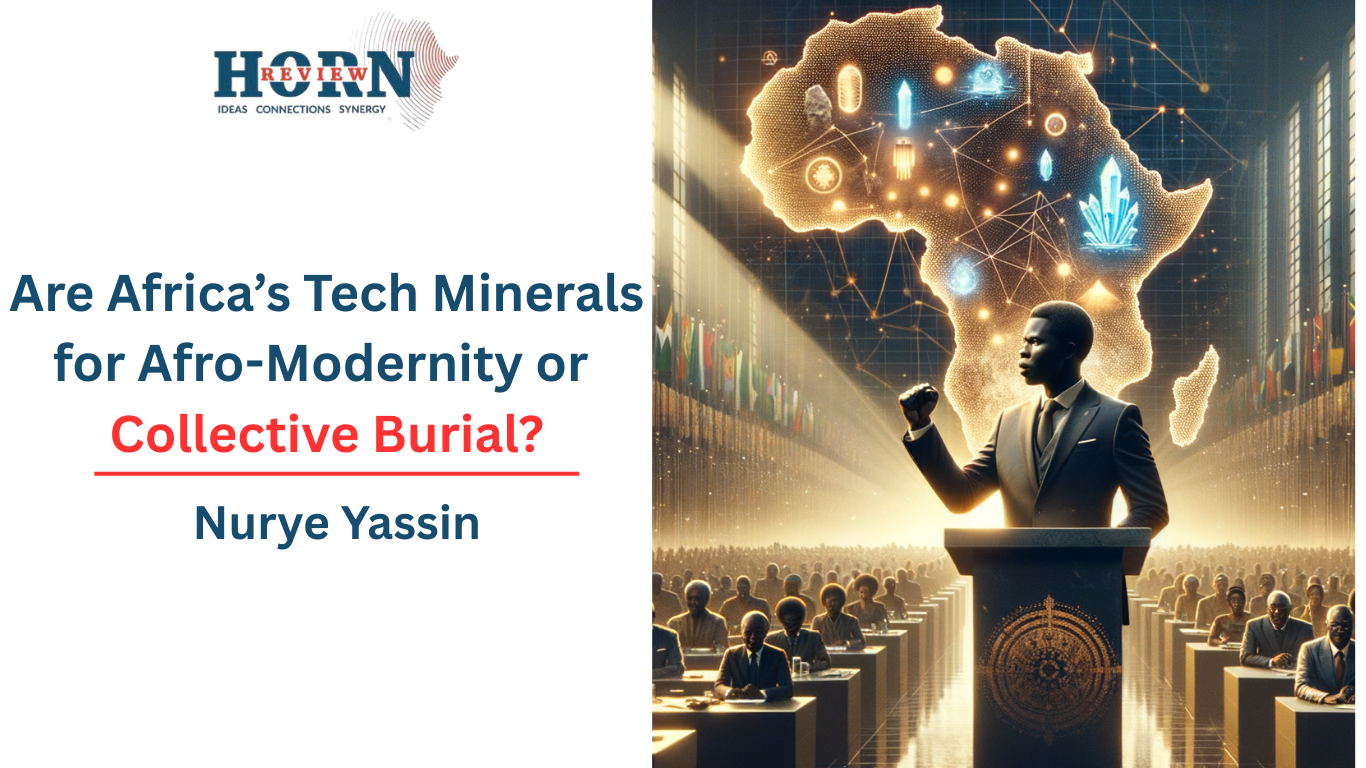
Critical minerals are foundational feeding these emerging strategic industries, which will determine the future of power. Africa, sitting on tech minerals, rare earth reserves, and traditional and new energies, stands to power advanced manufacturing technologies, facilitate geo-economic corridorisation as a major crossroad between the East and the West, as well as remake financial connectivity dynamics having control over the strategic resources, commodities and markets.
We cannot think of the growth of these tech labs, research facilities, data centers and above all emerging technologies without Africa’s critical minerals, conventional and new energies, and critical corridors or supply chains. The green and digital transition will not be complete without Africa’s rare earth elements, critical minerals and clean energies.
Despite this potential, Africa lags behind in this geo-technological AI race and needs to turn this potential into action while calmly and skillfully managing the resource, tech and rare earth wars. Ali Mazrui, one of the finest African intellectuals of the 20th century who dedicated his entire life for the elevation of Africa’s status in world affairs, realistically questioned the cruel irony of the world economy that leveraged Africa’s treasures and minerals for the strength and dominance of the industrial powers while turning the inhabitants of the continent into the condemned of the earth.
Mazrui underlined that Africa’s tragedy lies in the partnership between Africa’s strategic resources and technologies of the industrial powers. Mazrui went on to challenge the leadership and inhabitants of Africa to answer the riddle: “The digging continues! Dig! Dig! Is it for wealth or is it for the collective burial of a people.” The trends of the times have changed. However, the same question still haunts Africans. A radical rethinking of Mazrui’s question is relevant in the new geopolitical climate to address this geo-technological challenge confronted by Africa today as cutting edge technologies stand to re-map the global geography.
Africa, being at the center of the geo-technological, corridor-driven geo-economic and geo-financial showdown for world primacy, makes established, emerging, and middle powers recast their eyes at its critical minerals and new energies that fuel the cutting edge technologies of the future and determine the international distribution of power. These same new strategic industries, data centers, and high-tech labs are again clamoring for Africa’s critical minerals for technological sovereignty, and technological might. This is a historic opportunity that Africa should seize to address the digital and technological differential.
In spite of the myriad challenges arising from the messy international situation that implicates the continent in resource, corridor and geo-economic wars, the timing is right for Africa to confront this perennial question as well as re-imagine and rethink itself to do otherwise in the Fourth Industrial and AI revolution.
The moment is ripe for Africans to re-negotiate with the emerging world order to correct the skewed partnership between African resources and foreign technologies. It is an ideal time for Africa to invest its energy, resources, and expertise to leverage its tech minerals for industrial take off, productivity, and geo-technological relevance in the new era of global economy of knowledge anchored on emerging technologies.
Africa took a strategic move in exploring and supporting the “establishment of a coalition of critical mineral-producing countries of Africa’ during the 2025 African Climate Summit held in Addis Ababa to promote strategic and sustainable regional cooperation. This is one promising starting point putting a premium on a collective agenda to strengthen Africa’s bargaining position on its tech minerals and reshape its geo-technological interaction with the world on its own terms.
Nevertheless, Africa’s response to this new global rush for tech minerals is fragmented. African countries ink tech minerals agreements bilaterally, making themselves a space that can be restructured from outside. Fragmentation does not meaningfully address the lopsided partnership between Africa’s tech minerals and high-tech and military modernisation from new and traditional industrial powers.
Africa’s negotiation with the world has to be collective, approaching it as a unified unit to convert its tech minerals into industrial strength. Africa should leverage these tech minerals for scientific independence setting the terms of engagement with the industrial powers in favor of itself. Leveraging these critical minerals as a bloc is key to a world that seeks to negotiate African countries bilaterally.
Ethiopia, fully comprehending the strategic importance of technological strength as a condition for international policy autonomy, has become a front runner in Africa utilizing AI in various areas such as health, agriculture, and service. Efforts are being exerted by the government to make Ethiopia relevant to and useful for the global economy of knowledge investing resources and expertise in digital infrastructure and data centers as well as new technologies including cloud computing and robotics. Ethiopia should collaborate with African countries and genuine international partners with know-how to make emerging technologies as a foundation for Afro-modernity and power.
Africa should adopt a continental coordination and cooperation on critical minerals and energies that feed and power emerging technologies, maximize space for diversified geo-technological partnerships, co-write the rules of geo-technology on its own terms for scientific independence, and survive geo-technological showdown for preeminence.
As scientific independence is a necessary condition for economic, political and foreign policy autonomy, Africa should seize this momentum to change, to use the words of Paulin J. Hountondji, “a situation of growth without development” and “knowledge without invention.”
By Nurye Yassin, Researcher on Horn-Gulf Affairs