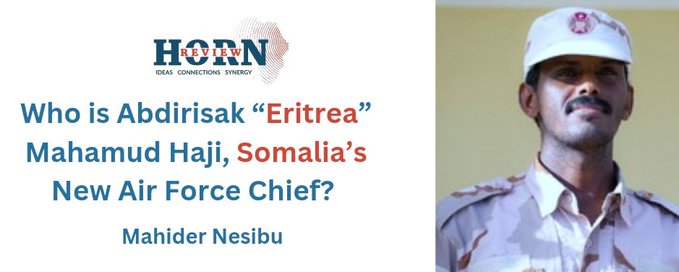
According to reports released in late February, senior military officer Abdirisak Mahamud Haji, commonly referred to as Abdirisak Eritrea, has been appointed Head of the Somalia Air Force. His appointment is part of a broader reshuffle of the Somali Armed Forces ordered by President Hassan Sheikh Mohammed, which also included the appointment of Ibrahim Mohamed Mahmoud as Chief of the Armed Forces. Abdirisak’s elevation, however, raises pointed questions given his past tenure and his longstanding connections with Eritrea.
Somalia has long depended on foreign support for its military. The war-torn country sends its soldiers abroad for training to a range of allied nations, as it wages its battle against Al-Shabaab. These partners include Turkiye, which trains Somali forces primarily from its large military installation, Camp TURKSOM, located inside the country, as well as the United Kingdom and, notably, Eritrea. Abdirisak’s ties to Eritrea, however, predate that cooperation by decades. He reportedly received military training there after travelling to the country as a fighter of the Ogaden National Liberation Front (ONLF) in the early 2000s. The ONLF is a secessionist organisation that has historically sought to separate the Ogaden region from Ethiopia, including through armed rebellion.
Abdirisak’s biography is part of a longer and more complex regional story. His trajectory across Ethiopia, Eritrea and Somalia embodies the cross-border networks that have long defined Horn of Africa politics. He is among the many figures with a regional resume who are now embedded within the establishment in Mogadishu and across the country’s political and security landscape.
Following Ethiopia’s military intervention against the Islamic Courts Union (ICU) in 2006, he made his way back into Somalia, most likely to join the fight against Addis Ababa’s forces. He re-emerged in a different capacity in 2018, this time within Somalia’s intelligence apparatus as a member of the National Intelligence and Security Agency (NISA), where he served the Farmajo administration as a useful conduit to Asmara.
His role would prove central to the dispatch and training of Somali soldiers in Eritrea between 2019 and 2024. This covert programme, which produced approximately 5,000 troops for the Somali National Army, was a joint operation between Somali intelligence and the Eritrean regime. It was made possible by a significant shift in the region’s political climate. A 2018 peace agreement brought Addis Ababa, Asmara and Mogadishu together, enabling a degree of rapprochement between Somalia and Eritrea and allowing Ethiopia to engage directly with rebel groups previously hosted on Eritrean soil, including the ONLF.
Within that opening, President Mohamed Abdullahi Mohamed, popularly known as Farmajo, made the decision to send what he later described as “the largest contingent of our army to Eritrea for training.” The programme was conducted in secrecy, channelled through intelligence agencies rather than formal military structures, and drew considerable criticism, in part due to Eritrea’s notorious approach to military training. Abdirisak’s connections to Eritrean intelligence are widely believed to have been instrumental in enabling the arrangement. The current Air Force chief can be seen alongside President Hassan Sheikh Mohamud and Eritrean President Isaias Afewerki in footage from a 2022 visit to the trainees.
His appointment comes after the last of these troops completed their delayed return to Somalia in 2025. The timing is also significant in a broader sense: the geopolitical landscape of the Horn has shifted considerably since 2018. The peace achieved then has since unravelled. Ethiopia and Eritrea now stand on opposite sides of a possible military confrontation, and Mogadishu’s relationship with Addis Ababa has also deteriorated, falling well short of the promise that period of reconciliation once held.
Somalia has, across different periods, served as terrain through which external actors have sought to exert pressure on Ethiopia. Asmara’s strategy to host the ONLF was precisely such a manoeuvre, allowing Eritrea to capitalise on its fraught relationship with Addis Ababa by supporting a secessionist movement targeting the Ogaden region. At various junctures, Eritrea has exploited Somalia’s fragility to pose security challenges to Ethiopia.
Despite the subsequent breakdown of the Ethiopia-Eritrea relationship, ties between Asmara and Mogadishu appear intact, and have arguably been reinforced by the fault lines now separating Somalia from its larger neighbour.
President Hassan Sheikh Mohammed has shown considerably less inclination than his predecessor to cultivate a constructive relationship with Ethiopia. The dispute over Somaliland remains the foremost source of tension between the two countries. Ethiopia’s signing of a Memorandum of Understanding with Somaliland in 2024, granting it sea access in exchange for recognition, provoked a sharp reaction from Mogadishu. Turkish mediation eventually led to the shelving of the agreement, but underlying tensions persist. More structurally, Somalia and Ethiopia now occupy opposing positions within the broader geopolitical fault lines reshaping the Horn and the wider Middle East region.
That positioning has drawn Eritrea and Somalia into the same alignment. Mogadishu has formalised this convergence through a trilateral pact with Asmara and Cairo, concluded in part as a counterweight to the Somaliland agreement. Against this backdrop, Abdirisak’s appointment is likely to be viewed with alarm in Addis Ababa. Through him, Eritrea may gain an unprecedented degree of influence within the Somali military, extending well beyond the thousands of troops it has trained who are now integrated into the national army. His rise to the upper echelons of the armed forces signals an asymmetry that is becoming increasingly difficult to ignore.
Abdirisak takes command of an Air Force that is gaining in capability at a moment of acute internal pressure. The African Union Peace Mission in Somalia is steadily drawing down, while Al-Shabaab has registered a troubling resurgence, achieving battlefield successes and recapturing territory. ISIS-Somalia remains active. In response, the Somali military has moved to expand its personnel and capabilities.
On the external front, Mogadishu has welcomed Egyptian troops into the country as part of what appears to be a broader trajectory towards militarisation. Beyond its primary partner Turkiye, which maintains a large military base in Somalia and has recently stationed F-16 fighter jets there, the country has also formalised military ties with Qatar and Saudi Arabia. Most significantly for the Air Force, Somalia is reportedly set to receive a whopping 24 JF-17 fighter jets from Pakistan, a delivery that will fundamentally alter the country’s airpower. With Abdirisak at the helm and his proximity to the Asmara government, Eritrea and President Isaias Afewerki may be well positioned to shape Somalia’s evolving security posture, most plausibly at Ethiopia’s expense.
Ethiopia already faces mounting pressures to its east. The clientelistic nature of Turkiye’s relationship with Somalia, combined with Mogadishu’s deepening alignment with Saudi Arabia, Qatar and Egypt, compounds an already difficult regional calculus for Addis Ababa. Despite this turbulence, Ethiopia retains considerable influence in Mogadishu and across Somalia’s federal states. Abdirisak’s appointment, however, threatens to complicate that further. His proximity to Asmara introduces a variable that Addis Ababa will find difficult to manage, and one that may deepen the already strained relationship between the two countries.
By Mahider Nesibu, Researcher, Horn Review