Egypt has always been known for its duplicity without fail. It fights the Muslim Brotherhood in Egypt with no mercy, to the extent of toppling a democratically elected government. Killed and jailed thousands of members and leadership of the Muslim Brotherhood. The consolidation of power by Abdel Fattah el-Sisi following the 2013 overthrow of Mohamed Morsi marked one of the most extensive campaigns of political repression in modern Egyptian history, reflecting Cairo’s determination to eliminate the Brotherhood as a domestic political force.
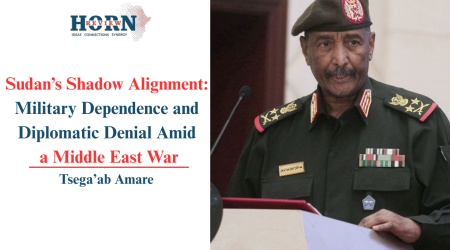
Yet the same regime has no problem bankrolling and nurturing it in Sudan because that’s what Abdel Fattah al-Burhan’s faction, an Egyptian henchman, depends on for its survival, as the Sudanese Armed Forces has been hollowed-out not later than the eruption of the conflict. The war in Sudan reflects the collapse of a fragile transitional order that emerged after the fall of Omar al-Bashir in 2019. The rivalry between the Sudanese Armed Forces and the Rapid Support Forces led by Mohamed Hamdan Dagalo has fragmented the state’s security apparatus, creating a vacuum that regional actors have sought to shape according to their strategic interests.
The conflict in Sudan presents yet another manifestation of such duplicity. Cairo’s regional conduct has historically been shaped less by ideological consistency than by regime survival and geopolitical hedging. This strategic opportunism allows Egypt to maintain simultaneous partnerships with rival regional blocs while preserving leverage across multiple theatres.
Al Sisi effortlessly swings between Mohammed bin Zayed Al Nahyan and Mohammed bin Salman. He tends to turn to MBZ when financial pressures mount, while continuing to encourage MBS to maintain his support for Burhan. Since the aftermath of the Arab Spring, Egypt has become heavily dependent on financial support from Gulf monarchies. Saudi Arabia and the United Arab Emirates have collectively provided tens of billions of dollars in aid, loans and investments aimed at stabilizing the Egyptian economy. This financial dependency has created a complex relationship in which Cairo attempts to preserve autonomy while simultaneously reassuring its Gulf benefactors.
The Egyptian regime has shown little hesitation in engaging multiple contradicting sides simultaneously. Such opportunistic duplicity has rarely gone unnoticed, though it has often been tolerated. That seems to run out of steam in connection to Iranian attacks against Gulf countries. Currently there is an ongoing debate and disagreement between Gulf and Egyptian elites regarding the official reactions to the Iranian attacks that targeted cities and facilities in the Gulf countries. The attacks followed a sharp escalation after the February 28 coordinated strikes by the United States and Israel against military infrastructure inside Iran, which prompted retaliatory missile and drone operations across multiple locations in the Gulf region. Energy infrastructure, airports and critical civilian facilities became potential targets, highlighting the vulnerability of strategic infrastructure in the region.
Sizable number of Gulf commentators believe that the official responses issued by the Arab League and Egypt failed to meet expectations and rise to the level of the security threats facing the Gulf states. Since its establishment in 1945, the Arab League has been headquartered in Cairo, giving Egypt considerable institutional influence over the organization’s diplomatic agenda. Critics have long argued that its bureaucratic leadership and institutional culture remain closely aligned with Egyptian foreign policy priorities.
The Arab League has always been dubbed to be none other than a department in Egyptian Foreign Affairs. It is conspicuously manifested in a way it waited for and echoed the statement of the government of Egypt which tailed the African Union. This reflects and exacerbates the growing crisis of trust between the Gulf countries and the Arab League institution. It rather exposed the Egyptian disregard for either side except fishing from murky waters. Alas, that has always been the case. Every GCC member country feels and admits in private but refrains to utter in public.
The anger among elites in Saudi Arabia, United Arab Emirates, Kuwait, Bahrain, and Qatar is based on the belief that their countries are always expected to provide financial and political support to Egypt. However, when Gulf cities come under attack, the official language from the Arab League and Egypt did not provide real support to the Gulf states. Instead, it remained silent; then issued a belated and non-committal statement calling on all parties to exercise restraint.
In practice, such statements and stance place the aggressor, Iran, and the victim, the Gulf states, on the same level without clearly condemning Tehran. The Gulf countries expected stronger action and clearer support from the Arab League and Egypt in international forums to pressure Iran to stop its attacks but to no avail. For Gulf policymakers, such ambiguity raises questions about the reliability of traditional Arab institutions when confronted with direct security threats.
It is also worthwhile to note that Eritrea has not yet issued any comment or official statement so far. There has also been no record of any contact or declared position regarding these attacks, despite its geographical proximity to the Gulf region. Eritrea also has close relations with Cairo, which may explain why it is avoiding taking a position that could be seen as different from or inconsistent with the Egyptian position.
A further dimension of the emerging divide concerns the alignment of Red Sea littoral states. Eritrea’s strategic posture has increasingly mirrored Cairo’s preference for limiting the role of non-coastal actors in Red Sea security discussions. In recent years, Asmara and Cairo have emphasized that the security architecture of the Red Sea should primarily remain the domain of coastal states, a position widely interpreted as aimed at constraining Ethiopia’s growing regional role. At the same time, reports of expanding links between Eritrea and Iran have raised concerns among regional security analysts about the possibility that Iranian influence could extend further into the Red Sea basin. Should Tehran gain reliable intelligence and logistical access to Eritrean coastline infrastructure such as facilities near the port of Massawa, it could potentially create an additional platform for projecting pressure against Israeli targets, United States naval assets, or commercial shipping routes traversing the Red Sea corridor.
The implications of such a development extend far beyond the Gulf itself. The Red Sea and the Horn of Africa are increasingly integrated into the broader security architecture of the Middle East. Over the past decade Gulf states have expanded their political, military and economic footprint along the Red Sea corridor through port investments and logistical hubs in countries such as Eritrea, Djibouti and Sudan. Control over maritime chokepoints like the Bab el-Mandeb Strait has therefore become a central concern for regional security planners, given that a significant portion of global trade and energy shipments transit through this narrow passage.
In contrast, Ethiopia has sought to frame its regional diplomacy around de-escalation and cooperative security frameworks linking the Horn of Africa and the Gulf. Within the evolving strategic landscape connecting the Gulf and the Horn of Africa, Ethiopia has increasingly attempted to position itself as a constructive stakeholder advocating stability of maritime trade routes, regional dialogue and cooperative security mechanisms across the Red Sea basin. Abiy Ahmed took the initiative and spoke with leaders of Saudi Arabia, the UAE, Qatar, Bahrain and Kuwait.
This will intensify the rift between the Gulf countries and Egypt which entails political consequences after the war ends. Hence Gulf countries must reconsider their relations with Egypt and reduce their political and economic support for the Arab League and for Egypt, while moving toward building broader regional partnerships with Asia and Africa. More broadly, the episode illustrates a gradual transformation in the geopolitical outlook of Gulf states as they diversify their diplomatic and economic partnerships beyond traditional Arab political frameworks and increasingly engage emerging partners across the Red Sea and the Indian Ocean corridors.
As geopolitical competition intensifies across the Red Sea basin, the traditional boundaries between Middle Eastern and African security theatres are rapidly dissolving, forcing regional powers to reassess alliances that were once taken for granted.