The paper “The Red Sea’s History is Today’s Framework: Ethiopia, Egypt, and Enduring Strategic Rivalries”, authored by Elias Wondimu and published in the November 2025 edition of Defense & Foreign Affairs Special Analysis, presents a rigorous historical and strategic examination of the 1875 to 1876 war between Ethiopia and Egypt. The analysis employs this conflict as an essential case study to decipher the contemporary geopolitical competition unfolding in the Horn of Africa and the Red Sea corridor. The central argument posits that the strategic patterns established in the late nineteenth century, encompassing fundamental contests over sovereignty, critical resources like water, and the pervasive influence of external powers, provide an indispensable framework for interpreting the current dynamics between regional states and the renewed involvement of global actors. This historical lens reveals that the region’s security architecture is shaped by enduring logic rather than transient events.
The paper begins by revisiting the decisive Ethiopian victories at the battles of Gundet in 1875 and Gura in 1876. These events are framed not as isolated historical incidents but as profound demonstrations of enduring strategic principles. The author emphasizes that Emperor Yohannes IV’s success was fundamentally rooted in domestic political cohesion, a unified military command under generals like Ras Alula Engida, and a sovereign knowledge of the territorial landscape. In direct contrast, Egypt’s modernized forces, despite their advanced weaponry and cadre of foreign advisors from Europe and America, were critically undermined by poor intelligence, fragmented logistics, and a lack of internal unity. This historical juxtaposition establishes the paper’s foundational thesis that sustainable power and security in the region derive from local legitimacy and sovereign integrity, not from imported military capability or external patronage. The victories demonstrated that technological advantage is neutralized by superior strategy grounded in territorial authenticity.
The analysis then systematically expands to situate the war within its intricate global context. The Horn of Africa in the 1870s is depicted as an early arena of modern imperial rivalry, where British and French financial interests in the Suez Canal and the Nile Valley directly influenced regional politics. Egypt’s Khedive Ismail Pasha, fueled by vast foreign credit and a desire to construct a European style empire, embarked on an expansionist campaign into the Ethiopian highlands that ultimately led to military disaster and national financial collapse. The author meticulously traces how this defeat triggered a cascading chain of events, including increased Anglo-French control over Egyptian finances, the Ottoman Sultan’s deposition of Ismail, and the eventual British occupation of Egypt in 1882. Furthermore, it created a vacuum on the Red Sea coast that Italy swiftly moved to fill by occupying Massawa in 1885, a breach on prior agreements with Ethiopia. This sequence powerfully illustrates how local conflicts can precipitate decisive shifts in the regional balance of power and invite further external intervention, setting patterns for colonial encroachment.
The core analytical contribution of the paper lies in its methodical drawing of explicit parallels between this nineteenth century template and the current strategic environment. The author contends that the Red Sea has once again become a primary theater for global competition, with the United States facilities, China’s Djibouti base, and pursuits by Turkey, UAE, Russia in Somali and Sudanese ports and intelligence facilities along its coasts. This modern rivalry, complete with its diplomatic maneuvering and investment in local proxies, directly echoes the earlier British and French contest for influence. Furthermore, the region is again a stage for complex proxy conflicts, where local grievances and civil wars in Sudan, Yemen and Somalia are leveraged by external powers pursuing broader strategic aims for maritime access and ideological influence, thereby perpetuating a cycle of instability. The Horn’s contemporary fragility, much like in the past, stems significantly from its exposure to these global rivalries fought through local intermediaries.
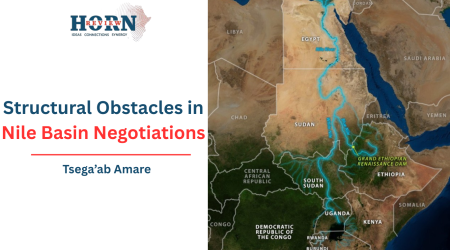
A critical contemporary echo analyzed in depth is the long standing dispute over the Nile River, now centered on the Grand Ethiopian Renaissance Dam. The author frames this not as a novel technical or legal issue but as the latest manifestation of a centuries old tension between upstream sovereignty and downstream colonial claims. Ismail Pasha’s invasion was motivated in part by a preemptive attempt to control the headwaters of the Blue Nile. Over a century later, Ethiopia’s construction of the GERD represents the concrete realization of that sovereign control over a national resource which Egypt had historically claimed and sought to prevent. This linkage argues compellingly that the Nile dispute is fundamentally a conflict over national identity, developmental rights, and unchallenged territorial authority.
The paper concludes by distilling strategic lessons from the 1875 to 1876 war that retain urgent relevance for modern policymakers. The first lesson is that military capability divorced from domestic political cohesion and unified command is inherently fragile. This is a caution for governments that prioritize imported platforms and foreign training missions over the painstaking work of building internal unity and legitimate institutions. The second lesson warns of the profound risks of strategic dependency, where states anchoring their security and economic models to external patrons face severe vulnerability when those alliances shift or their own independent ventures fail, as witnessed in Ismail’s bankrupt state following military defeat. The third reaffirms that any diplomatic or technical arrangement treating shared rivers like the Nile as mere administrative files, rather than as vital elements of national development sovereignty, is unlikely to yield lasting stability. Respect for water sovereignty is presented as a non-negotiable continuum of territorial defense.
The final and most geographically decisive lesson reiterates the inseparable linkage between the security of the Ethiopian highlands and the stability of the entire Red Sea maritime corridor. Instability inland, whether political, economic, or conflict driven, generates immediate downstream consequences including disrupted trade, exposed maritime routes, and heightened vulnerability for critical chokepoints like the Suez Canal. This reality, clearly recognized by British and French strategists in the nineteenth century, is now a calculable factor for all contemporary actors including China, the Gulf States, and the United States. Their military and economic engagements are implicitly or explicitly designed to manage the risks emanating from this interconnected geography.
Through this structured historical analysis, the author delivers a clear directive for contemporary statecraft. Sustainable advantage and resilience in the Red Sea basin will accrue to those states that ground their power in internal coherence, historical legitimacy, and sovereign control over critical resources, rather than in borrowed systems or transient alliances. The campaigns at Gundet and Gura demonstrated conclusively that territorial knowledge, unified leadership, and internal legitimacy could defeat a technologically superior adversary funded by foreign capital. The paper asserts that these principles remain as crucial for twenty first century security planning as they were one hundred and fifty years ago. It offers a sobering reminder that while actors and technologies evolve, the fundamental dynamics of power, sovereignty, and geography in the Horn of Africa exhibit a profound and enduring continuity. Understanding this historical framework is not an academic exercise but a strategic necessity for navigating the renewed great power competition centered on the Red Sea and the Nile.
By Yonas Yizezew, Researcher, Horn Review