Qatar’s rapid security intervention in Somalia in January 2026 was neither accidental nor purely reactive. It was the product of a sudden geopolitical rupture that created what Somali officials themselves describe as a “security and diplomatic vacuum” one that Doha has moved decisively to fill. At stake is not simply the replacement of the United Arab Emirates as a security partner, but the redefinition of power between Somalia’s federal center and its defiant periphery.
The immediate trigger was the abrupt collapse of Somalia–UAE relations on January 12, 2026. The Federal Government of Somalia (FGS) cancelled all Emirati security and port agreements following what Mogadishu framed as the “last straw”:reports that the UAE facilitated Israel’s recognition of Somaliland in December 2025 and enabled a Yemeni separatist leader to enter Somali territory illegally via Somaliland. Regardless of the full veracity of these claims, their political impact was decisive. Abu Dhabi’s decade-long role in Somali security was suddenly delegitimized at the federal level.
The fallout was swift. As UAE, military personnel and equipment began withdrawing from Puntland and other regions, Mogadishu faced an immediate capability gap. Funding streams dried up, training programs stalled, and the federal government was left exposed. Qatar’s intervention was therefore timed precisely to meet an urgent need but it was also strategically calculated. January 2026 offered Doha a rare opportunity to displace the UAE’s entrenched influence and position itself as the indispensable ally for Mogadishu’s survival.
This move must also be understood through Somalia’s unresolved struggle over sovereignty. For years, Mogadishu has viewed Emirati ties with Somaliland and Puntland as drivers of fragmentation. By stepping in now, Qatar reinforces the FGS’s claim to be the sole authority over national defense under the “One Somalia” doctrine. The defense agreement with Qatar is thus not merely a security arrangement; it is a political instrument aimed at recentralization.
That ambition directly collides with regional realities. Puntland and Jubaland rejected the federal decision to cut ties with the UAE, declaring it “null and void,”and arguing that the Provisional Constitution does not allow Mogadishu to unilaterally cancel regional agreements governing ports and security. Somaliland dismissed the move as “daydreaming,” reaffirming its partnership with DP World and Abu Dhabi. Puntland President Said Abdullahi Deni’s visit to the UAE to reaffirm ties underscored how openly the federal ban is being ignored.
Within this standoff, Qatar’s role has sharpened tensions rather than resolved them. By providing Qatari-backed training and funding, the FGS hopes to build a centrally loyal force capable of reasserting authority over defiant regions. Financial leverage is equally important. Mogadishu expects Qatari and potentially Saudi investment to eventually rival Emirati funding, pulling regional states back into the federal orbit. For now, that calculation remains unproven.
Regional authorities, meanwhile, perceive the emergence of a centrally loyal, Qatari-trained force as an existential threat. In Puntland, Jubaland, and Somaliland, these troops are widely viewed as a “private army” for Villa Somalia rather than a national force. The fear is that such units could be used to forcibly reclaim regional ports, airports, and revenue streams currently managed with UAE backing amounting to forced centralization in violation of the constitution.
This perception has hardened into open constitutional defiance. Puntland and Jubaland have reaffirmed independent security arrangements with the UAE, creating parallel military structures inside one state. Somalia is thus drifting toward dual security architectures: a Doha-aligned federal force versus Abu Dhabi-backed regional forces. Analysts increasingly warn of a “Two Somalia’s” scenario, where competing chains of command coexist uneasily.
The risks are substantial. The January 19 defense pact is viewed in the regions not as a national security measure but as a political tool for centralization. Regional leaders fear the use of Qatari-trained “elite” units to seize control of strategic assets. By bypassing consultation, the federal government has pushed Puntland and Jubaland toward administrative secession, suspending cooperation in protest of what they describe as repeated constitutional violations.
Proxy dynamics further complicate matters. Somalia is once again becoming a frontline in the Qatar–UAE rivalry. The internal focus on this geopolitical “tug-of-war” is already undermining the fight against al-Shabaab. Intelligence sharing between the center and regions has deteriorated, creating gaps that militants can exploit. As UAE-funded programs are canceled by Mogadishu but maintained locally, the absence of a unified command structure generates dangerous security vacuums.
Financial stability is another pressure point. Regional administrations depend heavily on UAE funding to pay civil servants and maintain local security. Replacing this with Qatari funding that flows only through Mogadishu amounts to what critics call “financial strangulation.” The resulting economic stress has fueled unrest in regional capitals and risks escalating into armed resistance.
In response, regional states are entrenching. Puntland has explicitly protected the UAE-trained Puntland Maritime Police Force (PMPF) as a necessary local asset against al-Shabaab and Daesh. Somaliland and Puntland have invited Emirati forces to remain even as they withdraw from federal-controlled areas, effectively creating “safe zones” for Emirati influence beyond federal reach. Politically, Somaliland, Puntland, and Jubaland have formed a coordinated front to isolate Mogadishu’s pro-Qatar policy and render the agreement a “paper pact.”
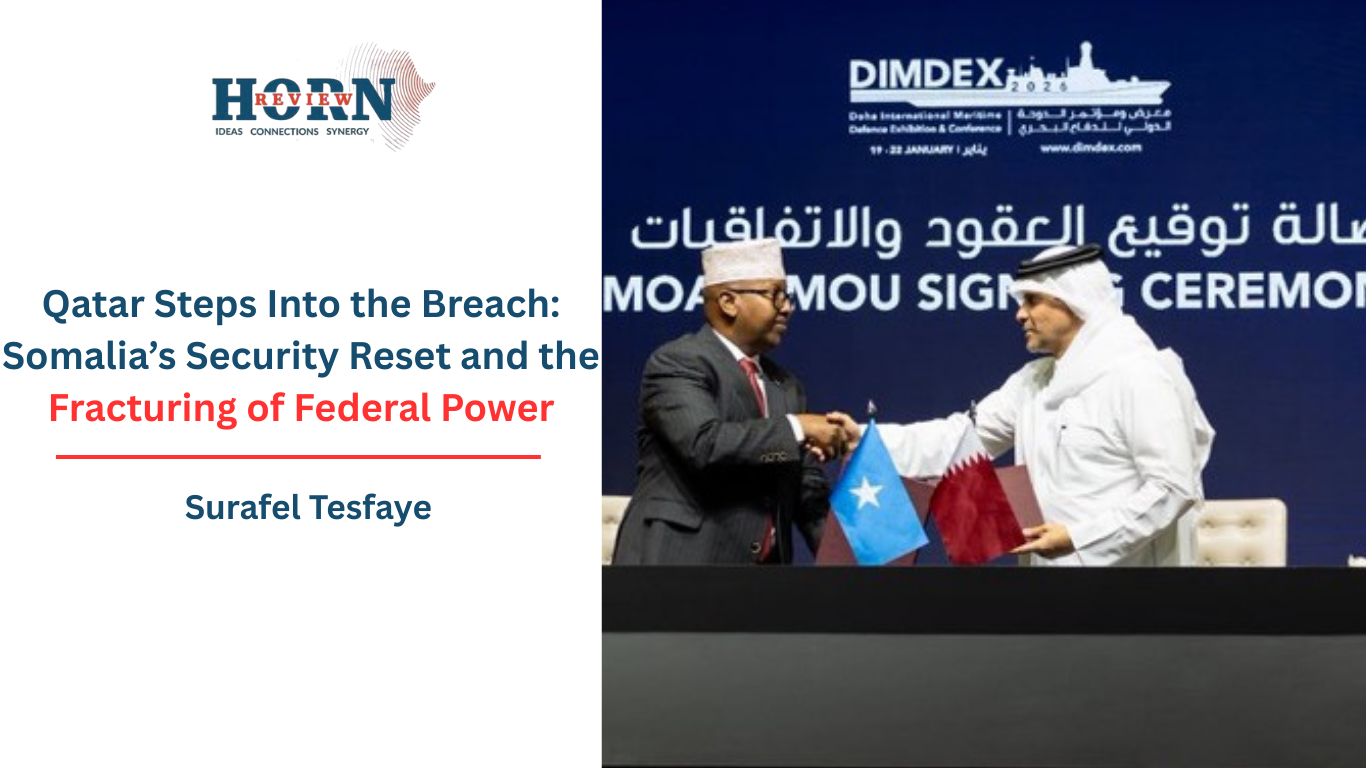
Yet Qatar’s strategy is not purely confrontational. By staying officially aligned with the FGS while maintaining humanitarian and developmental engagement in Somaliland, Doha is positioning itself as a future mediator. In December 2025, Somaliland President Abdirahman Mohamed Abdullahi “Irro” invited Qatar to open development and diplomatic offices in Hargeisa, offering a “new diplomatic chapter” without formal recognition. The timing alongside Qatar’s use of the Doha International Maritime Defence Exhibition (DIMDEX) to formalize its defense deal signaled Doha’s intent to shape Somalia’s security future.
Ultimately, Qatar’s return has altered Somalia’s internal balance. It has given Mogadishu the means to survive without the UAE, but at the cost of deepening federal fractures. The unilateral nature of this shift has pushed regional states into a corner, making the risk of a “civil war within the state” higher than it has been in years.
By Surafel Tesfaye, Researcher, Horn Review