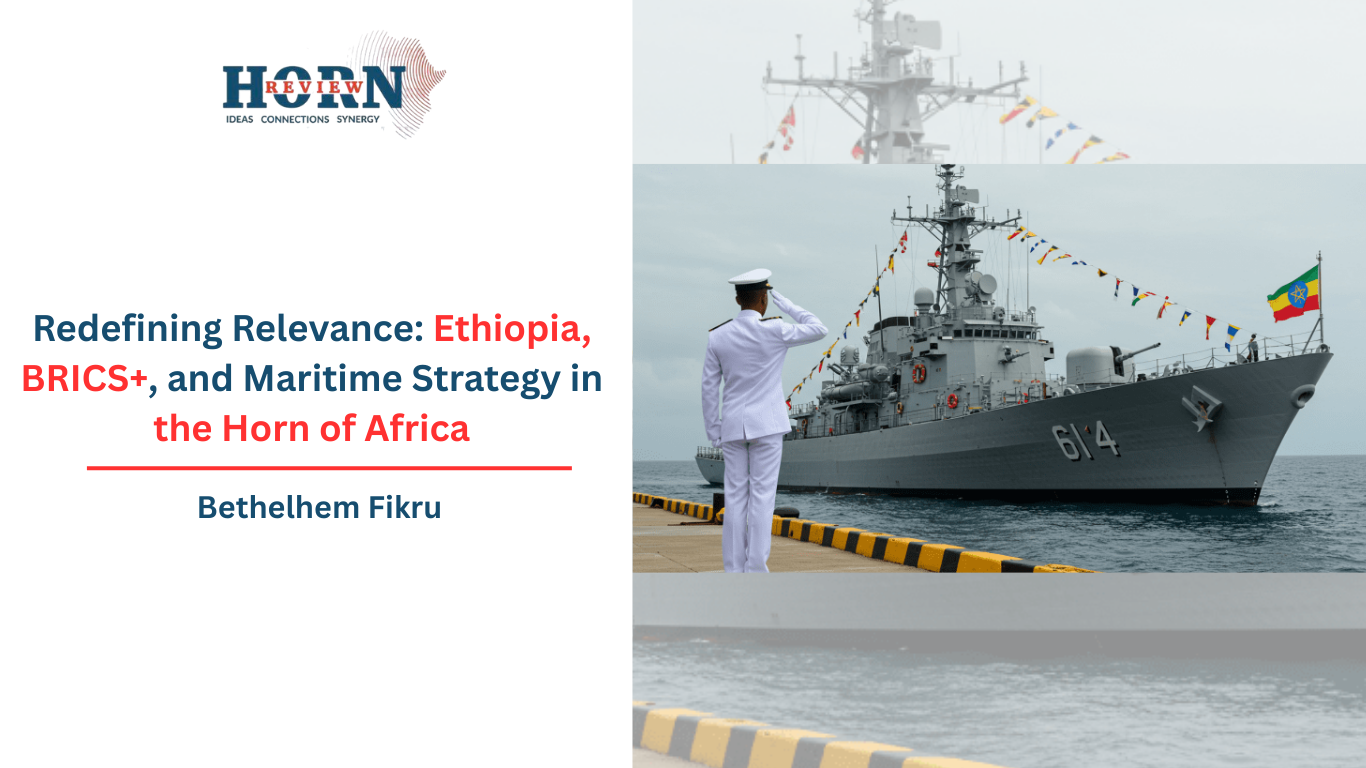
Ethiopia’s participation as an observer in the BRICS+ “Will for Peace 2026” naval exercise off South Africa’s coast represents a subtle but strategically meaningful shift in Horn of Africa geopolitics. For the landlocked state, the significance of this engagement does not lie in immediate naval power or access to contested waters. Rather, it reflects a recalibration of legitimacy, inclusion, and strategic visibility at a time when regional maritime governance has moved toward narrower and more exclusionary definitions.
The Ethiopian Navy, dissolved in the early 1990s following the loss of direct Red Sea access, was formally reconstituted in 2019. Initial efforts focused on institutional recovery rather than operational reach, including limited patrol activity on Lake Tana and foundational training programs. By 2025, however, Ethiopia had established permanent naval headquarters and training facilities in Addis Ababa, signaling a long-term commitment to maritime capability development. Participation in BRICS+ naval activities, alongside observers such as Brazil and Indonesia , marks a transition from internal reconstruction to external engagement within a multilateral, non-aligned framework.
This trajectory contrasts sharply with Ethiopia’s ongoing exclusion from maritime security arrangements in its immediate neighborhood, a situation influenced by Somalia’s role in shaping participation within these frameworks, which sidelines Addis Ababa. In the Western Indian Ocean and Gulf of Aden, cooperation has been structured around multinational initiatives such as EU NAVFOR Operation Atalanta, active since 2008 and continuing through 2025–2026. These operations are organized primarily around Somalia’s coastline and sovereignty framework, with mandates focused on counter-piracy, maritime policing, and capacity building off Somali territorial waters. Within this architecture, participation has been implicitly limited to littoral or host-state–approved actors. As a result, Ethiopia despite its economic centrality to the Horn of Africa and its overwhelming reliance on these same maritime corridors has remained institutionally outside these frameworks.
This exclusion reflects deliberate political choices rather than institutional oversight. Egypt has consistently advanced a restrictive interpretation of Red Sea governance that limits participation to littoral states alone. In late 2025, Egyptian Foreign Minister Badr Abdel Aaty articulated this position explicitly, stating that non-shoreline countries have no role in Red Sea governance and naming Ethiopia directly. This approach has been reinforced through coordinated diplomacy with Eritrea and Somalia, including trilateral summits such as the October 2024 Asmara meeting and subsequent consultations. The underlying message has been consistent: Ethiopia’s demographic weight, economic scale, and security interests do not translate into formal standing.
Parallel to this diplomatic posture, Egypt has expanded its port-related engagements along Ethiopia’s main maritime corridors. Agreements involving facilities at Assab, in alignment with local authorities and Doraleh in Djibouti in late 2025 have been widely interpreted as efforts to consolidate influence over critical access points. These moves coincide with broader Egyptian efforts to frame Ethiopia’s regional initiatives particularly those related to infrastructure and connectivity as destabilizing or hegemonic, rather than structural responses to landlocked vulnerability.
Ethiopia has explicitly rejected this framing and has sought to translate its position into practical diplomacy. In 2025, Addis Ababa took the initiative to convene a Red Sea–focused conference in Addis Ababa, bringing together regional and extra-regional actors to promote dialogue on inclusive maritime governance. The summit was intended to challenge exclusionary approaches by advancing a broader Red Sea basin perspective, one that recognizes economic interdependence, shared security risks, and the role of major non-littoral stakeholders. Through this initiative, Ethiopia emphasized its argument that Red Sea stability cannot be sustained through exclusion, particularly when one of Africa’s largest economies and most populous states is treated as strategically peripheral. Addis Ababa has continued to advocate for inclusive approaches through platforms such as IGAD–GCC consultations and wider basin-level frameworks that prioritize connectivity over shoreline status. The rationale is pragmatic rather than ideological: Ethiopia’s trade volumes, upstream Nile role, energy transit needs, and long-standing historical ties to the basin render it a stakeholder irrespective of geography.
Within this context, BRICS+ assumes strategic relevance. Unlike regionally bounded councils or legacy security mechanisms, BRICS+ operates on principles of strategic pluralism and Global South autonomy. Ethiopia’s inclusion in BRICS and its invitation to observe naval exercises reflect recognition of systemic importance rather than territorial proximity. The “Will for Peace 2026” exercise does not position Ethiopian forces in contested regional theaters; instead, it integrates Ethiopia into broader discussions on maritime security norms, logistics coordination, and crisis management at a global level.
The contrast is revealing. While regional actors seek to define legitimacy through restrictive criteria, BRICS+ engagement is based on capacity, demographic weight, and future relevance. For Ethiopia, this creates three distinct opportunities.
The engagement enhances Ethiopia’s institutional capacity by allowing its naval forces to observe complex exercises alongside experienced maritime powers, rebuilding doctrine and operational competence without provoking regional sensitivities. It also elevates Ethiopia’s maritime profile, reframing the country not as a marginal landlocked state but as a credible stakeholder in Global South security discussions. At the same time, this multilateral participation expands Ethiopia’s diplomatic leverage, reducing dependence on regional actors who have historically resisted inclusive governance.
This shift does not negate Ethiopia’s regional priorities. Negotiated, peaceful access to the sea through agreements with neighbors such as Djibouti and Somaliland remains central to its long-term strategy. Nor does BRICS participation substitute for regional engagement. Instead, it alters the strategic balance. Ethiopia is no longer solely petitioning for inclusion within constrained regional forums; it is demonstrating relevance beyond them.
The broader implication is structural rather than tactical. Efforts to define Red Sea governance through exclusion may yield short-term leverage, but they risk long-term instability by sidelining indispensable actors. Ethiopia’s BRICS engagement highlights an alternative logic: durable security emerges from inclusion that reflects economic and demographic realities, not from political vetoes.
The significance of Ethiopia’s role in the BRICS+ naval exercise lies less in platforms or deployments than in signal. It signals that Ethiopia’s strategic relevance is acknowledged beyond its immediate neighborhood. It signals that regional exclusion does not equate to global isolation. And it signals that future stability in the Red Sea and the Horn of Africa will ultimately depend on governance frameworks that accommodate reality rather than attempt to constrain it. In this sense, BRICS is not an alternative to the region, it is a reminder to it.
By Bethelhem Fikru, Researcher, Horn Review