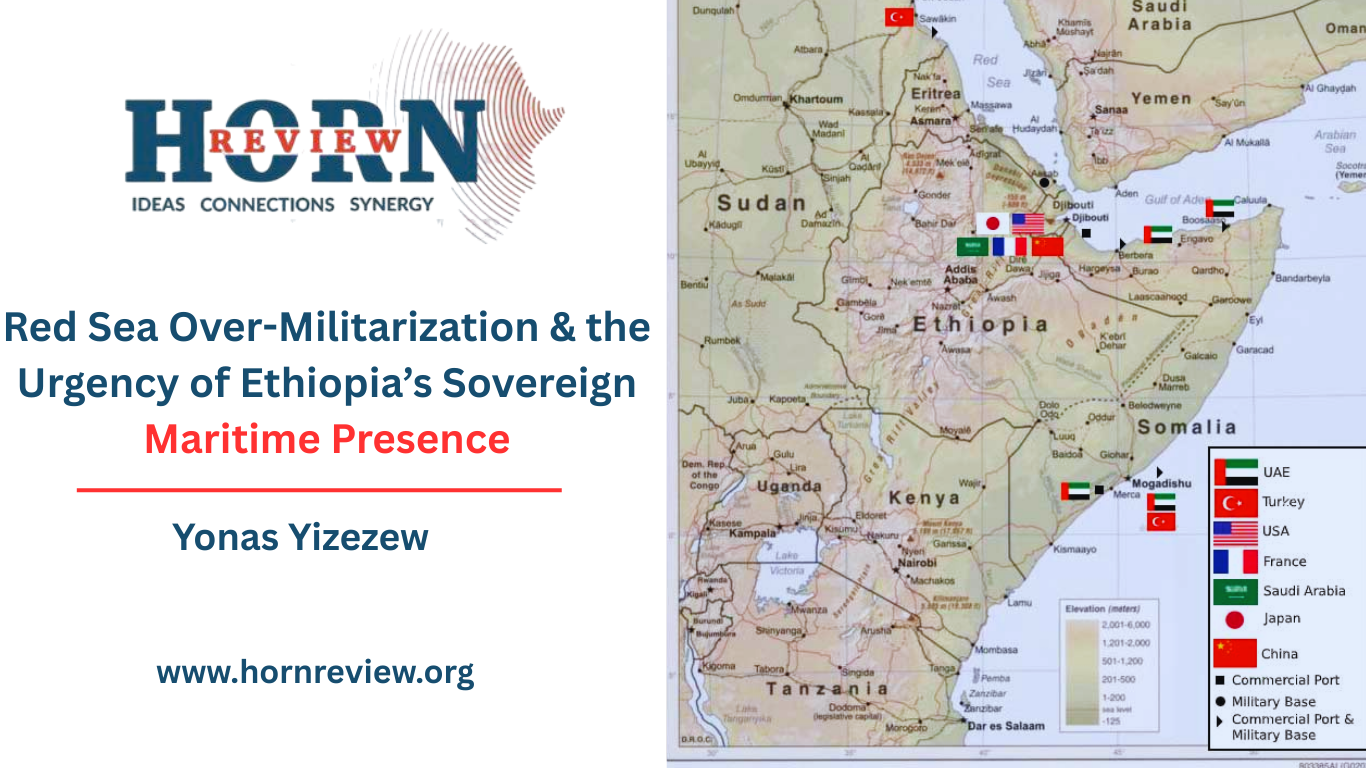
Red Sea security is no longer a distant abstraction for Ethiopia. It is an arena in which the survival, sovereignty and developmental trajectory of Africa’s second most populous state are increasingly entangled with a rapidly militarized maritime corridor. Over the last decade, the Red Sea has shifted to a core arena of global and Middle Eastern competition. Foreign powers have multiplied ports and military bases across Djibouti, Eritrea including UAE facilities that were dismantled, Sudan through an agreement with Russia and Somalia transforming the Horn into a pivotal junction between the security systems of the Middle East, Indo Pacific and Mediterranean. Djibouti alone now hosts US, Chinese, French, Japanese and other foreign military facilities, with base rents and port-related services forming an important componentof its rent-based economy. However,Ethiopia’s transit trade remains the central pillarof Djibouti’s port revenues and overall economic model.
This build up has been accelerated by Gulf rivalries. Saudi Arabia, the United Arab Emirates, Qatar and Turkey have invested in ports and bases along the Red Sea and Gulf of Aden both in the Yemen war effort and to secure long term positions in the corridor’s logistics and energy economy. Their competition raises the risk of proxy conflict as definitions of stability diverge and each seeks to check rivals including Iran and Turkey. Since late 2023, Houthi attacks on shipping around Bab al Mandeb have turned these structural trends into an acute security crisis. Drone and missile strikes on commercial vessels have forced widespread rerouting, cut Suez Canal traffic and undermined confidence in freedom of navigation. The result is a hybrid Red Sea order where land based insurgents, foreign navies, Gulf monarchies and extra regional powers converge, and where the line between coastal and hinterland security has effectively dissolved.
For states in the Horn, this environment creates both opportunities for rents and partnerships and heightened exposure to rivalries beyond their control. The war in Sudan has further intensified Red Sea militarization. What began as a conflict between Sudanese factions has drawn in multiple external states and private military actors, creating a proxy battlefield whose instability spills into neighboring littoral zones.
Moreover, Egypt’s deepening diplomatic, military and economic ties with Djibouti, Eritrea, Somalia and supporting SAF in Sudan civil war as one of the strategic effort to shape littoral alignments and, in practice, to constrain Ethiopia’s room for maneuver in securing reliable and sovereign Red Sea access. By upgrading port cooperation, signing defense pacts and exploring basing or logistical arrangements with these coastal states, Cairo increases Addis Ababa’s dependence on third-party gatekeepers and raises the political and operational cost of Ethiopia pursuing other routes. Driven in large part by Nile-water anxieties and a broader quest for regional influence, this posture creates structural leverage that amplifies Ethiopia’s vulnerabilities and makes the quest for sovereign, secured and diversified maritime access an urgent national-security and development priority. If not carefully managed, these dynamics could have serious repercussions for regional stability.
Ethiopia is deeply embedded in this emerging order yet lacks a coastline. More than 90% of its trade passes through Djibouti’s Red Sea ports, at annual cost of billions of dollars in port fees and related charges. These resources could otherwise finance infrastructure and social investment. Landlocked status also amplifies vulnerability. Ethiopia sits close to a maritime hub of military and economic activity but has no direct control over littoral space and no sovereign say in how coastal states and foreign navies manage threats that can easily spill inland. Rising great power rivalry in the Red Sea means that any escalation could disrupt Ethiopia’s lifeline corridors without Addis Ababa having meaningful influence over crisis management.
Domestically, previous administration framed ports as tradable commodities that could be purchased wherever cheapest. That view underestimated the security and political implications of dependence on neighboring coastal states and external powers. In the current administration, landlockedness has instead been recast as an existential constraint. Ethiopia’s leadership has described access to the Red Sea as vital for national survival and portrayed the country as trapped in a geographic prison. In this frame, Ethiopia contends that current arrangements, which force it to rely almost exclusively on Djibouti, impose a disproportionate developmental burden inconsistent with the spirit of UNCLOS and customary law on landlocked states.
The controversy illustrates a deeper dynamic. Faced with structural vulnerabilities and an increasingly militarized maritime neighborhood, Ethiopia is tempted to use its demographic weight and diplomatic leverage to recalibrate regional arrangements and recognition politics in search of sea access. At the same time, external powers are viewing Somaliland or other coastal entities as convenient strategic footholds.
A key evolution is the political decision to rebuild a national navy. Since 2018 naval reconstitution has been part of broader military reforms. This reflects two linked drivers. First is the ambition for regional leadership anchored in the ability to project security influence across the Red Sea and Indian Ocean. Second is the desire to protect maritime trade routes on which Ethiopian growth depends, even without sovereign coastline. Third, and increasingly central, is the recognition that securing sovereign access to the sea is an inevitable strategic imperative. This approach fits a wider rethinking of landlockedness. Rather than seeing geography as an unchangeable handicap, Ethiopia seeks to recast itself as a stakeholder in maritime governance through security partnerships, corridor investments and participation in negotiations on biodiversity beyond national jurisdiction and related global commons regimes.
The militarization of the Red Sea makes Ethiopia’s sea access imperative more urgent but also more constrained. Policy choices in the next decade will determine whether Addis Ababa becomes a responsible shaper of a fragile maritime order. Ethiopia’s quest for the sea is thus not a narrow territorial dispute. It is a litmus test for whether African states can collectively redefine their place in a crowded, contested maritime order that runs from Bab al Mandeb to the Suez Canal and beyond. The Red Sea corridor’s future depends either on continued competition and unstable alignments, or on collaborative legal frameworks, regional compacts, and shared understanding that security and access are indivisible.
By Yonas Yizezew, Researcher, Horn Review