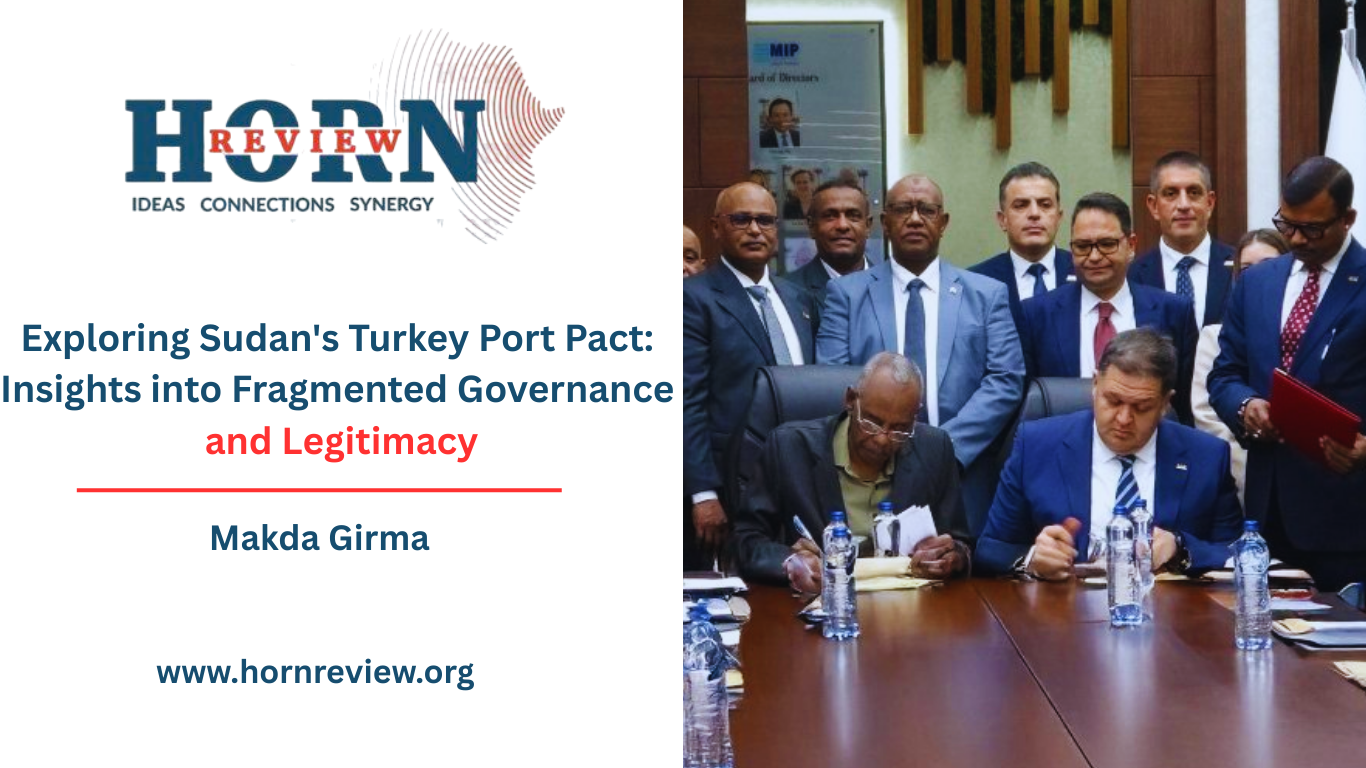
In the shadow of Sudan’s protracted civil war, a new bilateral agreement has emerged as a focal point for understanding the country’s complex political and economic terrain. On December 23, 2025, representatives from Sudan’s Red Sea State signed a twinning pact with Turkey’s Mersin Port, linking it to Port Sudan to facilitate expertise exchange in logistics, operations, and trade. This development, coming amid the ongoing clash between the Sudanese Armed Forces (SAF) and the Rapid Support Forces (RSF), reveals insights into Sudan’s fragmented governance and contested legitimacy. Turkey’s engagement adds another layer, driven by strategic interests in the Red Sea. With displacement figures surpassing 13 million and humanitarian crises intensifying, Port Sudan stands as a vital SAF-controlled asset. Through an analytical lens grounded in facts, this piece explores the accord’s implications, Turkey’s motivations, and stakeholder perspectives, highlighting dynamics without assigning fault.
At its heart, the agreement prioritizes practical collaboration, encompassing technical swaps and joint initiatives to modernize port functions. Stemming from recent Sudanese delegations to Mersin, it signals an effort to bolster Port Sudan’s resilience in wartime conditions. Streamlined cargo management and infrastructure upgrades address challenges in a facility strained by conflict. This fits Sudan’s urgent requirements, where ports are essential for survival. Lacking explicit military components, the pact’s emphasis on efficiency fortifies administrative capabilities in SAF-held regions. Turkey’s motivations align with its “Blue Homeland” doctrine, which, while centered on Mediterranean assertions, extends to Red Sea interests for strategic outreach. More pointedly, Ankara views this as a counterweight to the UAE’s influence in the Horn of Africa, especially given Abu Dhabi’s reported RSF support, leveraging humanitarian aid like recent tent deliveries and infrastructure partnerships as tools for soft power expansion.
Port Sudan serves as Sudan’s primary trade conduit, handling critical imports and exports amid the war’s disruptions. Under SAF oversight, it has become a humanitarian nexus, exemplified by the December 2025 shipment of tents from Turkey via Mersin. Extending beyond commerce, it functions as the base for the SAF’s “Hope Government.” In a divided landscape, dominion over such infrastructure equates to leverage. International alliances like this elevate SAF operations. The deal enhances logistics, supporting essential distributions during shortages. Locally, this intersects with the Beja community in eastern Sudan, whose longstanding complaints about unequal resource distribution and political marginalization, despite Port Sudan’s economic significance, fuel mixed reactions, as the pact overlooks their calls for greater inclusion.
The SAF’s territorial progress in 2025, including gains in al-Jazirah, has altered the conflict’s trajectory, consolidating eastern holds. Coupled with diplomatic moves like this pact, it underscores the SAF’s international viability. This shapes legitimacy views. The SAF portrays itself as the custodian of national unity on global stages. Though modest, the agreement demonstrates effective stewardship from Port Sudan. Turkey’s involvement heightens this, framing Ankara as a stabilizer for SAF areas, offsetting UAE competition while employing aid diplomacy to deepen Red Sea footholds without direct military entanglement.
The RSF’s establishment of a provisional constitution in April 2025 has intensified divisions, creating parallel authority structures. The December 2025 Nairobi roadmap, associated with RSF-aligned factions, proposes civilian pathways but invites skepticism. In this context, the pact favors one side by reinforcing SAF assets. Omitting RSF territories, it underscores compartmentalized governance, deepening silos. Regionally, responses vary: Egypt and Saudi Arabia, often aligned with the SAF, endorse it as a step toward stability in collaboration with Turkey, whereas the UAE, facing scrutiny over RSF ties, perceives it as a setback to their regional ambitions. Internationally, the UN and AU, advocating for Sudanese-led resolutions without military dominance, greet such pacts ambivalently, supporting them if they promote peace but cautioning against foreign meddling that undermines unity.
Escalating rhetoric, including online hate speech, has widened fissures, with both sides contesting legitimacy. The SAF resists RSF incorporation, branding it a rival entity. Here, agreements like the twinning influence narratives. Elevating Port Sudan aids the SAF in challenging RSF assertions. These pacts offer avenues for global interaction, shifting representations of Sudan. Turkey’s strategy capitalizes on this to neutralize UAE proxy influences, merging rivalry with philanthropic outreach in Red Sea affairs.
Mediation setbacks in 2025 highlight incompatible post-conflict visions. The SAF’s late-December push for “homemade” solutions seeks backing without RSF merger. Aligned with the pact’s timing, it accrues tangible successes for credence. This prolongs schisms through solo endeavors. Evidence indicates competing administrations veiling military control in civilian terms. The AU and UN evaluate how these bilateral ties integrate into holistic talks, stressing non-partisan approaches.
Economic dimensions underpin legitimacy, with port earnings sustaining claims. Discussions on Port Sudan’s activities, such as the December 17 logistics session, emphasize its aid and trade roles despite obstacles. The twinning amplifies efficiency, benefiting SAF zones. This strengthens the SAF’s internal position. RSF areas maintain independent local systems. Sudan’s substantial debts, approximately $18 billion to China and $4.4 billion in arrears to international financial institutions, introduce complexities: A Turkish alliance diversifies dependencies, aiding or hindering creditor dialogues with entities like the World Bank or IMF, while introducing fresh obligations if expanded economically.
Internal opposition underscores perceptions of Port Sudan-centric policies as exclusionary. Reports of reprisals in SAF territories, including evictions and dissent suppression, complicate inclusivity assertions. While not directly connected, the deal’s backdrop mirrors eastern power consolidation. Nonetheless, it enables humanitarian support, such as tent provisions. The Beja’s discontent intensifies if the accord bypasses their equity demands, intertwining local frictions with national rifts.
Sudan’s fragmentation extends regionally, burdening neighbors with refugee surges and volatility. The SAF’s selective engagements, shelving others in favor of this, demonstrate adaptability. Focused on trade, it affects governance perceptions. This suggests pragmatic eastern stabilization, though divergent strategies from Egypt, Saudi Arabia, and the UAE, ranging from alliance to contention,shape trajectories.
The agreement’s interface with peace efforts influences future paths, with the RSF rejecting ceasefires and the SAF upholding sovereignty. It acts as a confidence booster for one faction. This paves ways for dialogue or solidifies standoffs. Mediations continue despite challenges, with the UN and AU promoting impartial bilateralism that fosters cohesion.
Civilians strive for agency amid dual regimes, as factions incorporate non-military elements to enhance validity. The Nairobi initiative targets civilian advances, though linked to specific groups. Port Sudan’s operational emphasis aids civilian restoration in divided spaces. Turkey’s humanitarian focus contributes, rivaling UAE efforts.
Ultimately, the Sudan-Turkey port twinning, a targeted maritime collaboration, provides a prism for viewing late-2025 governance intricacies. It bolsters SAF eastern positions amid persistent fractures, enriched by Turkey’s geopolitical aims, Beja local concerns, regional power plays, and economic interdependencies. Grounded in facts, it depicts a web of contested authority where infrastructure intersects with politics. Ensuing pacts play roles in healing or heightening divides. As Sudan charts its course, sustained scrutiny of these forces is vital for grasping possible futures.
By Makda Girma, Researcher, Horn Review