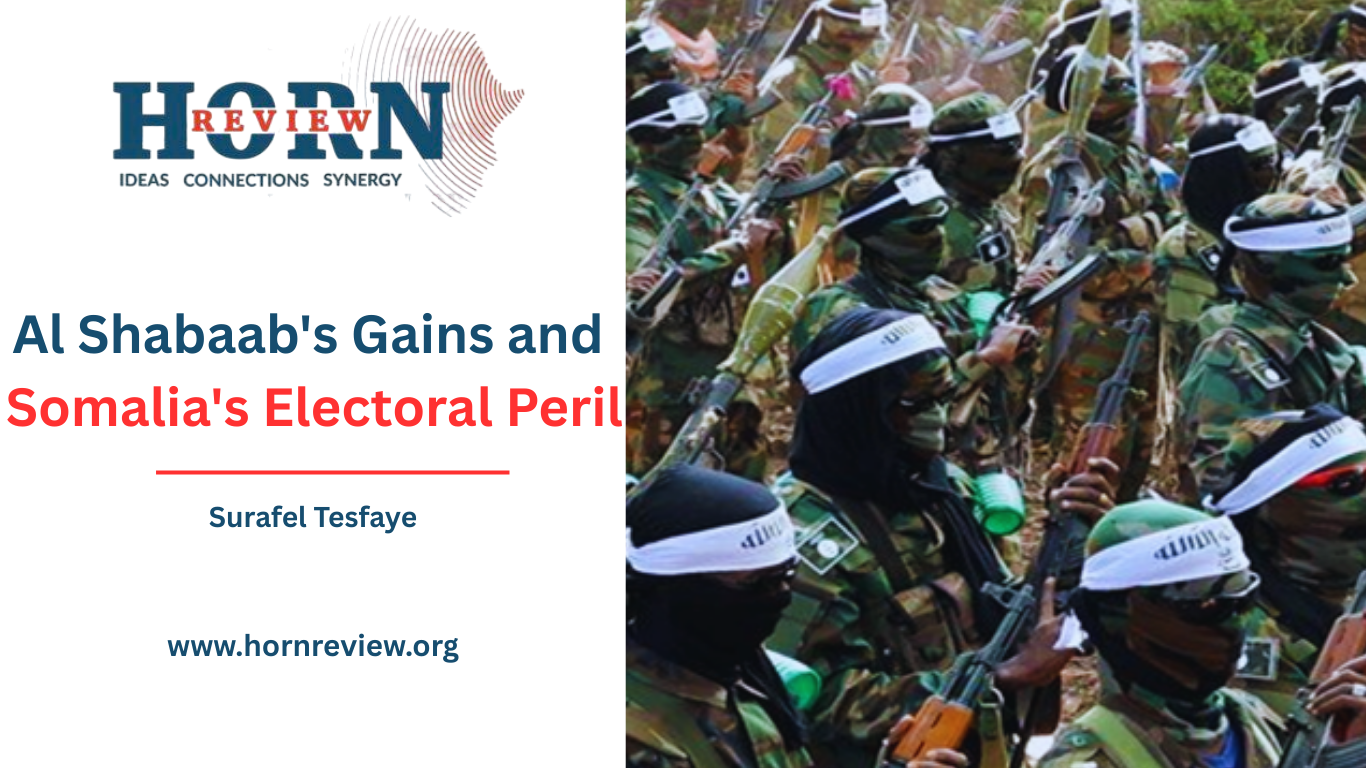
As December 2025 draws to a close in Mogadishu, Al Shabaab’s escalating assaults on Somali Federal Government (SFG) facilities have thrust the capital into its most vulnerable state in over a decade. The group has coordinated campaign, which included suicide bombings and attempted suicide attacks against military targets in early–mid December forms part of a broader spate of attacks that have exposed persistent security gaps in the city and its approaches.
These strikes, which employed vehicle-borne explosives and small-arms ambushes, sit atop a broader upward trend in operations through 2025. Regional developments have also given militant groups greater access to advanced systems: reporting and analyst work indicate deepening contacts between Yemen’s Houthis (Ansar Allah) and Somali militants, including exchanges that could enable the transfer of unmanned aerial systems and related technical expertise. This has altered the operational calculus of urban attacks and complicated traditional defensive postures.
Far from random violence, the December wave exploits deepening political fractures over electoral reform. The SFG’s contentious pilot of one-person-one-vote procedures in Mogadishu municipal polls has provoked fierce regional opposition; several federal member states notably Puntland and Jubaland view the move as a centralizing step that undermines negotiated power-sharing arrangements. Opposition meetings and declarations this month, including high-level gatherings in Kismayo and elsewhere, signal a credible threat of boycotts or parallel processes. Those disputes have tangible security effects: resources diverted to manage protests, registration disputes, and related political standoffs reduce attention and man power at urban perimeters, creating vulnerabilities exploited by militants.
Al Shabaab has explicitly branded the elections “apostate” endeavors, vowing to intimidate voters through targeted strikes on polling hubs and candidates a deliberate strategy to delegitimize results and amplify chaos. This mirrors historical patterns in which electoral delays and political disorder in 2020–2021 correlated with escalations in militant attacks, rural consolidations, and state authority erosion. In the present context, the municipal pilots are a litmus test: a failed or disrupted process risks cascading distrust, fragmenting alliances, and providing Al Shabaab with narrative ammunition to portray the SFG as ineffective or externally manipulated.
Territorially, Al Shabaab’s 2025 Shabelle offensive has reversed several earlier gains by the government and AU-backed forces in central and southern Somalia. The group has retaken and contested strategic towns like Adan Yabaal, Moqokori, Tardo, and Buq-Aqable to form a “strategic triangle” in central Somalia and in Lower and Middle Shabelle offensive (operation Ramadan) moves that have reconnected support zones and enabled pressure on supply lines into Mogadishu. Analysts warn this posture functions as a form of encirclement: control of key nodes and roads allows the group to impose taxation and extortion, choke commerce, and sustain forward operations against the capital.
The Afgooye corridor a roughly 30-kilometer axis west of the capital that hosts large displaced populations doubles as a recruitment, logistics, and extortion nexus. Although government and AUSSOM operations “Operation Silent Storm” (notably a joint offensive in June) have intermittently contested these areas, the corridor continues to enable economic and human flows that feed urban insecurity.
Across rural zones, Al Shabaab administers shadow courts, collects revenue, and delivers a minimal governance package in places where the state is absent; this hybrid governance improves the group’s resilience and local embedding.
Analysts increasingly draw comparisons with other cases of insurgent governance Kabul after the Taliban’s return and areas of Syria where HTS held sway. These analogies are useful but for the time being they are imperfect: Al Shabaab’s campaign in 2025 appears to favor methodical encirclement and exhaustion over the rapid, decisive urban collapse seen in Afghanistan. A crucial difference is the sustained international and regional force posture around Somalia.
AUSSOM the African Union Support and Stabilization Mission in Somalia continues to play a central stabilizing role. The UN Security Council and AU have been engaged in reauthorization and resource discussions to sustain the mission through the coming year; the mission provides a key buffer for Mogadishu during the electoral period, but its effectiveness depends on political cohesion among contributors and reliable funding.
Concurrently, U.S. and partner strike activity has increased in December, with AFRICOM conducting airstrikes against militant concentrations in mid-December. Such strikes can disrupt hostile concentrations and degrade capabilities, but they do not on their own resolve the political drivers that empower insurgent expansion.
International contributions including regional states and other partners blunt the immediate risk of a rapid regime collapse. Yet their presence also creates conditionality’s and competing strategic interests: some partners prioritize denying militant sanctuaries and protecting their borders; others advance influence through security cooperation. These dynamics complicate unified mission command and burden political coordination inside AUSSOM and between the AU, UN, and the SFG.
Political unity or the absence of it remains the SFG’s strategic vulnerability. Al Shabaab’s organizational coherence contrasts starkly with Somalia’s persistent clan and federal-state rifts. That fragmentation both undermines national coordination and simultaneously limits the militants’ ability to impose uniform rule, since many clans resist domination to preserve local autonomy. Local militias (macawisley) and clan forces have, at times, effectively pushed back for example, sub-clan mobilizations rooted in Hawiye and Rahanweyn areas have repelled incursions or disrupted supply lines. These grassroots forces prevent outright, immediate conquest of Mogadishu but are hampered by limited heavy weaponry, weak central coordination, and internal rivalries that Al Shabaab seeks to exploit.
The presidential and parliamentary elections scheduled in the first half of 2026 are the primary political trigger. If the broader process remains unresolved or if key, deadlines are missed and if boycotts or parallel institutions emerge, a legitimacy crisis could widen governance gaps that Al Shabaab will exploit. The group’s objective is not necessarily an immediate, dramatic capture of Mogadishu; rather, it pursues a strategy of exhaustion and attrition: intimidating voters, infiltrating and undermining institutions, and using economic coercion on critical supply lines (for example, the Mogadishu–Afgooye and Mogadishu–Balcad arteries) to isolate and squeeze the capital.
As of late December 2025, an outright, immediate military fall of Mogadishu remains unlikely: AUSSOM forces, partner strikes, and clan resistance provide important buffers. Nevertheless, the “Afghanization” risk understood here as slow-motion erosion of state capacity, legitimacy, and territorial integrity grows if political consensus collapses and international coordination falters. Al Shabaab’s de facto dominance over parts of the periphery, combined with electoral sabotage and infrastructural strangulation, could render the SFG increasingly nominal.
The present threat is therefore not an “invasion” that happens overnight, but a protracted “exhaustion” strategy, in which the government is slowly suffocated by isolation, political infighting, and economic pressure until it can no longer exercise effective sovereignty. To avert that outcome, the SFG and its partners must pursue credible, inclusive political settlement measures, secure and sustain AUSSOM’s operational capacity, and prioritize civilian governance interventions in contested peripheries so local populations have tangible alternatives to shadow rule.
By Surafel Tesfaye, Researcher, Horn Review