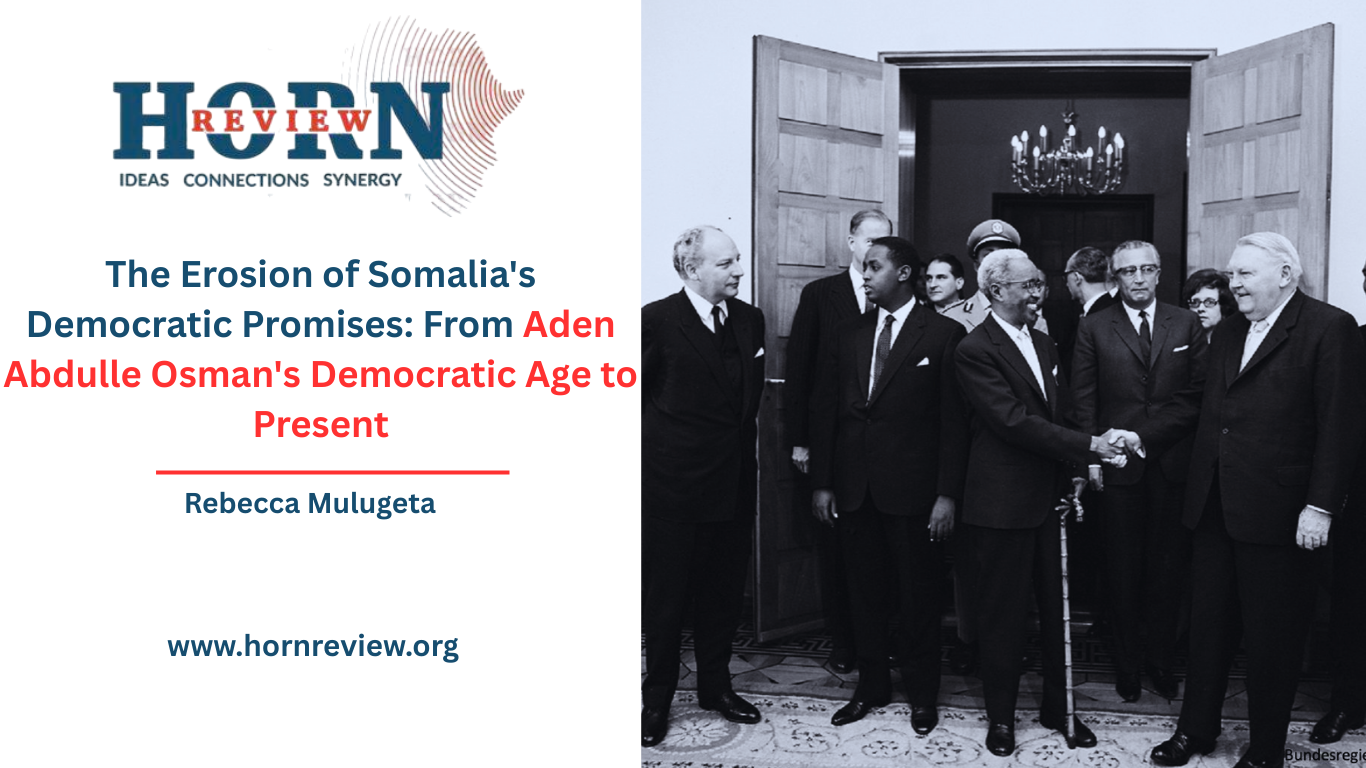
In the expansive skies over the Horn of African region in 1964, Somalia presented a living testament to the possibilities of democracy. Long queues of nomadic herders from the Juba Valley, traders from Mogadishu, and elders from the historic streets of Hargeisa waited tirelessly to press their thumbs into ink. An unprecedented 84% turnout of 1.8 million registered voters picked that moment as the ultimate achievement under Aden Abdulle Osman’s administration, the peak of Somali democracy. This parliamentary republic, born out of the union of British Somaliland and Italian Somalia in 1960, buzzed with an array of a staggering 82 political parties vying for a place within a National Assembly consisting of 123 members.
Aden Osman, the president of Somalia, ruled the nation with the soft touch of courage that established schools in land that had been parched and cracked. Legislative chambers buzzed with unfettered debate, judicial independence rigorously checked executive authority, a vibrant free press disseminated opposition critiques without censorship, and state-building initiatives flourished that schools proliferated across arid pastoral interiors, roads interconnected isolated clan enclaves, and military modernization proceeded without Barre-era centralist excesses. Osman’s pursuit of irredentism emphasized calibrated diplomacy over militarism, fostering pan-African solidarity while his dignified 1967 electoral defeat by Abdirashid Ali Shermarke accepted without contest affirmed accountability, peaceful power transfer, and popular sovereignty as bedrock principles.
However, cracks began to emerge beneath this veneer of optimism. The Darod clan became paramount in government employment, displacing the majority Hawiye and minority Digil-Mirifle clans to secondary positions. Expenditures reached staggering levels, bordering on imperialism, weakening the economy. The earliest indications revealed a clan influence seeping into mainstream politics, and nooks of elite agreements corroding the foundations of democracy. However, in 1969, the killing of Shermarke paved the way for a Siad Barre coup, which led Somalia away from its path of democracy.
However, after twenty-one years of stern governance, Barre’s regime dislodged Osman’s entire nation. There was talk of providing education for every citizen, but with the 1977 Ogaden War against Ethiopia, the economy disintegrated. Prices skyrocketed, savings evaporated, and refugees thronged every border while a tightening noose of clan rivalry turned savage. Then, in 1988, the Isaaq killing bombed Hargeisa with 50,000 deaths and another 500,000 uprooted from their homes, Somaliland’s most dreadful moment. Uprisings among Hawiye and Ogaden soon ensured further disintegration. By 1991, the state itself began unraveling. Mohamed Farrah Aidid’s clique turned Mogadishu into a bloody maze of snipers & armed convoys. After 1992, Barre’s unitary state disrespected Osman’s warnings of a federal distribution of power for enough, using clan affiliations to accelerate self-destruction.
A glimmer of hope emerged in 2004 with Abdullahi Yusuf Ahmed, a man who had already built Puntland State into a solid foundation since 1998, complete with operational ports, a police force, and a court system. Under his solution of formula 4.5, he allocated seats to a total of 275 members of parliament from among the four major clans and then included representatives of minority clans. His efforts also relocated the seats of power in parliament, which was originally ensconced in a safe haven in Nairobi, to the danger-zone city of Baidoa, later to a suburb of Mogadishu, reviving trading routes, which finally allowed a legitimate election in the year 2009, recognized by no less than the United Nations. Puntland State proved federalism could be made to thrive on a small level. However, this was short-lived. Clan rivalry saw his dismissal of three prime ministers, IGAD imposed sanctions, and due to his alliance with the CIA, warlords made a return. By this time, in 2008, he resigned, which proved that there could be a successful transitional federalism on a local arena, but not on a national platform.
In 2006, another road swung open that the Islamic Courts Union came forward from local Sharia courts that had been arbitrating disputes since 1991. United, eleven factions tossed out the warlords and brought a semblance of order to Mogadishu. Checkpoints disappeared, Aden Adde Airport stirred from its 15-year slumber, and trade costs were halved between Kismayo and the capital, while militias were remolded into disciplined forces. Justice was harsh but no clan received favoritism. Under Sharif Sheikh Ahmed, leadership bridged clan divides, protecting minorities and even battling pirates. UN officials dubbed it a “golden era.” American fears of al-Qaeda provoked an invasion. The moderate courts were dissolved, but their youth wing morphed into Al-Shabaab, mutating nationalist discontent into terror.
Al-Shabaab’s rise devastated Somalia. By 2009 they controlled southern ports and 40% of territory despite AMISOM retaking Mogadishu in 2011. Attacks shocked the world, the Westgate Mall siege, Garissa University massacre, Mogadishu truck bombs killing. Hassan Sheikh Mohamud and Mohamed Farmajo made gains with U.S. drones and Gulf money, but corruption ate aid budgets, clan exclusion fueled recruitment, and indirect “clan caucus” elections kept warlords in power. As 2025 AMISOM withdrawal approaches, Al-Shabaab survives by exploiting weak governance.
The 2012 Federal Government constitution created five Federal Member States through Garowe talks Puntland, Jubaland, Galmudug, Hirshabelle, South West. This promised to fix Barre’s centralism with Yusuf’s decentralization. But unclear borders, disputed port revenues, and Mogadishu’s undefined status created endless conflicts. Farmajo sent troops to Jubaland and ignored Puntland, facing resistance. Today federalism is paralyzed in Somalia, Garowe runs a parallel government to Mogadishu, Jubaland defies the center, aid is frozen over money disputes, Al-Shabaab taxes divided trade routes. The 4.5 formula became elite corruption, ordinary people call federalism “foreign-made,” while foreign actors play favorites. Instead of unity, federalism scattered Barre’s warlordism into regional versions.
What connects Osman’s democracy to today’s fragmentation? Empty spaces in the system, unclear rules that elites fill with clan deals, outsiders exploit with money and weapons, anger grows in the gaps. Every revival repeats the same mistakes. Now 2026 elections are approaching Somalia’s one moment. President Hassan Sheikh Mohamud promises “one person, one vote,” starting with Banadir local elections, the first direct vote since Osman’s time. This aims to end clan caucus elections.
Danger lurks nearby. Countries are demanding elections be held, threats of bombings by Al-Shabaab, reminiscent of the attacks in Baidoa, and a reminder of last year’s violent election process by supporters of president-elect Mohammed Abdullahi Mohammed, known as Farmajo. Outside countries are also taking sides, foreign actors supplying weapons to rival groups. Without firm security agreements and financial support, the electoral process could quickly descend into chaos. Somalia requires action more than words. In the photograph of a 1964 herder proudly displaying ink on his thumb, and today’s rumors of disunity, Somalia makes it clear how a democracy can die not quickly, but through the absence left at the top through leadership. Will 2026 restore Osman’s vision for a federal unity, or disintegrate Somalia into fragments controlled by terror and warlords? The answer is up to the Somalis.
By Rebecca Mulugeta, Researcher, Horn Review
.