By Blen Mamo
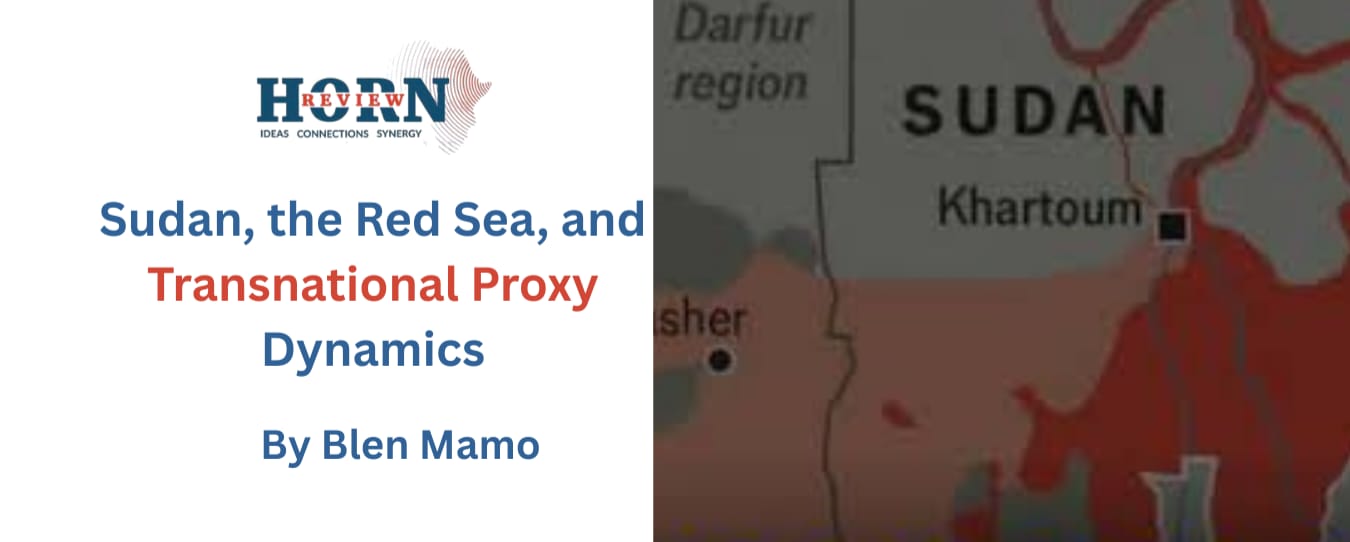
Sudan’s ongoing crisis cannot be apprehended as a mere contest between the Sudanese Armed Forces (SAF) and the Rapid Support Forces (RSF); it constitutes a manifestation of profound structural realignments whose ramifications extend across the Horn of Africa, the Red Sea, and beyond. Ideological networks, transnational proxy alignments, maritime strategic competition, and great-power maneuvers converge within a theater that overlaps Ethiopia’s traditional sphere of influence and one of the world’s most consequential maritime arteries, where each operational choice entails systemic consequences. This multifaceted environment establishes the stage upon which internal actors, regional powers, and transregional stakeholders interact, often with overlapping or contradictory agendas.
Eritrea occupies a pivotal position within this ecosystem. Under President Isaias Afewerki, Eritrea functions as a force multiplier and shadow actor in Sudan, systematically destabilizing the country through direct military intervention, logistical facilitation, and transnational ideological coordination. Eritrea aligns closely with General Abdel Fattah al-Burhan and coordinates with Egypt – the former leveraging Sudan as a pressure point against Ethiopia, the latter employing it as a bargaining instrument in Nile River disputes. Reports indicate that Eritrean operations have utilized the Gash-Barka region as a logistical corridor and platform for force projection, deploying more than a thousand personnel from its army divisions, including mechanized units and drone-capable specialists, to strategic locations such as Gargar and Al-Qutaina, while arms shipments and trained operatives have transited via Tessenei to Kassala and in camouflaged movements toward Gedaref and Wad Sayidna near Khartoum. Eritrea has also reportedly received aircraft carrying weaponry into Asmara and provided sanctuary to Sudanese Air Force pilots, maintaining a duplicity in which it publicly presents itself as neutral while actively driving militarization on the ground. This combination of overt and covert engagement situates Eritrea as a key vector in shaping operational dynamics in Sudan and the broader Red Sea region.
Eritrea’s influence is institutionalized through a network of training and mobilization centers, including Sawa, Om Hager, Adi Bara, Ad Erser, Hashekit, and Hamelmalo Jengeren, which collectively have produced hundreds of combatants proficient in urban warfare, guerrilla operations, and operational coordination. A recorded graduation ceremony documented the completion of training for hundreds of trainees, while a parallel conscription pipeline recruited under the pretext of “community defense,” channeling them through Eritrean facilities into Sudanese operational theaters. Leadership nodes of Eritrean military officials, alongside SAF, exemplify the structured chain of command underpinning Eritrea’s regional interventions. These institutionalized mechanisms provide Eritrea with enduring leverage over Sudanese operations, ensuring continuity even in the face of local and regional volatility.
Eritrea’s operational posture is further amplified through the Tsimdo alliance, a strategic convergence between Eritrea’s PFDJ, the TPLF faction in Tigray, and select elements of the Amhara Fano movement, which aligns with Al-Burhan and El-Sisi to consolidate influence in Sudanese territories bordering Ethiopia, and inside Ethiopia. This arrangement situates Eritrea at the intersection of multiple conflict vectors: Ethiopian national security, Nile River geopolitics, and Red Sea maritime strategy, while embedding Sudan within a wider proxy and ideological architecture.
Egypt maintains active operational involvement, leveraging Eritrea and Sudanese alignments to influence Nile-related negotiations and project power regionally. Israel monitors these developments as potential threats to its security calculus, particularly given the alleged coordination between Sudanese, Iranian, Turkish and other proxy networks. Ethiopia, despite its landlocked status post 1993, confronts near-geostrategic encirclement, with the strategic logic resembling a regional variant of the Cuban Missile Crisis, wherein proximate deployment of adversary-aligned assets transforms latent threats into immediate strategic dilemmas. This framing positions Sudan not only as a national security concern but as a pivotal element in broader regional calculations.
Moreover, Sudanese institutional structures remain deeply entwined with transnational Islamist networks. Elements of SAF trace their organizational and ideological lineage to the Muslim Brotherhood, shaping external alignments and internal policies over decades. Individuals such as Abdelbasit Hamza, released after the 2021 Burhan-led coup, operate transnationally, facilitating high-profile operations including the October 7 Hamas attack in Israel. Other leaders, including Khalil Al Haya and Khaled Meshal, share comparable Sudanese affiliations, highlighting the broader networked role of the Muslim Brotherhood and allied political-Islamist movements in shaping the internal and external alignments of the SAF and RSF. Historical links extend further, with Sudan allegedly providing sanctuary to figures connected to Osama bin Laden in the 1990s and enabling the incubation of radicalized networks that persistently intersect with Eritrea’s Al-Shabaab strategy and Egypt’s, alongside other state actors’ regional strategic objectives. The confluence of these factors underscores how Sudan’s internal fragilities create openings for both ideological and strategic external influence.
Turkey’s engagement in Sudan complements and complicates the conflict’s dynamics. Drawing on patterns observed in Somalia and Libya – where Ankara has exercised influence through training, infrastructure, and control over strategic nodes – Turkey leverages formal military cooperation and arms transfers to extend operational reach along the Red Sea corridor. These activities intersect with Iranian-aligned proxies, including the Houthis, creating a layered network of influence that shapes regional maritime and strategic calculations. Within Sudan, Turkish involvement operates alongside Eritrean interventions, Egyptian strategic priorities, and Islamist-aligned networks connected to the Muslim Brotherhood, situating Ankara as a vector of external influence that amplifies the interaction between internal vulnerabilities and broader geopolitical contestation.
Saudi Arabia and the United Arab Emirates operate as calibrated partners to the conflicting parties, engaging primarily through advisory, logistical, and selective material support to factions aligned with broader regional strategic objectives. Their involvement intersects with the ideological landscape shaped by decades of Muslim Brotherhood influence within Sudanese state and military institutions, including the SAF and RSF, which have historically mediated transnational Islamist networks. By reinforcing actors capable of counterbalancing Brotherhood-affiliated influence – or alternatively shaping their operational decisions – Riyadh and Abu Dhabi exert indirect leverage over Sudanese power dynamics, particularly within the Red Sea corridor, while maintaining alignment with their broader interests in regional stability, maritime security, and the containment of ideologically motivated networks that could threaten allied states. This underscores how regional actors calibrate engagement to maximize strategic influence while minimizing overt exposure.
At the transregional level, the United States and the Europeans are profoundly invested in ensuring that the conflict in Sudan does not conclude in a manner adverse to their strategic interests. Meanwhile, Russia is re-negotiating a quarter-century naval basing arrangement in Sudan, an initiative initially negotiated under Omar Al-Bashar’s leadership, designed to accommodate nuclear-capable vessels, thereby consolidating a new strategic foothold in the Red Sea. Collectively, these interventions illustrate the highly contested transregional environment in which Sudan operates, where multiple powers project influence simultaneously through both direct and proxy mechanisms.
The cumulative effect of all the aforementioned external engagements is a highly militarized and ideologically saturated Red Sea corridor, embedding Sudan as both a proxy battlefield and a staging area for broader regional maneuvers. The presence of Islamist-linked actors within Sudanese institutions, historical links to transnational militancy, and coordination with regional and global powers generates a multi-dimensional threat environment that extends well beyond Ethiopia to Israel, the Gulf, and Western security interests, emphasizing the necessity for nuanced, multiscalar strategic responses.
Authors Bio
Blen Mamo is Executive Director of Horn Review and a researcher specializing in law, international security, and geopolitics in the Horn of Africa. She holds an LL.B and an M.Sc. in International Security and Global Governance