
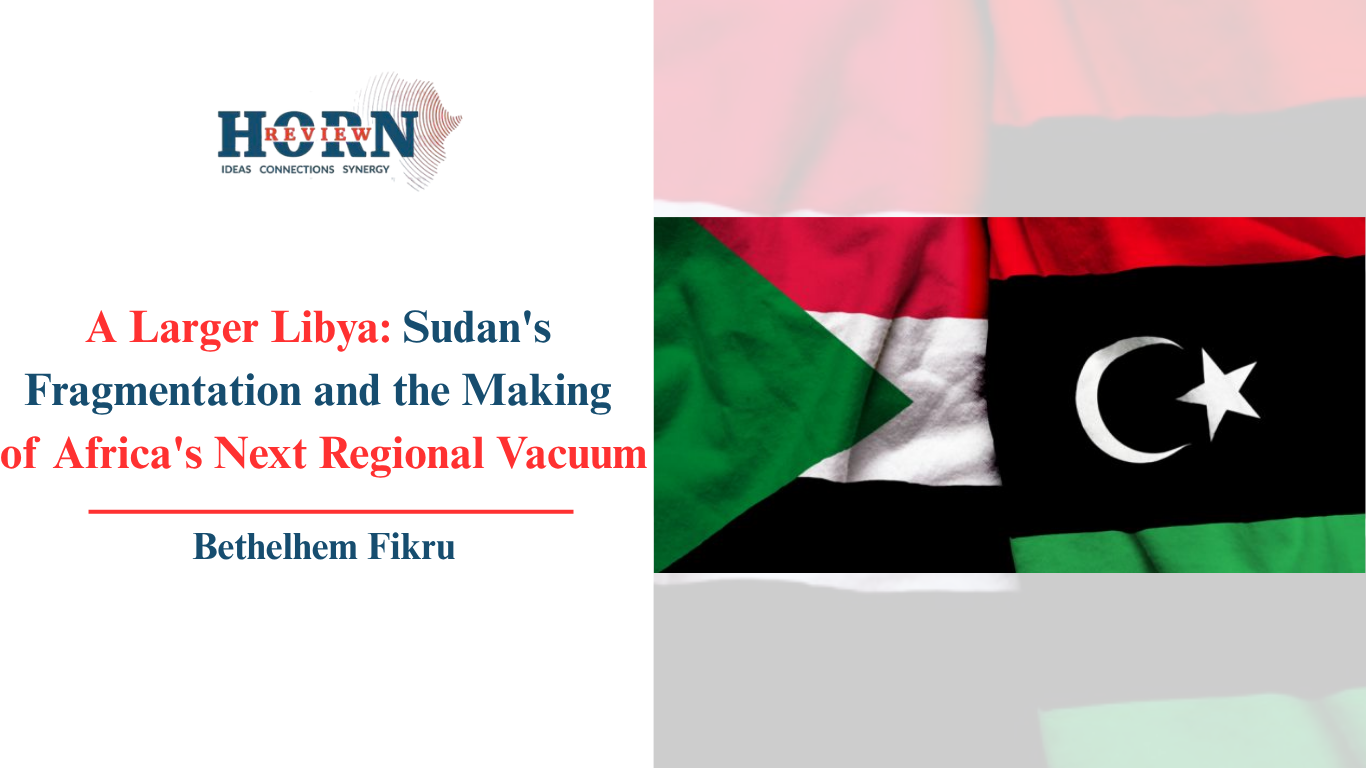
A Larger Libya: Sudan’s Fragmentation and the Making of Africa’s Next Regional Vacuum
The war in Sudan is increasingly discussed through the framework of the “Libya scenario,” but the connection between the two crises extends beyond a simple comparison between fragmented states. Sudan is not merely beginning to resemble post-2011 Libya; rather, Libya’s collapse fundamentally reshaped the regional security environment that later accelerated Sudan’s own fragmentation. The destruction of centralized authority in Libya after 2011 transformed large parts of North Africa, the Sahel, Central Africa, and the Horn of Africa into an increasingly militarized geopolitical space defined by uncontrolled weapons proliferation, transnational armed networks, proxy competition, trafficking economies, and weakened state structures. Libya’s fragmentation therefore did not remain an isolated national crisis. It produced a wider regional vacuum that weakened surrounding security architectures and intensified instability across interconnected regions, including Sudan.
Before Libya’s collapse, Sudan already faced deep structural crises rooted in center-periphery inequality, militarization, exclusion, and unresolved conflicts in Darfur and other marginalized regions. However, the destruction of centralized authority in Libya dramatically intensified these vulnerabilities. The collapse of the Libyan army, the institutionalization of armed militias, and the emergence of competing centers of power under rival political authorities transformed Libya into one of the region’s largest sources of weapons proliferation and cross-border militarization. Vast quantities of arms flowed across porous borders into the Sahel, Chad, Central Africa, and Sudan, strengthening insurgent networks, armed groups, smuggling economies, and militia structures across the region. Libya’s fragmentation therefore did not merely create instability inside Libya; it produced a wider regional vacuum that fundamentally altered the political and security landscape surrounding Sudan.
This transformation was particularly significant because Sudan already occupied a strategic geographic position linking North Africa, the Sahel, Central Africa, the Horn of Africa, and the Red Sea corridor. As Libya weakened, Sudan increasingly became exposed to the consequences of regional militarization. Armed networks, mercenary movements, trafficking routes, ideological actors, and conflict economies expanded across previously controlled spaces. The erosion of Libyan state authority created an environment in which weapons, fighters, and armed financing mechanisms could circulate more freely across interconnected regional conflicts. The destabilization of Libya effectively weakened the broader regional security architecture that once helped contain transnational militarization.
In this sense, Libya’s fragmentation became part of the structural environment that accelerated Sudan’s own descent into conflict. The current war between the Sudanese Armed Forces and the Rapid Support Forces now reflects many of the same patterns that emerged in post-2011 Libya rival military centers claiming national legitimacy, competing governance structures, external proxy involvement, territorial fragmentation, and war economies increasingly disconnected from centralized state authority. Similar to Libya’s division between eastern authorities under Khalifa Haftar and western Tripoli-based structures, Sudan is gradually evolving into separate zones of military and political control. The SAF maintains state institutions centered in Port Sudan and parts of northern and eastern Sudan, while the RSF has consolidated influence across much of Darfur and parts of Kordofan alongside attempts to institutionalize alternative administrative structures.
The danger, however, is that Sudan’s fragmentation may become even more severe than Libya’s because Sudan’s structural composition is fundamentally more complex. Libya’s conflict evolved largely through competing military-political coalitions concentrated around east-west divisions. Sudan’s fragmentation risks becoming far more diffuse and multilayered. Sudan possesses a significantly larger population, wider ethnic and regional diversity, deeper center-periphery tensions, and broader geographic exposure. The country borders seven fragile or conflict-affected states and connects multiple highly sensitive geopolitical arenas simultaneously: the Red Sea, the Nile Basin, the Sahel, and the Horn of Africa. If Sudan fragments further, the consequences will not remain internal. They will reshape the wider African security environment.
This is why Sudan’s crisis cannot be understood merely as a domestic civil war. The collapse of Sudanese statehood would likely produce cascading regional consequences across eastern and central Africa. Darfur, Kordofan, Blue Nile, eastern Sudan, and peripheral regions could gradually evolve into semi-autonomous militarized spaces connected through trafficking economies, armed patronage networks, and external sponsorship. Refugee flows, arms proliferation, insurgent mobility, and proxy competition would intensify across already fragile neighboring states. In such a scenario, Sudan would not fragment neatly into two rival entities. It could instead evolve into multiple overlapping zones of militarized authority, producing a wider regional arc of instability stretching from the Sahel to the Horn of Africa.
This possibility is especially dangerous because Sudan already possesses a historical precedent for fragmentation through the independence of South Sudan in 2011. Partition was widely viewed as a political solution to decades of conflict, yet it failed to produce lasting stability either in Sudan or in South Sudan itself, which later descended into internal civil war and political fragmentation. The lesson from South Sudan is critically important: territorial separation alone cannot resolve structural crises rooted in exclusion, militarization, unequal governance, and weak state institutions. Sudan’s current crisis therefore reflects not only a Libya-style trajectory of fragmentation, but also Sudan’s own unresolved historical cycle of incomplete state formation.
The most urgent priority, therefore, is freezing the conflict before Sudan’s fragmentation becomes irreversible. This does not mean accepting permanent division or institutionalizing rival sovereignties. Rather, it means preventing the hardening of current frontlines into enduring political borders while a broader political process begins. The longer the war continues, the more likely it becomes that military lines of control will transform into permanent territorial realities supported by separate economies, governance systems, and external alliances. Once this process deepens, rebuilding unified state authority becomes exponentially more difficult.
Freezing the conflict is therefore not a final solution, but a strategic necessity to preserve the possibility of Sudanese statehood itself. Sudan cannot survive another historic rupture similar to South Sudan’s separation. More importantly, the current conflict carries an even greater danger because fragmentation today would likely not stop at a single partition. If the war continues unchecked, Sudan risks evolving into multiple fragmented centers of authority across Darfur, Kordofan, eastern Sudan, and other marginalized regions. Such a scenario would not simply create another divided state; it could generate a wider regional security vacuum similar to the one produced by Libya’s collapse, but on a much larger and more interconnected scale.
For this reason, a civilian-centered parallel three-track framework is essential. The first priority must be immediate humanitarian access through humanitarian corridors, civilian protection mechanisms, and unconditional aid delivery to affected populations. Sudan’s humanitarian catastrophe cannot remain hostage to military calculations while displacement, famine, and institutional collapse deepen across the country. However, humanitarian intervention alone cannot preserve Sudanese statehood.
The second and third tracks , cessation of hostilities and political solutions , must therefore move together simultaneously. This is the central political imperative of the crisis. A ceasefire without political negotiations risks becoming merely another pause for rearmament and territorial consolidation. At the same time, political dialogue without freezing the conflict lacks credibility because negotiations remain shaped entirely by battlefield dynamics. The cessation of hostilities track must therefore focus on freezing conflict lines, reducing violence, protecting civilians, and preventing further territorial fragmentation through monitoring mechanisms supported by regional and civilian oversight.
Yet freezing the conflict alone is insufficient unless accompanied by an inclusive political process capable of addressing the structural roots of Sudan’s instability. Military victory alone cannot restore legitimacy, national cohesion, or sustainable peace. Sudan’s crisis is fundamentally political, rooted in decades of exclusion, unequal governance, militarization, and unresolved center-periphery tensions. The political process must therefore remain civilian-centered and include resistance committees, women, youth, political parties, civil society actors, and representatives from marginalized regions. Only a genuinely inclusive settlement addressing governance, justice, security sector reform, constitutional restructuring, and regional inequalities can preserve Sudan’s future as a unified state.
Within this context, Ethiopia holds a particularly important regional role through its position within the African Union Peace and Security Council and the Intergovernmental Authority on Development. Ethiopia is geographically and strategically tied to Sudan’s stability and remains capable of convening regional diplomacy. One of Libya’s greatest failures was the fragmentation of mediation initiatives into competing international tracks shaped by external rivalries. Sudan cannot afford a similar diplomatic fragmentation. Ethiopia can help coordinate regional mediation, reduce proxy escalation, facilitate inclusive Sudanese dialogue, and protect a civilian-centered political framework capable of preventing irreversible state collapse.
Ultimately, Sudan’s crisis is no longer only about a struggle between two armed actors. It is about whether another large African state will descend into the same regionalized fragmentation that emerged after Libya’s collapse. Libya’s weakness helped create the wider environment of militarization and instability that now surrounds Sudan. If Sudan itself collapses into prolonged fragmentation, the consequences may extend even further across Africa, producing a new arc of instability stretching from the Red Sea and the Horn of Africa into Central Africa and the Sahel. Preventing that outcome requires more than temporary ceasefires or military calculations. It requires freezing the conflict before fragmentation hardens into permanent reality while simultaneously advancing an inclusive civilian-centered political process capable of preserving Sudanese statehood before it fractures beyond recovery.
By Bethelhem Fikru, Researcher, Horn Review

RELATED
Posts
12
Jul
Army 70, Tsimdo, and the Fight for Kurmuk
A drone strike on the evening of July 10 struck...
21
May
The Necessity of Reconstituting Civilian Political Order in Sudan
The conventional foreign policy frame casts Sudan’s war as a...