
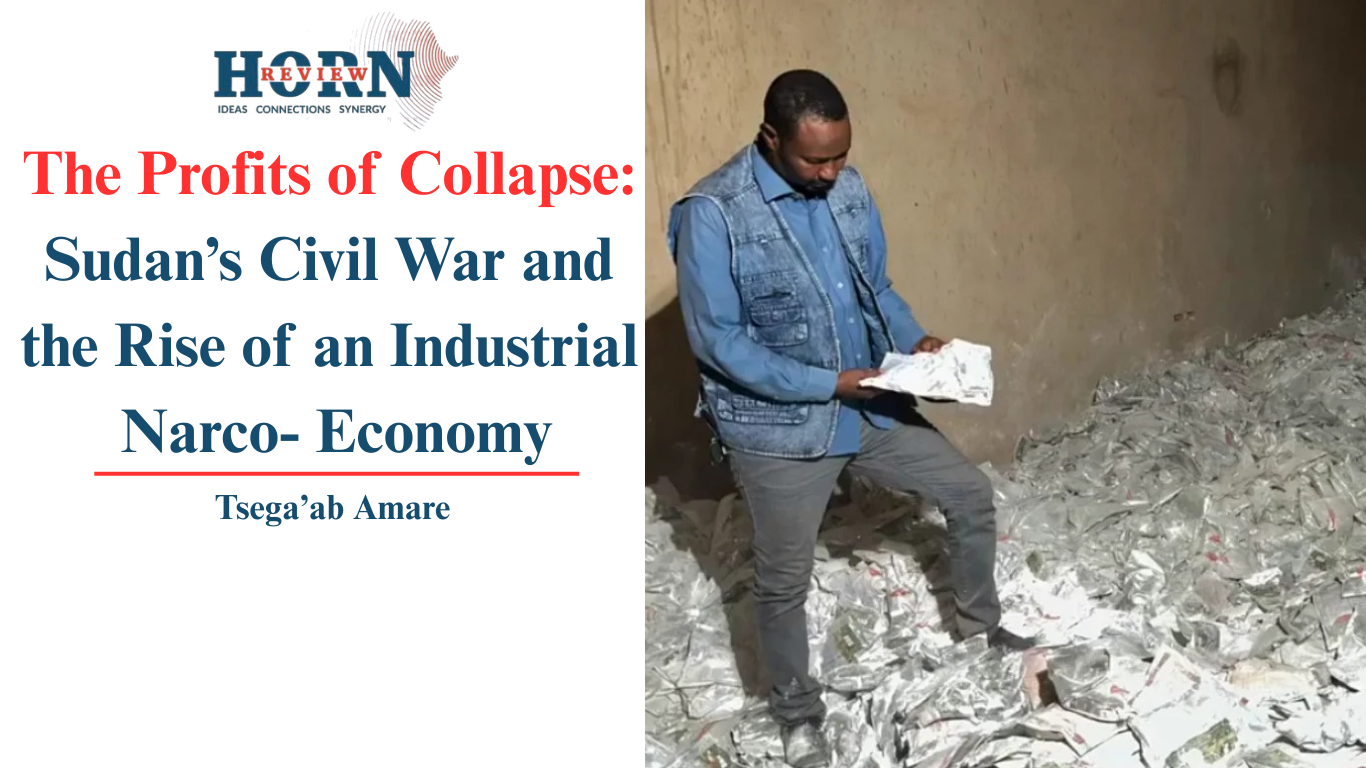
This analysis is based on the landmark report released by the Sudan Transparency and Policy Tracker (STPT) on the 5th of March, 2026, titled “Drugs in Wartime Sudan: An Illicit Economy Fueling the War.” The report’s findings suggest that the civil war in Sudan has evolved from being merely a military conflict to being the catalyst for the structural change that has created fertile ground for the activities of criminal networks and armed groups to expand illicit economic activity into the multi-billion-dollar industry of the synthetic narcotics enterprise.
Executive Summary
Sudan’s civil war is producing an unintended but increasingly consequential transformation in the regional drug economy. As conflict prolongs, armed actors are turning toward industrial synthetic drug manufacturing, particularly Captagon, to offset the economic cost of war. Unlike plant-based narcotics, synthetic production requires limited land, minimal labor, and relatively small facilities, allowing armed groups to scale production rapidly while operating within fragmented conflict zones. Evidence suggests that Sudan is emerging as a new node in the post-Syria Captagon economy. The profitability and scalability of synthetic drug production are reshaping the incentives of conflict actors, creating a “Peace-Drug Paradox”: the more lucrative the narco-economy becomes, the weaker the incentives for armed groups to pursue peace. Addressing this emerging threat requires a coordinated response focusing on: tighter monitoring of chemical precursors, stronger financial intelligence against trafficking networks, and community-level resilience programs to mitigate recruitment into narco-economies.
Introduction
Modern wars seldom rely solely on taxation, foreign aid, or the extraction of natural resources. Increasingly, they are sustained by complex illicit economies that thrive in the political and security vacuums created by collapsing state authorities.
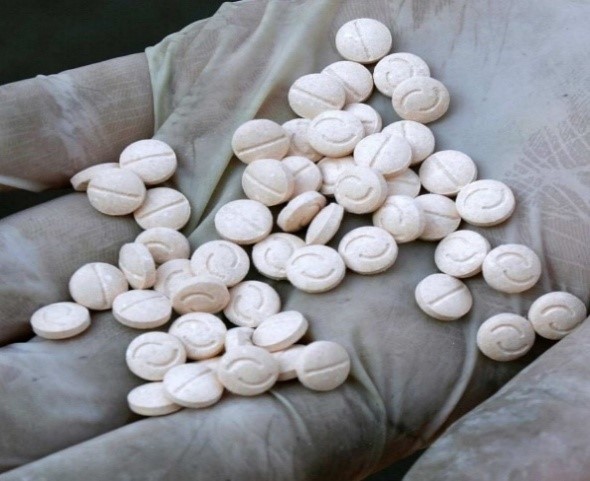
The narcotics economy of Sudan has undergone a dramatic but also alarming transformation in a span of two years. The Production capacity to manufacture synthetic narcotics has increased from small-scale pill-press operations that are capable of churning out roughly 7,200 pills per hour in 2023 to industrial-scale laboratories capable of producing as many as 100,000 pills per hour in 2025. This rapid and high-scale expansion represents a fundamental structural shift in the region’s political economy.
Sudan is not merely experiencing a surge in wartime drug trafficking; it is becoming the primary production and trafficking frontier of a post-Syria Captagon economy.[1] This new industry has been fully integrated and deeply embedded into the governance structures of the fractured militias, as well as the maritime routes of the Red Sea, ensuring a permanent place in the security architecture of the region.
Synthetic Frontiers: Laboratory versus Field
The classic war economies in drug production have traditionally been based on agriculture. In Afghanistan’s opium trade[2] or Colombia’s cocaine production;[3] narcotics production has traditionally relied on arable land, rural labor pools, and long production cycles. As a result, these war economies have traditionally been geographically fixed and somewhat static in their ability to grow or change location. They were also vulnerable to aerial eradication and seasonal weather patterns.
In contrast, synthetic drug production occurs in very different conditions. Substances like Captagon or methamphetamine production do not require land or harvest seasons.[4] Production, rather, is based on precursor chemicals, pill presses, laboratories, and protection from armed groups. In an environment where central state authority is weak or nonexistent, these conditions can be met with remarkable speed. Sudan’s civil war has created the ideal conditions for a laboratory-based narcotics frontier.
The implications of this transformation for the conflict in Sudan is significant because synthetic narcotics production differs from traditional production in a few ways.
First and foremost, synthetic narcotics production is a highly mobile industry. As a result, equipment can be moved rapidly in response to military pressure or changing territorial control. This makes this economy difficult to stop because even if a production facility is destroyed by authorities, production can be quickly re-established in a neighboring territory controlled by a militia group.
A second key feature of synthetic narcotics production is its profitability. Captagon tablets are inexpensive to produce, with a production cost of around $1, but command a high price of around $20 in the Gulf States.[5] As a result, a single industrial facility can produce enough revenue to pay thousands of militia men, effectively creating a financial infrastructure for these groups that operates independently of the formal financial system.
The Macroeconomics of Fragmented Sovereignty
The expansion of Sudan’s wartime drug economy is inseparable from the total collapse of state authority following the outbreak of civil war. The weakening of state institutions and the territorial fragmentation of Sudan meant that the mechanisms that previously constrained illicit markets disappeared. In economic terms, Sudan has transitioned from a centralized rentier state where the government controlled oil and gold revenues to a state of fragmented sovereignty. In this vacuum, the state monopoly on legitimate use of force was replaced by a decentralized market of violence, in which gold, fuel, and drugs had emerged as the most liquid currency.
For the RSF in particular, the drug boom represents an evolution of an existing highly sophisticated illicit infrastructure that pre-dates the current conflict in Sudan. Well before the conflict, the RSF had consolidated its position in Sudan’s most lucrative gold-producing areas, such as the Jebel Amer mines.[6] Gold remains the “hard currency” of the war; it provides the capital necessary to procure arms and reward tribal loyalty.
However, with the disruption of traditional economic activity caused by war, the RSF has had to turn to the taxation of survival. At every roadblock in Darfur[7] and Kordofan, it taxes food and fuel in transit. Narcotics have emerged as the ultimate high-margin addition to this portfolio, utilizing the same desert smuggling routes used for gold and fuel.
This creates a triple-threat revenue stream: gold for international procurement, fuel for local tactical mobility, and drugs for pure, un-trackable liquidity.
The Logistics of Precursors: The Invisible Supply Chain
One of the major findings made by the STPT report is the identification of the precursor chemical supply chain. The production of synthetic drugs cannot occur without the presence of chemicals such as pseudoephedrine, caffeine, and various acids. These chemicals are often siphoned off from legitimate pharmaceutical and industrial channels.
Considering the civil war in Sudan, these chemicals are potentially smuggled into the country under the pretext of humanitarian medical supplies, veterinary food supplies, and industrial cleaners. The industrialization of Sudan’s laboratories suggests that these are not haphazard diversions but organized, high-volume shipments facilitated by international middlemen. Operating in a gray zone, they exploit the lack of customs oversight and the desperation of a wartime economy to move tons of precursors into the hands of militia-linked chemists.[8]
The degree of technical sophistication required to orchestrate this effort and ensure the purity of chemicals while maintaining clandestine supply chains indicates that Sudan has moved beyond the amateur stage of drug production.[9] These brokers often act as illicit integrators, connecting Levant-based chemical expertise with Sudanese-controlled territory.[10] They exploit the “Dual-Use” concept, whereby chemicals required to produce life-saving medicine are also the primary ingredients of Captagon.
Ultimately, the industrialization of clandestine supply chains is indicative of the total weaponization of the global supply chain, whereby the very arteries meant for humanitarian aid have been repurposed into a life-support system for a narco-economy.
The Syrian Connection and the Industrial Transition
Another striking aspect of the development of Sudan’s burgeoning narcotics industry is its direct link to Syria and the regional transformation of the Captagon trade.[11] For over a decade, Syria served as the world’s epicenter for Captagon production, with networks connected to the Syrian government controlling and overseeing a vast industry. However, the disruption of Syria’s domestic industry after 2024, along with the increasing international pressure on the Levantine routes, led these networks to seek alternative production zones.
As the New Lines Institute observed, although laboratories were uncovered in Syria, the producers, smugglers, and distributors behind them were rarely arrested, meaning the technical expertise required to manufacture Captagon remained intact and could be redeployed elsewhere,[12] creating conditions for the industry’s migration to emerging conflict zones.
The conflict in Sudan proved to be an opportune setting for this transition, given the weak governance, well-established smuggling routes, and access to the Red Sea routes, leading to high-demand markets in the Gulf. The scale of this migration is reflected in the rapid industrialization of production capacity. Early operations in Sudan consisted of makeshift laboratory settings and small, hand-powered pill presses. By 2025, however, investigators reported the presence of a large-scale industrial facility capable of producing industrial-grade products.[13]
The technical indicators are also striking, as a laboratory was identified in early 2025 containing industrial equipment valued at over $3 million.[14] This suggests that the expansion was not organic or localized; it required significant foreign capital investment and technical expertise that likely migrated from previously established hubs in the Levant. The fourteen-fold increase in production capacity also demonstrates that Sudan has transitioned beyond opportunistic trafficking and has become a strategic node in the global geography of synthetic drug production.
Financing the Frontlines: The King of Ice and Militia Entrepreneurship
The trade in illicit narcotics has now come to represent a vital financial lifeline for various militias in Sudan’s fragmented territory. The ability to control territory affords militias the ability to dominate the entire chain of production. In RSF-controlled territory, reports indicate that the trade in narcotics and cannabis production occurs with minimal interference and, in many cases, with a potential direct sponsorship by the militia forces. This reflects a form of vertical integration in which the same armed actors control the land, the production facilities, and the export routes.
The ability to dominate the entire chain of production, from laboratory production to the export route via the Red Sea coast, affords militias the ability to maximize financial gains while securing a cash flow for the acquisition of advanced military equipment. This financial flow also enables them to bypass international sanctions. When formal assets are frozen or gold mines are contested, the Captagon economy provides the liquidity needed to maintain the loyalty of mercenary fighters.
However, the STPT report clarifies that this is not a one-sided issue. SAF-aligned groups are also deeply involved. The report identifies the Sudan Shield Forces(SSF) and its high-ranking official, Brigadier General Bashir Abdalla Haimoor, as central players in the burgeoning crystal methamphetamine trade. Haimoor, often referred to as the “King of Ice,” exemplifies how this war has created an environment where military command and criminal entrepreneurship are indistinguishable. For these commanders, the end of the war would mean the end of their most lucrative business model.
The Aggression Drug and the Psychology of Violence
The proliferation of synthetic drugs in Sudan has consequences that go beyond the financial ledgers of the militia groups. The use of stimulants by combatants is an increasingly visible and destructive characteristic of the conflict in Sudan. Drugs such as Captagon are used by combatants to reduce hunger, combat fatigue, and maintain alertness during the brutal, multi-day operations that characterize the fighting in Khartoum and Darfur.
However, the aggression drug fundamentally changes the character of combat in Sudan. Fighters operating under the influence of high-potency stimulants often exhibit heightened risk tolerance and a complete lack of inhibition. This psychological state contributes to the escalating levels of hyper-violence and the horrific human rights abuses reported by civilian survivors. When combatants are chemically disconnected from fear and empathy, the traditional laws of armed conflict become irrelevant. In this sense, the drug economy is not just funding the war; it is fueling its most barbaric elements.
Sudan’s Strategic Geography and the Red Sea Corridor
Sudan’s strategic geography is perhaps the most significant multiplier of the risks associated with this emerging narco-economy. By virtue of its position as a tri-continental pivot, Sudan acts as a logistical bridge between the Mediterranean, the Sahel, and the Indian Ocean. This intersectionality allows narco-militias to exploit three distinct but overlapping trafficking corridors, effectively globalizing a local conflict.
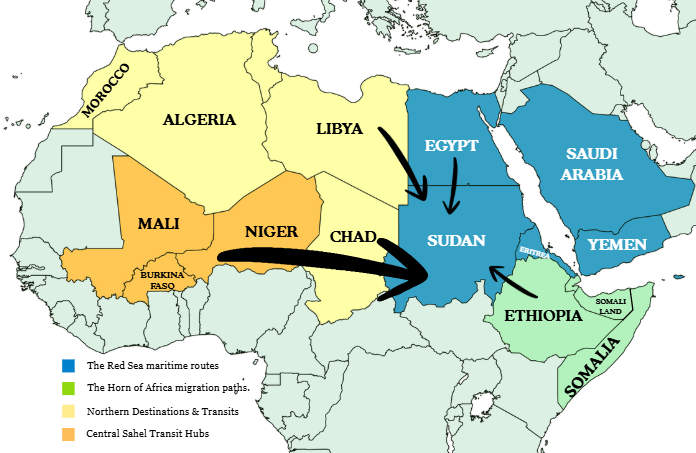
1. The Red Sea Maritime Routes:
The most lucrative of these corridors involves the maritime routes connecting Sudanese ports to the Gulf. The proximity of Port Sudan and Suakin to major consumer markets in Saudi Arabia and the United Arab Emirates creates a high-speed “maritime gray zone.”[15] [16]
- Traffickers utilize the high volume of legitimate commercial traffic in the Red Sea to hide illicit shipments. Industrial quantities of Captagon are often concealed within the “Blue Economy”—containerized shipping, fishing dhows, and even specialized commercial vessels.
- As the Yemeni conflict continues to disrupt the northern Red Sea, the Sudanese coast has emerged as a safer alternative for Levantine networks seeking to move products into the Gulf. This shifts the security burden southward, complicating international maritime task force efforts that are already stretched thin by piracy and regional naval tensions.
2. The Sahelian Smuggling Networks:
To the west, Sudan serves as the eastern anchor of the Trans-Sahelian Narco-Highway.[17] This corridor runs through Darfur into Chad, Niger, and Mali, eventually reaching the Atlantic coast of West Africa.
- These routes are not new; they were carved out decades ago for the smuggling of gold, arms, and fuel. By layering narcotics onto this existing infrastructure, militias can utilize a “proven” logistical path with established “protection” agreements from local tribal actors and trans-border insurgents.
- The porous borders of the Sahel allow for the rapid relocation of laboratory equipment. If a production site in North Darfur is threatened, it can be dismantled and re-established across the border in Chad within 48 hours, making traditional law enforcement virtually impossible.
3. The Horn of Africa Migration Paths:
Perhaps the most insidious corridor is the overlap with the Horn of Africa’s migration paths. These routes connect Ethiopia, Eritrea, and South Sudan to the Mediterranean and the Gulf.
- The same criminal syndicates that manage human trafficking and migrant smuggling are increasingly diversifying into the distribution of synthetic stimulants. Migrants are often used as “mules” or forced into low-level distribution networks as a way to pay off their smuggling debts.
- As these drugs move along migration routes, they “leak” into the local populations. This creates a trail of addiction through transit hubs and refugee camps, further destabilizing already vulnerable communities and creating a permanent market for the narco-commanders.
The convergence of these three routes means that a spike in production in a Sudanese laboratory has immediate security repercussions from the Gulf of Aden to the outskirts of Bamako. Sudan is no longer a peripheral player in global illicit trade; it is becoming a primary logistical pivot.
Recent confiscations along the Red Sea coast, including nearly half a ton of narcotics in early 2026,[18] highlight the rising maritime dimension of trade. If production continues at this current industrial rate, Sudan will become a central drug production hub for the wider Middle Eastern and North-East African region. This represents an existential threat to the region. Increased drug traffic fuels organized crime, destabilizes the borders, and complicates maritime security in the Red Sea. A narco-entrenched Sudan is not only a problem for Sudan but also a threat to global security.
Furthermore, the Intergovernmental Authority on Development (IGAD) and the African Union (AU) have found themselves largely paralyzed. Traditional diplomatic frameworks are designed to mediate between political actors, not “narco-militias.” When the primary incentive for a commander is the protection of an industrial laboratory rather than a political constituency, traditional peace-building tools such as power-sharing or constitutional reform lose their efficacy.
The ‘Peace-Drug’ Paradox
Perhaps the most daunting conclusion for the proliferation of the narco-industry is to look at it through a Peace-Drug Paradox. In traditional conflicts over resources like gold or oil, peace can be achieved because these resources are tangible, and their value increases in a stable, legitimate market. A gold mine is more profitable when the owner can export via official channels without being bombed.
In contrast, the narcotics trade thrives exclusively in the absence of the state or within the vacuum of a ‘semi-state’ structure. The industry’s profitability is predicated on the very lawlessness that peace seeks to resolve. The only historical outlier to this rule is the anomaly of Syria under the Assad regime, where the narcotics trade evolved not in the absence of the state, but as a deliberate instrument of state-sponsored survival amidst heavy sanctions.[19]
The Prisoner’s Dilemma[20] of Narco-Commanders
Using a Game Theory framework, we can model the behavior of “Narco-Commanders” on both sides of the Sudanese conflict. Let us consider two rival commanders who each control industrial-scale Captagon laboratories. They face two choices: Cooperate with a Peace Process or Defect (Maintain the Narco-War).
| Opponent Continues War | Opponent Moves Toward Peace | |
| Actor Continues War | Maximum drug profits; narco-economy expands; conflict persists | Actor retains drug revenues while gaining a territorial advantage |
| Actor Moves Toward Peace | Loses access to drug revenue while the opponent continues profiting | Mutual de-escalation, but both actors sacrifice narco-profits |
In this scenario, Defection or the Sabotage of Peace is the Dominant Strategy. Neither commander can trust the other to stop producing drugs, and the cost of being the only one to stop is total military and economic annihilation.
This paradox explains why potential peace talks often result in agreements that will falter within hours. For a commander whose laboratory produces 100,000 pills per hour, a ceasefire is not a relief; it is rather a threat to their supply chain. Sabotage, therefore, is not a failure of diplomacy; it is a rational economic act designed to protect the Spoiler’s Payoff.
When an industrial drug enterprise becomes embedded in a military structure, the commanders transition from being soldiers of a cause to entrepreneurs of violence. In their logic, the state is not a provider of security, but a competitor that must be kept weak. Consequently, they will intentionally trigger front-line skirmishes or commit atrocities to ensure that the fog of war remains thick enough to hide their laboratories.
Social Collapse and the Public Health Crisis
Aside from geopolitical concerns, the social implications of this drug economy are critical for Sudan. The pervasiveness of drug usage in conflict zones increases rates of civil drug addiction, particularly among youth who face unemployment and displacement. Confirmed reports of drug usage in cities such as Nyala and Al-Daein[21] highlight the availability of synthetic drugs more than medicines.
In the meantime, Sudan’s public health infrastructure has been decimated. Hospitals have been bombed, medical professionals have fled the country, and addiction support services are nonexistent. The convergence of expanding supply and declining institutional capacity creates a public health time bomb. History shows that these wartime drug economies leave lasting scars. Once a generation is habituated to these substances and the criminal infrastructure is built, they do not disappear simply because a ceasefire is signed.
Policy Frameworks for Restoration
Addressing Sudan’s emerging synthetic narcotics economy requires a multi-level response that targets four structural pillars of the trade: chemical supply chains, trafficking corridors, financial laundering networks, and local recruitment ecosystems.
Tier I – Disrupting the Precursor Pipeline: The first priority is tightening control over dual-use chemical precursors entering Sudan through maritime trade routes. Regional governments and international partners should expand monitoring mechanisms at Port Sudan through coordinated customs inspections and chemical tracking systems. International organizations such as the United Nations Office on Drugs and Crime could assist regional authorities in developing chemical risk-profiling databases capable of flagging suspicious imports of industrial solvents and pharmaceutical precursors commonly used in Captagon production.
Tier II – Trafficking Route Disruption: Given Sudan’s strategic location along the Red Sea, enhanced maritime surveillance and container profiling will be critical to disrupting trafficking routes linking Sudan to Middle Eastern drug markets. At the same time, coordinated border monitoring and intelligence sharing with neighboring states such as Chad and Libya will be necessary to limit the expansion of westward trafficking corridors across the Sahel. These efforts should be reinforced through joint border task forces and regional coordination mechanisms under frameworks such as the Intergovernmental Authority on Development and the African Union.
Tier III – Financial Intelligence and CBR Integrity: The third policy priority is disrupting the financial infrastructure that enables narcotics profits to circulate through regional markets. Governments in the Horn of Africa and the Gulf should strengthen anti-money-laundering cooperation by expanding financial intelligence sharing and monitoring informal transfer networks. Financial regulators should prioritize mapping the growing links between hawala systems and cryptocurrency exchanges, which increasingly serve as laundering channels for synthetic drug revenues.
Tier IV – Community-Led Resilience: Because state institutions have largely collapsed across much of Sudan, addressing the social consequences of drug proliferation will require community-level interventions. Local civil society organizations, health workers, and traditional authorities can play a critical role in prevention campaigns and addiction treatment programs. International humanitarian organizations should therefore integrate drug-awareness initiatives into existing health and food-security programs in conflict-affected regions of the country.
Conclusion: The Long Shadow of Narco-Entrenchment
Sudan’s emerging narcotics economy illustrates how modern civil wars transform states into platforms for transnational illicit markets. What began as opportunistic smuggling has rapidly evolved into an entrenched system of industrial production and militia protection, seamlessly integrated with the existing gold and fuel trades.
If current trends continue, Sudan risks entering a path-dependent trajectory similar to other failed states, where illicit markets, so deeply embedded in the political structure, become impossible to extract. Preventing this outcome will require more than just a military ceasefire. It will demand intense regional cooperation to disrupt the supply of precursor chemicals, a concerted effort to restore the rule of law, and a long-term commitment to addressing the social and health consequences of these trades.
Without these efforts, the Profits of Collapse will ensure that Sudan’s war economy casts a long, dark shadow over the region’s future for decades to come. The transition from a “conflict zone” to a “narco-state” is a threshold that, once crossed, is rarely undone without generations of struggle.
References
ACAPS. Sudan: Economic Impacts and Emerging Trends in West and Central Darfur. ReliefWeb, November 25, 2025. https://reliefweb.int/report/sudan/sudan-economic-impacts-and-emerging-trends-west-and-central-darfur-thematic-report-25-november-2025
“From Syria to Sudan: How Captagon Fuels Instability.” Arab Center, Washington DC.
https://arabcenterdc.org/resource/from-syria-to-sudan-how-captagon-fuels-instability/
Conflict and Environment Observatory. “Pills and Pollution: Captagon Production in Syria.” May 2025. https://ceobs.org/pills-and-pollution-captagon-production-in-syria/
Dabanga. “STPT – Drugs: An Illicit Economy Fuelling Sudan War.” AllAfrica, March 8, 2026. https://allafrica.com/stories/202603090017.html
Ibrahim, Elfadil. “How Syria’s Captagon Empire Is Being Reborn in Sudan’s War.” The New Arab, August 20, 2025. https://www.newarab.com/analysis/how-syrias-captagon-empire-being-reborn-sudans-war
InSight Crime. “Colombia’s Coca Crops Grew, But Cocaine Production Exploded.”
https://insightcrime.org/news/colombias-coca-crops-grew-cocaine-production-exploded/
Caroline Rose and Rafaella Lipschitz. Sudan’s Emergence as a New Captagon Hub. Strategic Assessment, New Lines Institute for Strategy and Policy, August 12, 2025.
https://newlinesinstitute.org/global-security-mil-priorities/sudans-emergence-as-a-new-captagon-hub/
Karam Shaar and Roaa Obeid. Captagon After the Fall of Assad: Transformations, Challenges, and Regional Implications. Washington, DC: New Lines Institute for Strategy and Policy, June 17, 2025. https://newlinesinstitute.org/wp-content/uploads/20250617-Captagon-after-Assad-NLISAP.pdf
Sudan Nabaa. “Red Sea State Forces Seize Nearly Half a Ton of Drugs in Major Operation.” January 19, 2026. https://sudannabaa.com/en/news-en/red-sea-state-forces-seize-nearly-half-a-ton-of-drugs-in-major-operation/67238/
Sudan Transparency and Policy Tracker. Drugs in Wartime Sudan: An Illicit Economy Fueling the War. March 5, 2026. https://sudantransparency.org/wp-content/uploads/2026/03/Sudan-Drugs-Paper-Final-5March2026.pdf
Sudan Tribune. “Sudan Transforms into Industrial-Scale Captagon Hub as War Fuels Drug Trade.” March 5, 2026. https://sudantribune.com/article/311408
Sudanow Magazine. “Danger of Drugs Increases in War Crises.” March 16, 2025.
https://sudanow-magazine.net/page.php?subId=1&Id=1617
“The Sinews of Sudan’s Latest War.” African Arguments. October 2023.
https://africanarguments.org/2023/10/the-sinews-of-sudans-latest-war/
“Syria’s Government Curbing Once-Booming Captagon Industry: UN Report.” Al Jazeera, December 22, 2025. https://www.aljazeera.com/news/2025/12/22/syrias-government-curbing-once-booming-captagon-industry-un-report
United Nations Office on Drugs and Crime. The Opium Economy in Afghanistan: An International Problem. New York: United Nations, 2003.
https://digitallibrary.un.org/record/488828/files/afg_opium_economy_www.pdf
World Drug Report 2024: Drug Market Trends. Vienna: UNODC, 2024.
https://www.unodc.org/unodc/en/data-and-analysis/wdr2024-drug-market-trends.html
United Nations Office on Drugs and Crime. Transnational Organized Crime Threat Assessment (TOCTA) – Sahel Maps. Vienna: UNODC. https://www.unodc.org/unodc/en/data-and-analysis/Tocta_Sahel_maps.html
“Prisoner’s Dilemma.” Investopedia. https://www.investopedia.com/terms/p/prisoners-dilemma.asp
[1] Syria’s Government Curbing Once-Booming Captagon Industry: UN Report.” Al Jazeera. December 22, 2025.
[2] United Nations Office on Drugs and Crime. The Opium Economy in Afghanistan: An International Problem. New York: United Nations.
[3] InSight Crime. “Colombia’s Coca Crops Grew, But Cocaine Production Exploded.”
[4] United Nations Office on Drugs and Crime. World Drug Report 2024: Drug Market Trends. Vienna: UNODC, 2024.
[5] “From Syria to Sudan: How Captagon Fuels Instability.” Arab Center Washington DC.
[6] “The Sinews of Sudan’s Latest War.” African Arguments. October 2023.
[7] ACAPS. Sudan: Economic Impacts and Emerging Trends in West and Central Darfur. ReliefWeb, November 25, 2025.
[8] Sudanow Magazine. “Danger of Drugs Increases in War Crises.” March 16, 2025.
[9] “STPT: Drugs – An Illicit Economy Fuelling Sudan War.” Radio Dabanga. March 8, 2026.
[10] Ibrahim, Elfadil. “How Syria’s Captagon Empire Is Being Reborn in Sudan’s War.” The New Arab. August 20, 2025.
[11] Ibrahim, Elfadil. “How Syria’s Captagon Empire Is Being Reborn in Sudan’s War.” The New Arab. August 20, 2025.
[12] Shaar, Karam, and Roaa Obeid. Captagon After the Fall of Assad: Transformations, Challenges, and Regional Implications. Washington, DC: New Lines Institute for Strategy and Policy, June 17, 2025.
[13] Rose, Caroline, and Rafaella Lipschitz. Sudan’s Emergence as a New Captagon Hub. Strategic Assessment, New Lines Institute for Strategy and Policy, August 12, 2025.
[14] Dabanga. “STPT – Drugs: An Illicit Economy Fuelling Sudan War.” AllAfrica, March 8, 2026.
[15] Rose, Caroline, and Rafaella Lipschitz. Sudan’s Emergence as a New Captagon Hub. Strategic Assessment, New Lines Institute for Strategy and Policy, August 12, 2025.
[16] Sudan Transparency and Policy Tracker, Drugs in Wartime Sudan: An Illicit Economy Fueling the War (March 5, 2026)
[17] United Nations Office on Drugs and Crime. Transnational Organized Crime Threat Assessment (TOCTA) – Sahel Maps. Vienna: UNODC.
[18] Sudan Nabaa. “Red Sea State Forces Seize Nearly Half a Ton of Drugs in Major Operation.” Sudan Nabaa, January 19, 2026.
[19] Conflict and Environment Observatory. “Pills and Pollution: Captagon Production in Syria.” May 2025.
[20] Verrilli, Thomas. “Prisoner’s Dilemma.” Investopedia. September 08, 2026.
[21] Sudan Tribune. “Sudan Transforms into Industrial‑Scale Captagon Hub as War Fuels Drug Trade.” Sudan Tribune, March 5, 2026.
By Tsega’ab Amare , Researcher, Horn Review

The Recurring Script of Eritrea’s Invasion-Victim Cycle
In the Horn of Africa, history under Isaias Afwerki does...
Under the Banner of Red Sea Security, Egypt Encircles Ethiopia
Reports of Egyptian naval movements toward the southern Red...
Egypt's Attack on Sudan's Gold Mines and the Long Road That Led to It
The airstrikes that tore through the artisanal gold mining...
Where Somalia’s Federal and Regional Fight Is Going
The 2012 federal settlement was less a constitutional order...
Eritrea’s Post-Pretoria Strategy and the Escalation in Ethiopia
Our latest report examines Eritrea’s post-Pretoria trajectory and how selective...
The Houthi-al-Shabaab Nexus and the Emerging Security Architecture of the Gulf of Aden
The growing relationship between Yemen’s Houthi movement and Somalia’s al-Shabaab...
“Decaffeinated Sovereignty”: Eritrea’s One-Way Street with Ethiopia
There is a peculiar contradiction at the heart of Eritrea’s...
Leaked Documents Allege Sudanese Army Weapons Pipeline to TPLF-Aligned Forces as Tigray War Reignites
Leaked documents alleging a Sudanese army weapons pipeline to TPLF-aligned...
Eritrea Has Officially Invaded Ethiopia, Says Government Communication
Ethiopian Government Formally Condemns Eritrean Territorial Incursion as Its Forces...
Turkey, Somalia and the Transactional Reading of Alamein
The Alamein Declaration functions less as a coherent framework...