
9
Apr
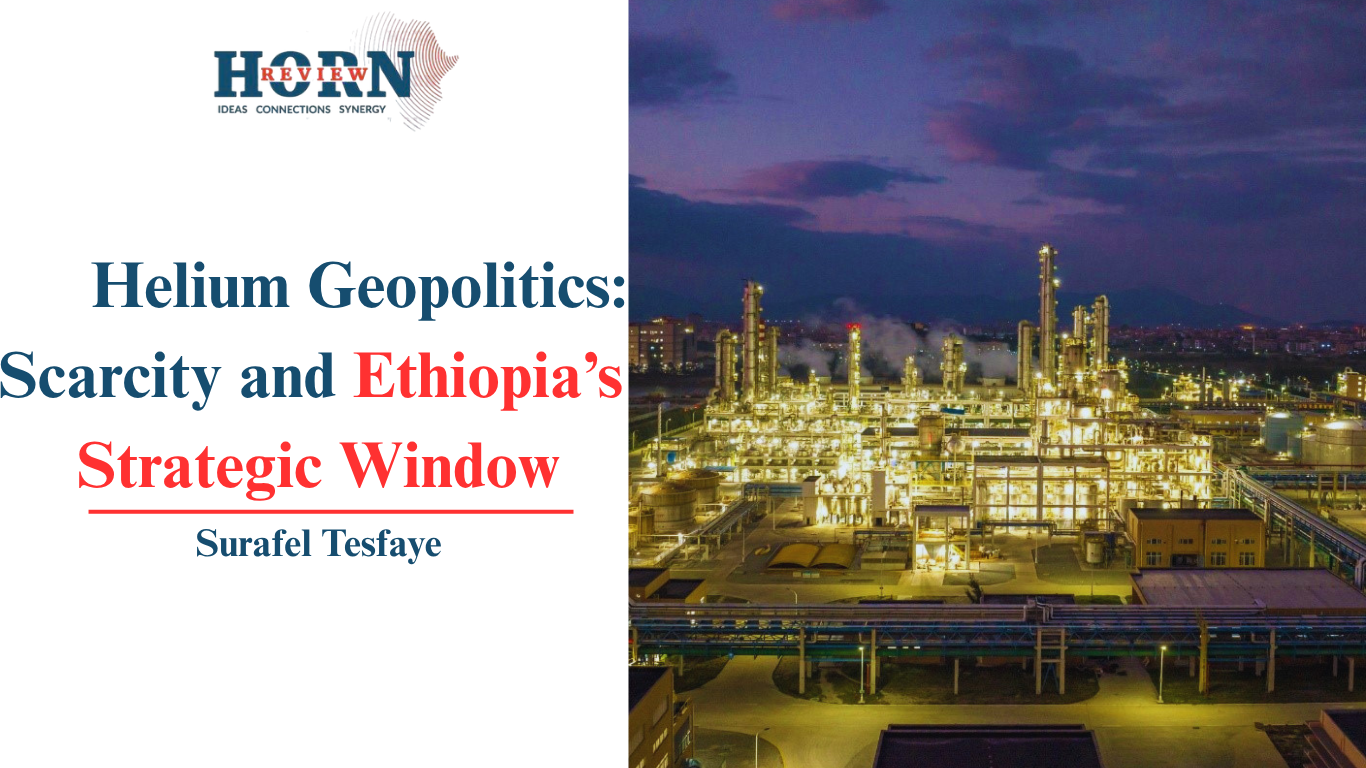
Helium Geopolitics: Scarcity and Ethiopia’s Strategic Window
Helium is the second most abundant element in the universe, yet on Earth; it exists under conditions of near scarcity. This contradiction is not simply a matter of distribution but of physics. Helium is fundamentally different from other industrial gases. Its atoms are so light that once released into the atmosphere, they eventually reach escape velocity and drift into space. Unlike oxygen or nitrogen, it does not cycle back into the Earth’s system. Every unit that is vented, flared, or lost during industrial processes disappears permanently. In practical terms, helium is not just scarce it is non-renewable on any human timescale.
What makes this scarcity more complex is that Helium is rarely produced as a primary resource; it is typically a byproduct of natural gas extraction. It is generated over geological time through the radioactive decay of uranium and thorium, forming alpha particles that become helium atoms. These atoms slowly migrate upward and accumulate in natural gas reservoirs, but only where geological conditions allow them to be trapped beneath impermeable rock. As a result, helium extraction is inseparable from natural gas production. It is recovered as a secondary product during the liquefaction process, when natural gas is cooled to extremely low temperatures and its components are separated. Helium extraction technology includes single helium extraction, combined natural gas extraction and co-production natural gas extraction.
This structural dependency defines the global helium market. When liquefied natural gas production expands, helium supply increases. When it is disrupted, helium disappears from the system almost immediately. The current geopolitical crisis has exposed this relationship with unusual clarity. Following Iranian strikes on Qatari gas infrastructure in March 2026, a significant portion of Qatar’s production capacity estimated at around 17 percent was taken offline. With key facilities damaged and maritime routes constrained, Qatar Energy has indicated that restoring full production could take years.
Because helium production is tied directly to LNG processing, the consequences extend far beyond energy markets. Once LNG facilities shut down, helium production stops entirely. Unlike oil, this is not a resource that can be stored and released later to stabilize supply. Liquid helium exists at extremely low temperatures and is inherently unstable in storage. Even under optimal conditions, it continuously evaporates through boil-off. The industry operates under a narrow time window roughly weeks, not months within which helium must be transported and used. If shipments are delayed or infrastructure is disrupted, the product quite literally vanishes. This creates a form of “perishable economics” in which supply cannot be hoarded and value cannot be preserved.
Before the 2026 crisis, global helium distribution functioned through a highly optimized logistical system. Major industrial gas companies such as Linde and Air Liquide did not simply ship helium directly from producers to consumers. Instead, they relied on a “swap system,” selling locally available helium in one region while allocating production from another region elsewhere to minimize transport losses. This system allowed global supply to function efficiently despite the physical constraints of helium transport. However, it also meant that disruptions in one major production hub could cascade across the entire network.
The shutdown of Qatari supply has triggered exactly such a cascade. While the United States historically imported only a small percentage of its helium from Qatar, USGS estimates the United States has 306 billion cubic feet (BCF) of recoverable helium in geologic reservoirs, while the rest of the world has 31.3 billion cubic meters. The removal of Qatari volumes has forced a global rebalancing. Supply that once served Asian markets must now be redirected, increasing pressure on alternative producers such as the United States and Russia (but Russian supplies are banned under States and European Union sanctions). The result is not simply a shortage but a reconfiguration of global supply chains, with the most severe consequences felt in regions that were already logistically disadvantaged.
The Horn of Africa represents one of the most vulnerable points in this system. Countries such as Ethiopia are geographically distant from major helium producers and lack direct transport links to them. Previously, supply routes from the Gulf provided a relatively efficient pathway. With those routes disrupted particularly due to instability affecting key maritime corridors helium must now travel longer distances under less predictable conditions. This introduces a critical problem: the longer the journey, the greater the loss through evaporation.
Transporting helium across oceans requires specialized ISO cryogenic containers designed to maintain extremely low temperatures. These containers are both technologically complex and limited in number. The current crisis has created a severe imbalance in their availability. With shipping lanes disrupted and vessels rerouted, containers are being stranded in some regions while shortages emerge in others. This has produced what can be described as a reverse logistics crisis, where the inability to reposition empty containers becomes as significant as the shortage of helium itself.
At the regional level, Djibouti has become a focal point of this disruption. As the primary maritime gateway for East Africa, its ports are now facing congestion from ships diverting away from conflict-affected routes in the Persian Gulf. This congestion is not limited to helium. It is delaying the arrival of fertilizers, machinery, and other essential imports, amplifying inflationary pressures and compounding the economic impact of the crisis. Helium, in this context, is part of a broader system under strain.
Yet the importance of helium extends beyond logistics and economics. Its unique physical properties make it indispensable in critical sectors. In liquid form, helium is the coldest substance available, enabling technologies that depend on extreme cooling, including MRI machines and advanced scientific instruments. Its status as a noble gas means it is chemically inert, preventing corrosion and combustion in sensitive environments. Its low viscosity allows it to flow rapidly and efficiently, making it essential in medical devices such as heart-lung machines. In many developing regions, the issue is not advanced technological competition but access to basic medical infrastructure. A disruption in helium supply therefore has direct implications for healthcare capacity.
The current crisis centers on helium-4, the common isotope. Nevertheless, a parallel scarcity is emerging for helium-3, an ultra-rare isotope essential to quantum computing. Dilution refrigerators the cooling systems that bring quantum processors to their operating temperature of approximately 15-mill kelvin require helium-3 as a working fluid. There is no substitute.
Helium-3 is not found in commercial natural gas deposits. It is produced almost exclusively as a byproduct of nuclear weapons maintenance, specifically the decay of tritium, and in certain nuclear reactors. Global supply is measured in tens of thousands of liters per year. As quantum computing moves from laboratory curiosity toward commercial deployment, demand is expected to outstrip supply significantly.
As we build a future defined by quantum computing, fusion energy, advanced medicine and artificial intelligence all of which depend on helium the resource is quietly becoming one of the most strategically critical elements of the 21st century.
At the same time, structural shifts are beginning to reshape how helium itself is sourced. As Qatar’s production becomes disrupted, South Africa’s ASP Isotopes project represents a historic transition from reliance on natural gas-associated helium toward standalone helium production in politically stable regions. This shift away from geopolitically volatile supply hubs signals a broader transformation in the helium economy. Ethiopia, by integrating helium recovery into the Ogaden project, has the potential to align itself with this emerging model and position itself alongside Tanzania as a new East African helium hotspot.
For Ethiopia and the broader region, this crisis is not only a challenge but also a strategic opportunity. The Ogaden Basin, particularly the Calub and Hilala gas fields, offers a pathway toward long-term self-sufficiency. Unlike Tanzania, which possesses rare high-concentration helium deposits and is developing what is often described as “green helium,” Ethiopia’s advantage lies in integration.
While there is currently no reported commercial helium concentration in the Ogaden Basin, its geological profile mirrors many of the world’s most productive helium-rich regions. It is a close analogue to Algeria’s Hassi R’Mel field, where helium has been successfully extracted for decades. Both systems feature deep sedimentary basins in which gas is trapped beneath thick geological seals such as shale or salt. Like Algeria, the Ogaden contains “wet gas” methane mixed with light hydrocarbons and condensates creating an ideal environment for helium accumulation.
While Middle Eastern reservoirs are typically large and structurally simple carbonate systems, the Ogaden is more complex and faulted. However, this complexity is not a disadvantage. The Somali Plateau, on which the Ogaden sits, was once geologically connected to the Arabian Peninsula before the opening of the Gulf of Aden. As a result, the deep subsurface formations share structural similarities with major gas fields in Saudi Arabia and Yemen. More importantly, the Ogaden is part of the Karoo Rift system one of the most favorable geological environments in the world for high helium concentrations.
This geological “DNA” aligns it with Tanzania’s Rukwa Basin, currently the most significant helium discovery in Africa, where concentrations have reached up to 10 percent an exceptionally high figure by global standards. The implication is clear: while Ethiopia may not yet have confirmed such concentrations, the underlying geological system strongly suggests comparable potential.
Therefore strongly suggests comparable potential. Given this geological promise, the focus should be on the co-production rule; it is a method that extracting helium, producing LNG, nitrogen removal and other units at the same time, obtaining helium while producing other by-products, to achieve the purpose of reducing unit extraction cost and increasing the whole value chain economic benefits.
The country’s multi-billion-dollar LNG project already includes the infrastructure necessary to process natural gas at cryogenic temperatures. This creates a unique opportunity to capture helium as a byproduct at relatively low additional cost. By doing this inside the project, they use the same electricity, the same security, and the same pipes already at the site. This makes it much cheaper than building a standalone plant later.
The technical solution is straightforward but time-sensitive. During LNG production, natural gas is cooled to approximately -161°C, at which point methane becomes liquid while helium remains in gaseous form. In the absence of dedicated equipment, this helium is treated like “trash” and is released (wasted) during the cleaning process. Installing a Helium Recovery Unit allows this remaining gas to be further cooled to approximately -269°C, at which point helium can be liquefied and captured. The government should not build a separate helium plant later. They should install a Helium Recovery Unit (HRU) as a “plug-in” component to the current Ogaden LNG infrastructure immediately. If they wait until the project is 100% finished, it will be much harder and more expensive to “break into” the pipes to save the gas. There must be a technical design that incorporates Helium Recovery Units (HRUs) into the Ogaden facility.
The timing of this integration is critical. Since the Ogaden project is still in its early phases (Phase 1 started in late 2025, and Phase 2 is being built now), the government has a “Golden Window”.
There are also additional technical pathways that could be utilized even if initial integration is missed. Boil-off gas, the inevitable evaporation that occurs during LNG storage and transport, contains recoverable helium. Capturing this stream represents a secondary opportunity, although it is less efficient than primary recovery during processing.
Strategically, the implications of developing this capacity extend beyond national self-sufficiency. Algeria proves that you don’t need the massive 10% concentrations found in Tanzania to be a world leader. By using the existing LNG cooling already happening in the Ogaden, Ethiopia can produce helium as “profit on top of profit,” exactly as Algeria has done since 1995. Algeria’s journey from a natural gas giant to a global helium leader started by recognizing that their massive LNG infrastructure could “serendipitously” capture a rare and valuable resource. Instead of letting helium escape as waste, they strategically integrated recovery into their existing gas export hubs.
For Ethiopia, the choice is not simply between importing helium or developing domestic capacity. It is a question of long-term strategic positioning. For aerospace, Ethiopia can use helium for rocket engine testing and satellite launches. Since helium is an inert gas that doesn’t burn and stays liquid at extreme cold, it is used to pressurize fuel tanks, purge propulsion systems, and leak-test hardware. If Ethiopia develops its own space program or partners with international agencies, having a domestic supply is a massive strategic advantage.
Therefore, the following recommendation is directed to the Government of Ethiopia:
Address the helium gap now, before the Ogaden LNG project moves beyond its golden window. Direct the Ministry of Mines and the Ministry of Energy to conduct a formal assessment of helium concentration in the Calub and Hilala gas fields, using existing drill data and gas samples. Instruct the project operator to include a Helium Recovery Unit in the current phase of construction, even if this requires renegotiating technical specifications or offering modest fiscal incentives. If full integration is not immediately possible, mandate a secondary capture system for boil-off gas during LNG storage and transport.
The broader lesson emerging from the current crisis is that helium can not be treated as a secondary or insignificant resource. The current global disruption provides a massive immediate opening, but the decision to extract helium in the Ogaden project is not just about a temporary opportunity; it is a long-term strategic necessity for Ethiopia’s industrial future.
By Surafel Tesfaye, Researcher, Horn Review
.

RELATED
Posts

8
Apr
Who Remains Turkiye’s Reliable Strategic Gateway to a Complicated Horn of Africa?
Turkiye, much like the financially powerful Gulf states and the...

26
Mar
Meles Zenawi’s Prescience: The Case for SWS, Puntland and Jubaland and the Domino Effect
Revisiting Meles Zenawi’s Case for Semi-Recognition
On March 17, 2026...
26
Mar
Ethiopia’s “Horn First” Doctrine in the Face of Externally Conditioned Sovereignties
The geopolitical landscape of the Horn of Africa is shifting...

23
Mar
Why Ethiopia Should Treat the Sahel as an Immediate Neighbor
Ethiopia’s foreign policy has long been guided by a map...

19
Mar
Pre-War Equilibrium: Why Ethiopia Holds Time and Eritrea Is Racing Against It
The contemporary dynamics of interstate relations between Ethiopia and Eritrea...
18
Mar
Air Power and the Politics of Defence Dependence: Ethiopia's Strategic Imperative
In 2020, former Malaysian Prime Minister Mahathir Mohamad, in discussing...


13
Mar
Structural Obstacles in Nile Basin Negotiations
The hydropolitics of the Nile Basin have long represented an...

13
Mar
Gulf Experiences and Strategic Choices for the Horn of Africa
Within the volatile architecture of modern international relations, few...

12
Mar
Interpreting Abiy Ahmed’s Visit to the United Arab Emirates
The visit by Abiy Ahmed to the United Arab Emirates...