
23
Mar
The Ultimatum as Narrative: How it is Reframing Escalation and Reimagining the Horn of Africa’s Place in a Changing Regional Order
The escalating tensions between the United States and Iran are reshaping the strategic environment across the Middle East and its adjacent regions. The latest ultimatum, issued amid active military operations, highlights how coercive signaling is now central to managing escalation and redefining regional power balances. These dynamics are already extending from the Strait of Hormuz to the Horn of Africa, a widening corridor where maritime security, alliance cohesion, and regional stability intersect. This analysis assesses the policy implications of these shifts and the strategic choices they now force across multiple theaters. Some scholars view the moment as “the world in labor pain” in assessing whether the ultimatum bears the expected outcome or escalate tension or give rise to the birth/rebirth of unexpected powers illuminated by a new global order and signaling the slow death of others.
The United States of America issued a 48‑hour ultimatum to Iran on Saturday, 21 March 2026, demanding the full reopening of the Strait of Hormuz or facing strikes on Iran’s power infrastructure sits at the top of a conflict already in motion. It is not a warning before escalation but it is a political frame placed over escalation that has already begun. President Trump’s threat to “hit and obliterate” Iran’s power plants if the blockade is not lifted within the deadline comes after weeks of U.S. and Israeli strikes on Iranian military infrastructure and the deployment of U.S. naval force to secure maritime routes. The ultimatum, in this sense, is an attempt to narrate the meaning of force rather than to initiate it. This pattern is deeply familiar in U.S. – Iran relations. Washington has long used ultimatums not as preludes to action but as political overlays on operations already going on. The United States often moves first through sanctions, covert operations, cyberattacks, or targeted strikes and only afterward articulates comprehensive demands that retroactively frame those actions as conditional and reversible. The ultimatum becomes a diplomatic narrative device that allows Washington to claim the escalation is purposeful, controlled, and still open to negotiation, even when the machinery of force is already in motion.
We can see this logic clearly in earlier confrontations. In the late 2000s, U.S. forces were already conducting covert raids against Iranian‑backed militias in Iraq when Washington issued public warnings that Iran must “cease destabilizing activities” or face “serious consequences.” The ultimatum did not trigger the operations, however, it justified them after the fact, transforming ongoing raids into leverage for political concessions. A similar pattern emerged in 2011–2012, when the Stuxnet cyberattack (The Stuxnet was a highly sophisticated computer worm, jointly developed by the United States and Israel, designed to secretly sabotage Iran’s nuclear program). It had already damaged Iranian nuclear in Natanz uranium enrichment facility before the United States announced that “all options are on the table” unless Iran returned to negotiations. The ultimatum framed the cyber operation as part of a pressure campaign rather than as unilateral escalation.
The 2019 crisis followed the same rhythm. The United States had already deployed carrier groups, tightened sanctions, and conducted covert strikes when Secretary of State Mike Pompeo unveiled twelve comprehensive demands requiring Iran to fundamentally change its regional behavior. The ultimatum was not a starting point but it was a political capstone placed above a campaign already underway. Iran understood this clearly, which is why it responded with calibrated defiance downing a U.S. drone, striking Saudi oil facilities, and expanding its nuclear program testing Washington’s resolve without crossing into full‑scale war. Even the assassination from Iranian senior military ranking, Qassem Soleimani in January 2020 fits this pattern. The strike came first then the ultimatum came after, framed as a warning that any further Iranian retaliation would be met with overwhelming force. Iran’s ballistic missile strikes on U.S. bases in Iraq were a direct response to this logic and a demonstration that it would not accept the political meaning Washington tried to impose on the use of force. The current ultimatum functions in exactly this way. The United States and Israel have already carried out strikes on Iranian military infrastructure, deployed naval forces to secure maritime routes, and begun a de facto campaign to break Iran’s blockade of the Strait of Hormuz. The ultimatum is demanding that Iran reopen the strait within 48 hours or face strikes on its power grid does not initiate escalation; it seeks to define it. It transforms ongoing operations into a test of Iran’s willingness to accept a U.S.-defined regional order, which is, freedom of navigation, maritime dominance, and the political architecture of the Gulf are set by Washington and its allies.
The geography of this ultimatum is not incidental. The Strait of Hormuz is the hinge between the Middle East and the wider Indian Ocean, and its closure reverberates far beyond the Gulf. Iran’s counter warning that U.S. energy infrastructure across the region will be targeted if attacked signals that Tehran sees this as an existential confrontation, not a tactical dispute. The stakes are regional, systemic, and deeply tied to questions of hierarchy, sovereignty, and civilizational identity. The role of Diego Garcia and the United Kingdom adds another layer of complexity to the tension. Diego Garcia remains a critical platform for U.S. operations across the Middle East, South Asia, and East Africa, and Iranian media have explicitly identified it as a potential target if the United States or Israel attacks Iran. Yet London has refused U.S. requests to use the base for pre‑emptive strikes, creating a rare public rift. Prime Minister Keir Starmer’s decision to block U.S. strike plans from Diego Garcia while still hosting U.S. forces and condemning Iranian attacks on the base produces a dual posture: operational cooperation without political endorsement. The EU’s stance diverges even further, with Brussels refusing to align itself with Washington’s military strategy and emphasizing de‑escalation and legal constraints. NATO, for its part, remains structurally sidelined because the conflict does not meet the criteria for collective defense and because its drivers like control of chokepoints, regional hierarchy, and civilizational narratives fall outside NATO’s doctrinal framework.
Taken together, these dynamics reveal a conflict that is geopolitical in its stakes and civilizational in its narratives resonating S. Huntington’s “Clash of Civilizations Theory”. For Iran, the evolving direct conflict is often framed as a struggle between the West and the so‑called “Axis of Resistance,” while Prime Minister Netanyahu casts it as a fight against “civilizational annihilation,” a language that deliberately situates the war within the grand narrative both Tehran and Jerusalem appear to draw by portraying the confrontation as a collision between incompatible worldviews rather than a dispute over policy or security. In this sense, while the rhetoric of “civilizational struggle” echoes Huntington,’s concept, the reality on the ground is far more entangled, rooted not only in identity but in shifting alliances, contested regional orders, and the instrumental use of civilizational narratives to legitimize escalating forms of violence, including the destruction of infrastructure and cultural heritage.
The Horn of Africa
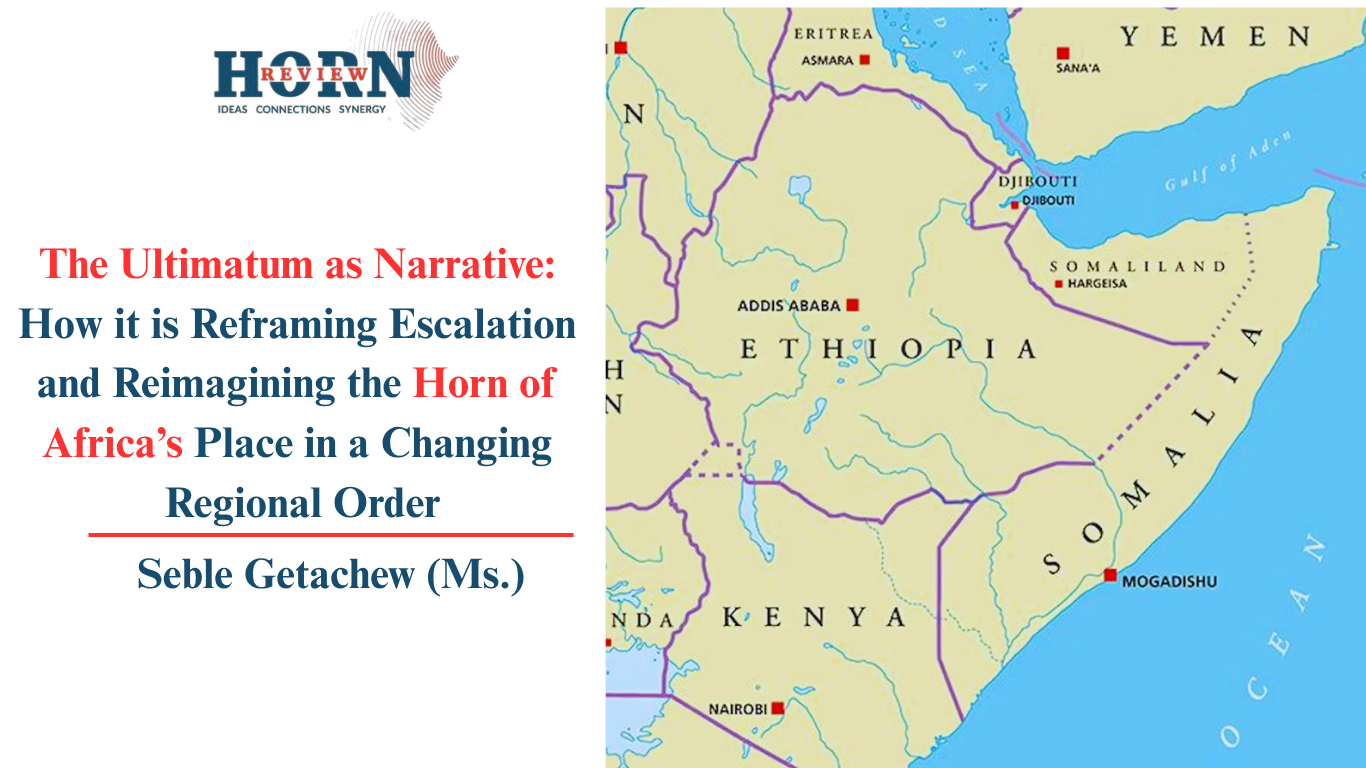
The geopolitical horizon continues to widening and the Horn of Africa appears not to be a distant observer to the U.S.–Iran confrontation, it is part of the same strategic ecosystem. The region sits at the western mouth of the Indian Ocean security architecture that links the Red Sea, Bab el‑Mandeb, and the Gulf of Aden to the Strait of Hormuz. This is where shifting alignments, maritime vulnerabilities, and great‑power competition converge. Hence, what happens in Hormuz ripples across the Horn with remarkable speed and intensity. A prolonged closure of Hormuz would immediately raise shipping and insurance costs through Bab el‑Mandeb, straining the budgets of import‑dependent states such as Ethiopia, Somalia, and Djibouti. It would also elevate the strategic value of ports like Djibouti, Berbera, and Assab, making them even more contested spaces for Gulf states, China, and the United States. The UAE’s expanding influence in Somaliland and Eritrea, China’s base in Doraleh, and the U.S. presence in Djibouti all reflect a region already saturated with external military and economic interests. A U.S.–Iran escalation would intensify this competition, forcing Horn governments to navigate a more polarized environment where alignment choices carry higher risks.
The ultimatum also has symbolic implications for the Horn. It signals that the United States is willing to use overwhelming force to secure maritime corridors, a message that resonates in a region where maritime security is deeply intertwined with political stability. For the Horn countries the ultimatum is a reminder that their strategic relevance is tied to geography, i.e., they sit at the crossroads of global energy flows, great‑power competition, and Gulf rivalries. This creates both opportunities and vulnerabilities. Some states may leverage their geography for diplomatic or economic gain and others may find themselves caught in the middle of a conflict they cannot control. For instance, Somaliland’s Berbera port and Eritrea’s Assab have gained value as Gulf states and global powers seek alternative maritime routes and logistical footholds, on the contrary states located along chokepoints or contested maritime corridors can be pulled into rivalries they cannot control. Yemen’s fragmentation shows how quickly external actors can turn a strategic coastline into a battleground. Somalia risks similar exposure as Gulf states, Ethiopia despite being landlocked feels the pressure indirectly as any disruption in Bab el‑Mandeb or Hormuz raises import costs, strains foreign exchange reserves, and heightens its dependence on external partners for access to the sea. This informs how the geographic location of the Horn of Africa is a double‑edged asset in that it can elevate a state’s strategic relevance, at the same time easily expose it to coercion, economic shocks, or proxy competition when regional crises escalate.
In short, the Horn of Africa is not a peripheral theatre but an extension of the same geopolitical contest unfolding in the Gulf. The ultimatum’s consequences, (economic, security, and diplomatic) will be felt across the region, shaping political choices and regional alignments for years to come.
General Diplomatic and Policy Implications
The ultimatum exposes fractures within the Western camp and accelerates a shift toward fragmented, interest‑driven alignments. The United States and Israel form the core military axis; the UK is a critical but ambivalent enabler; the EU distances itself; and NATO remains structurally sidelined. This weakens the perception of a unified Western front and gives Iran and other regional actors a space to exploit these divisions.
For the Horn of Africa, the implications are profound. The region must prepare for secondary shocks that may be economic, security, and diplomatic emanating from the Gulf. Governments will need to diversify energy sources, strengthen maritime security cooperation, and avoid becoming proxy arenas for Gulf or great power competition. The ultimatum underscores that the Horn’s stability is inseparable from the wider Indian Ocean system. It also highlights the need for regional institutions like IGAD and the African Union to anticipate and mitigate the spillover effects of Gulf crises.
Policy wise, the ultimatum demonstrates both the utility and the limits of coercive signaling. It may compel Iran to adjust its tactics around Hormuz, but it cannot resolve the underlying geopolitical and civilizational contest. For the Horn, the lesson is clear: the region must build resilience not only to local conflicts but to the global confrontations that shape its strategic environment.
______________________________
Sources:
African Security Analysis: United States Policy in Somalia and the Horn of Africa: ASA Strategic Assessment
Gavin_Testimony: https://www.foreign.senate.gov/imo/media/doc
Mesob Journal: How the 2025 US Security Strategy Reframes Eritrea and the Horn
Middle East Forum: America’s Military Buildup Around Iran: What We Know and What It Means –
Policy Exchange – The Attorney General, the Iran-Israel war, and the future of Diego Garcia
Https://www.armyrecognition.com/news/army-news/2026
The Arsenal Of Epic Fury: Every US Aircraft Taking Part In The Strikes On Iran
The Independent: Iran-US war latest: Trump threatens to ‘obliterate’ Iran’s power plants if Strait of Hormuz is not opened ‘within 48 hours’
The Milli Chronicle: Trump issues 48-hour ultimatum to Iran over Hormuz blockade, threatens strikes on power plants
US Military Build-Up on Diego Garcia: Risk Assessment
World News: ttps://www.ndtv.com/world-news/us-gathers-troops-jets-at-uk-raf-fairford-diego-garcia-bases-
By Seble Getachew (Ms.)

RELATED
Posts
26
Mar
Sudan’s Shadow Alignment: Military Dependence and Diplomatic Denial Amid a Middle East War
The geopolitical orientation of the Sudanese Armed Forces (SAF), under...
23
Mar
Africa in Iran’s Broader Geopolitical Strategy
The eruption of the 2026 military conflict between Iran and...
17
Mar
Reassessing Egypt’s Myth of Regional Leadership
In the unstable landscape of the Middle East and North...
17
Mar
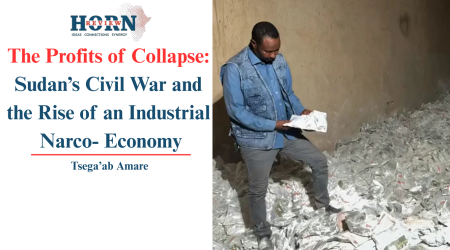
The Profits of Collapse: Sudan’s Civil War and the Rise of an Industrial Narco-Economy
This analysis examines how the ongoing conflict in Sudan is...
16
Mar
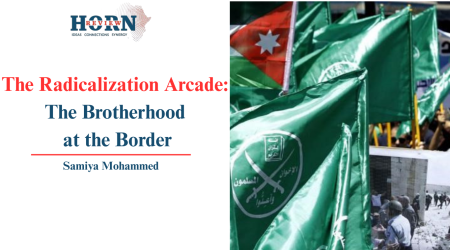
The Radicalization Arcade: The Brotherhood at the Border
Why the Muslim Brotherhood's Control of Sudan's Military Is...
16
Mar
The Profits of Collapse: Sudan’s Civil War and the Rise of an Industrial Narco- Economy
This analysis is based on the landmark report released by...
13
Mar
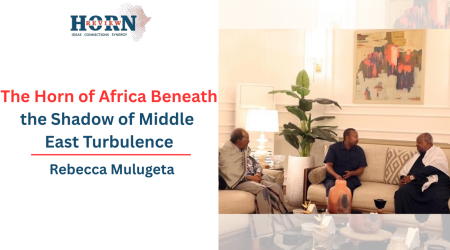
The Horn of Africa Beneath the Shadow of Middle East Turbulence
The Horn of Africa has officially evolved from a silent...
13
Mar
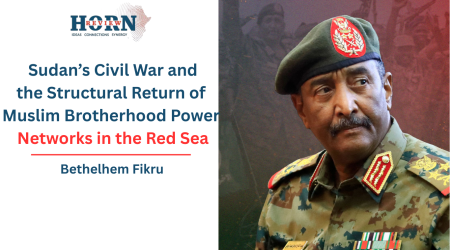
Sudan’s Civil War and the Structural Return of Muslim Brotherhood Power Networks in the Red Sea
Sudan’s current foreign alignment reflects the structural imperatives imposed by...
13
Mar
South Sudan’s Violence and The Strategic Unraveling of The Horn
For decades, the Horn of Africa has been defined as...
13
Mar
The Geopolitics of Energy and the Global Shift Beyond Regional War
Many scholars ask that, Do current U.S. strategic maneuvers from...