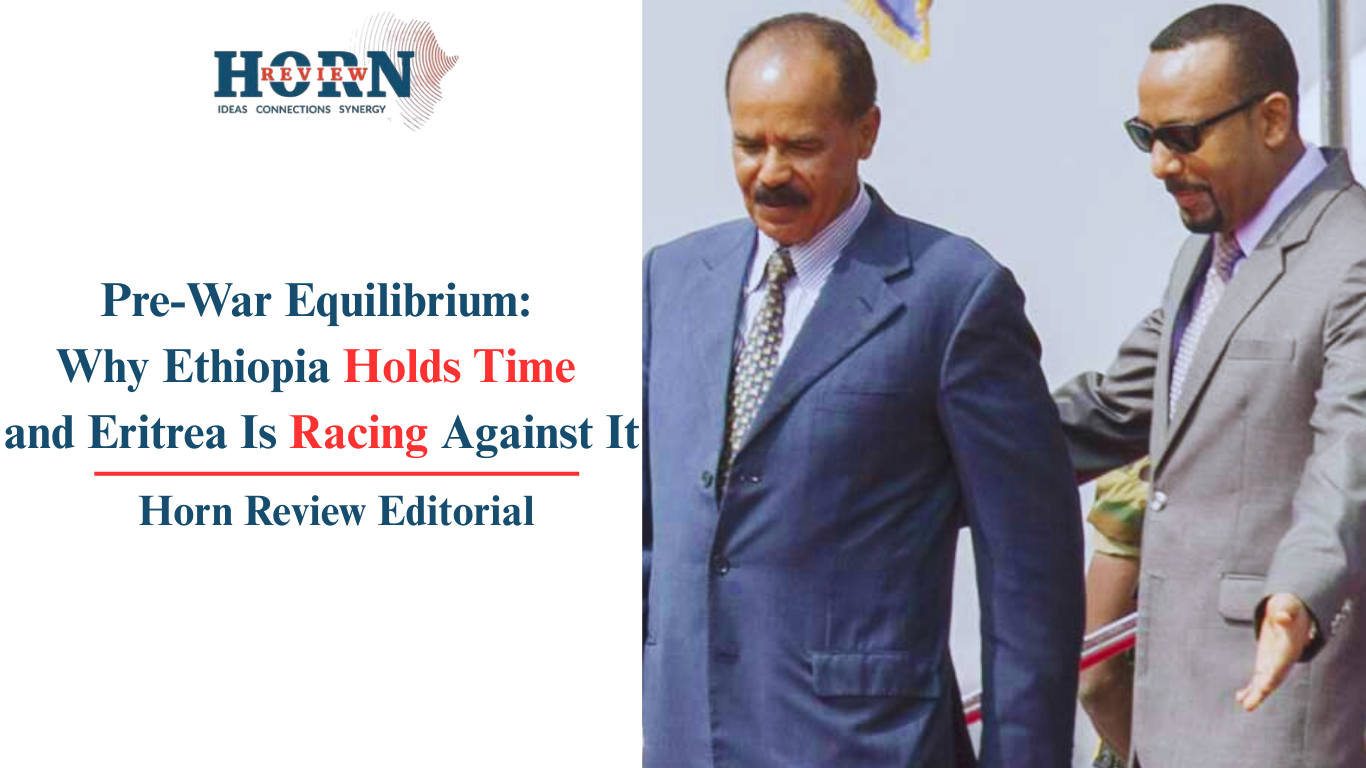
The contemporary dynamics of interstate relations between Ethiopia and Eritrea defy simplistic categorization within conventional dichotomies of “war” and “peace.” Rather, what is manifesting is a volatile pre-war equilibrium: a state in which deterrence endures, yet the structural, political, and military determinants that historically presage interstate conflict are increasingly salient and mutually reinforcing. Any rigorous assessment of imminent risk necessitates a perspective that transcends episodic indicators and situates present tensions within a multilayered matrix encompassing historical antagonisms, evolving regional geopolitics, and domestic structural fragility. From a diachronic standpoint, the 2018 rapprochement represents less a durable transformation than an episodic interruption within a protracted pattern of antagonism. Conflict between the two polities is structurally embedded – intermittently suppressed but never conclusively resolved. This framing underscores the salience of systemic analysis: contemporary tensions are not anomalies but rather expressions of enduring asymmetries, strategic calculations, and demographic and institutional trajectories.
Beyond Eritrea’s longstanding subversion against the Ethiopian state, the dispute can be analytically construed through legal-strategic prisms, particularly with regard to the Algiers Agreement. Questions of compliance, sovereignty, and residual prerogatives – most saliently concerning maritime access – remain unresolved. The Red Sea, and access to ports such as Assab, has transcended peripheral economic significance to assume a dimension of existential strategic import. Such structural imperatives circumscribe the latitude for compromise, particularly when juxtaposed with Eritrea’s equally intransigent interpretation of territorial sovereignty. Nonetheless, structural and juridical considerations alone fail to account for the immediacy of the current risk environment. That immediacy derives from the convergence of multiple destabilizing processes, foremost among them the re-fragmentation of northern Ethiopia in the aftermath of the Tigray War. The post-war settlement has proven tenuous, and renewed volatility in Tigray has reintroduced precisely the type of ambiguous security environment in which misperception and miscalculation are likely to thrive again. Eritrean overt interference functions as a catalytic variable, introducing disruption and amplifying instability, rather than serving as a structural counterweight. Localized confrontations can rapidly acquire interstate significance precisely because Eritrea acts as a disruptive actor within an otherwise asymmetrically structured system.
The broader regional architecture further amplifies systemic instability. The Horn of Africa is increasingly enmeshed within geopolitical crises extending from the Red Sea to the Gulf. The confrontation between Israel and Iran, alongside intensifying strategic competition among Gulf polities, injects additional volatility into regional alignments. Actors including Saudi Arabia, United Arab Emirates, Qatar, and Iran constitute stakeholders with material, military, and logistical interests along the Red Sea littoral. Their involvement – manifest through infrastructural investments, security partnerships, and proxy configurations – transmutes local bilateral tensions into nodes within a broader systemic competitive framework. Egypt persists as a strategic balancer within the region, while Eritrea functions more accurately as a disruptor than a counterweight to Ethiopian strategic initiatives. Cairo itself confronts escalating pressures – most notably vis-à-vis the Gulf Crises – raising questions regarding the durability and operational limits of its influence. Concurrently, instability in Sudan, the contested status of the Sudanese Armed Forces and the US designation of it as a terrorist group, and the dispositions of Somalia and Djibouti vis-à-vis Eritrea introduce additional vectors of systemic uncertainty. Within such a configuration, deterrence is inherently less stable, as actors must calibrate not only dyadic risks but also the cascading implications of regional systemic interdependencies.
Domestically, Ethiopia’s strategic calculus reflects a sophisticated balance of constraint and opportunity. While internal tensions in Tigray and Amhara, coupled with fiscal pressures from the Gulf crisis and the residual costs of prior conflicts, limit immediate large-scale engagement with Eritrea, these same dynamics enable the state to calibrate its actions deliberately. Historical precedent suggests that states navigating internal fragmentation can leverage external engagement selectively – not out of vulnerability, but as a means to optimize the strategic conditions for long-term objectives. In this sense, Ethiopia’s internal pressures function as instruments of strategic patience rather than points of systemic weakness. Most importantly, Ethiopia’s present leadership embodies a generational and strategic departure from prior patterns. Under Abiy Ahmed, statecraft is oriented toward a long-term vision encompassing economic integration, strategic autonomy, and eventual maritime reintegration. These objectives are temporally expansive, obviating the necessity for immediate confrontation. Delay, calibrated sequencing, and strategic patience thus function as mechanisms to enhance Ethiopia’s structural position, facilitating incremental accumulation of demographic, economic, and diplomatic capital.
Eritrea, in contrast, operates under a markedly compressed temporal horizon. Isaias Afwerki’s leadership cohort is aging, institutionally static, and deeply entrenched in secession-era structures. The durability of the regime is predicated upon preservation rather than renewal, while its demographic base has been attenuated through protracted national service obligations and extensive emigration. In this context, strategic patience carries divergent implications: measures construed as prudent deferral by Ethiopia may be interpreted in Asmara as strategic attrition, thereby intensifying the perceived urgency for preemptive action. It is within this divergence of temporal and strategic horizons that the comparative urgency of conflict emerges as an analytically determinative variable. Ethiopia’s leadership possesses the capacity for temporally expansive planning; Eritrea confronts a constricted strategic window. Consequently, the actor perceiving temporal compression is structurally more predisposed toward risk acceptance, including preemptive escalation. This systemic asymmetry – rooted in generational, demographic, and institutional differentials – renders the calculus of misperception and inadvertent escalation markedly asymmetric.
This analytical perspective does not presuppose intent, nor does it reduce complex strategic decision-making to a single determinant. Rather, it reorients the inquiry toward systemic conditions shaping risk: the immediacy of escalation is contingent upon structural asymmetries and perceptions of temporal advantage. While localized clashes in contested regions such as Tigray could theoretically generate escalation through misperception, signaling, and retaliatory logic, Eritrea’s prior attempts to provoke such dynamics have consistently failed, demonstrating the structural limitations of its capacity to induce interstate confrontation. Ethiopia, in contrast, exhibits a high degree of strategic resilience, capable of absorbing Eritrea’s disruptive provocations without undermining its long-term objectives. The present environment’s heightened precariousness derives not solely from mobilized grievances or force posturing, but also from the erosion of institutional mechanisms that might otherwise mitigate escalation. Diplomatic architectures established in 2018 have attenuated, regional mediation remains fragmented, and the discursive framing of elite decision-making has hardened. “Peace” persists, yet in a fragile and contingent form; the boundary between crisis and conflict is increasingly indeterminate.
War has not materialized – not because provocations have been insufficient, but because Ethiopia operates on a temporal horizon of strategic patience. In Ethiopia’s long-term calculus, immediate confrontation with Eritrea is unnecessary; the state is exercising maximum restraint, affording diplomacy repeated opportunities to succeed, as evidenced by the official letters dispatched to leaders of international and regional organisations and global and emerging powers and allies – by the Ethiopian Foreign Minister, Gedion Timotheos. The absence of war thus reflects not inaction, but Ethiopia’s developed capacity to absorb shocks from Eritrea’s persistent subversion and overt provocations without compromising systemic objectives. Here, it is also critical to situate this restraint accurately. Repeated portrayals of Ethiopia as poised to wage war over Assab misrepresent both the temporal asymmetry and Ethiopia’s strategic discretion. Ethiopia is not acting under temporal duress; Eritrea’s compressed horizon and aging political leadership generate the structural pressure for escalation. Ethiopia’s restraint demonstrates strategic foresight, institutional resilience, and demographic depth, allowing it to convert potential provocations into opportunities for strengthening its defensive position rather than precipitating conflict. Meanwhile, the Eritrean regime operates as a disruptive and provocative actor, yet within a framework in which Ethiopia maintains a decisive advantage in strategic clarity, military capacity, and long-term systemic leverage. In other words, Ethiopia’s restraint has turned Eritrea’s provocation into strategic opportunity – it is deliberate, patient, and in control of timing. Eritrea, on the other hand is pressed by age, leadership constraints, and strategic urgency. However, that doesn’t mean war is not inevitable, its rather not imminent, as long as Ethiopia continue to chose restraint of course.
By Horn Review Editorial