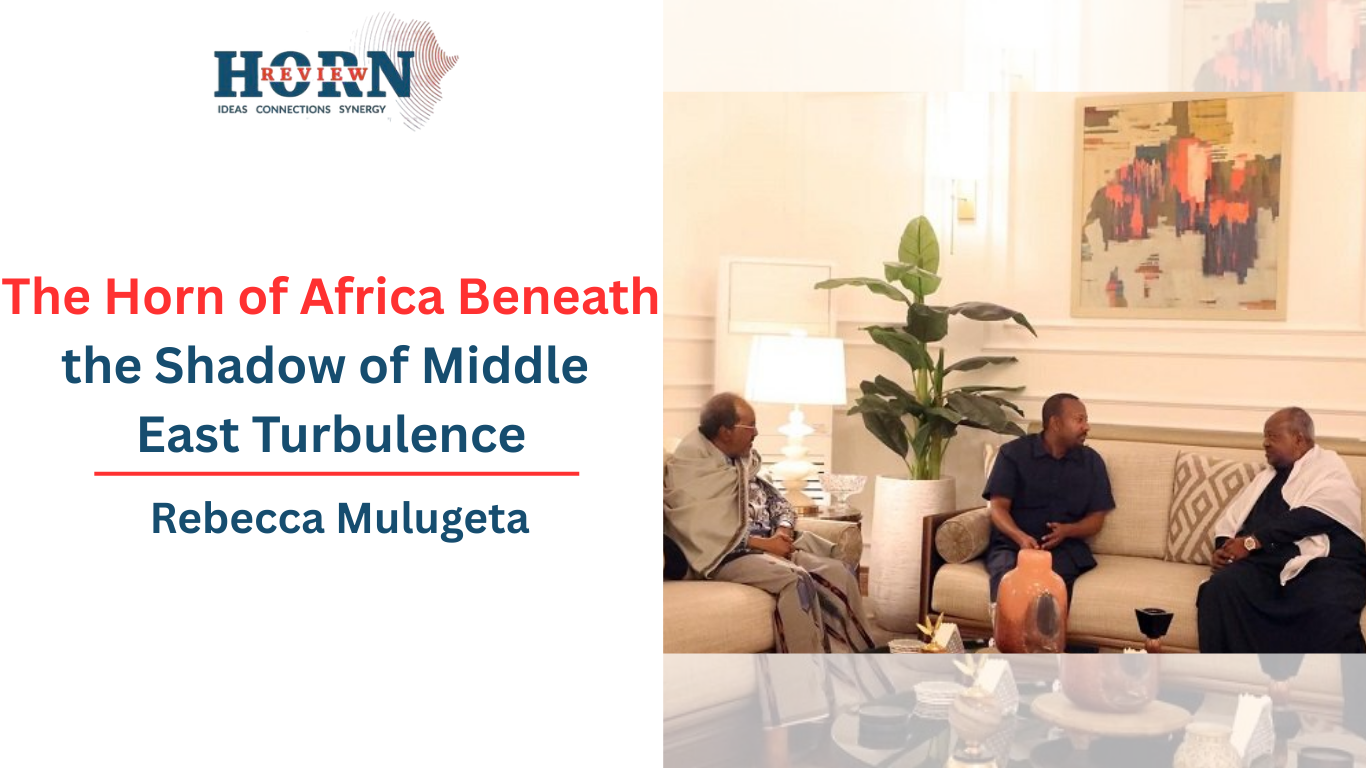
The Horn of Africa has officially evolved from a silent spectator of Middle Eastern volatility into a primary area for its strategic and economic aftershocks. While global attention remains fixed on the escalating tensions in the Levant, some shift is quietly occurring across the Red Sea. The recent summit in Djibouti between President Ismail Omar Guelleh, Prime Minister Abiy Ahmed, and President Hassan Sheikh Mohamud was far more than a routine diplomatic consultation; it was a clear signal that the region’s leaders recognize that the rivalries shaping the Middle East are now casting long shadows over their own soil.
This meeting, followed by the Ethiopian Prime Minister’s strategic visit to Abu Dhabi and high-level engagement with U.S. officials like Marco Rubio, suggests a sophisticated effort to manage shifting alliances. These diplomatic threads are likely aimed at easing friction between Somalia and the UAE while addressing the sensitive geopolitical discussions surrounding Somaliland, Israel, and Ethiopia’s existential search for reliable maritime access.
As some writers say “When your neighbor’s house is on fire, you should carry water to your own,” and the leaders of the Horn are doing exactly that. From the tragedy of the Sudan war to Somalia’s internal challenges and Ethiopia’s maritime quest, the map of the region is being redrawn by the same pressures that dominate the Gulf. This newfound trilateral engagement proves that for the Horn, regional integration is no longer just diplomacy, it is a vital survival mechanism. These nations are finding that “a bird that flies off the earth and lands on an anthill is still on the ground.” No matter how they attempt to distance themselves from Middle Eastern chaos, the very ground they stand on is shifting, forcing a defensive consolidation that prioritizes regional cohesion over the unpredictable interests of external powers.
Beyond tackling these external challenges, the recent diplomatic shift in Djibouti reveals that the Somalia-Eritrea-Egypt tripartite pact is increasingly becoming a relic of the past. This coalition has been largely paralyzed by Egypt’s internal fiscal crisis and a rapidly changing regional security landscape that Cairo can no longer afford to micro-manage. At the time of this change is the Bab el-Mandeb Strait a high-stakes maritime artery where Middle Eastern instability is no longer a distant headline, but a direct threat to the region’s economic survival. For Ethiopia, Djibouti, and Somalia, this means that a crisis in the Gulf translates immediately into empty ports and rising costs.
However, the ripple effects go deeper: the very powers currently embroiled in the Middle East confrontation have long been key players in the Horn, often pursuing divergent interests that fueled local rivalries. Now, as their own economies are hollowed out by the costs of direct war, these external actors are being forced to scale back their financial and military footprints in East Africa. This forced departure creates a massive power vacuum; as Middle Eastern involvement wanes, the geopolitical map of the Horn is being redrawn in real-time. From the shifting dynamics of the Sudan conflict to the security architecture in Somalia, the region is redrawing.
In fact Egypt is facing severe economic challenges that limit its ability to fund foreign infrastructure projects, including those in Doraleh port, Assab, or Somalia, reducing its influence in the Horn of Africa. Eritrea similarly lacks the resources to advance strategic ports or support regional development as planned. Specifically Egypt’s capacity for regional power projection is currently hitting a financial and strategic ceiling, as its internal economic dependencies largely anchored by Gulf capital are being strained by the very Middle Eastern volatility it seeks to navigate.
Egypt’s regional strategy is increasingly hitting a wall of fiscal reality. The projected $166 million required for the AUSSOM mission in Somalia is now mired in a massive funding shortfall, with current pledges covering barely half of the 2025-2026 budget. While Cairo attempts to project strength, the numbers tell a different story: the Egyptian economy is navigating a “safety zone” built on shaky grounds, with the Egyptian pound recently crossing the LE52 mark and the Suez Canal losing nearly $10 billion in revenue due to the Red Sea crisis.
This financial strain has turned Egypt’s ambitious infrastructure plans from interests in Doraleh and Assab to the $100 million dam financing package offered to Kenya into more of a diplomatic strategy than a confirmed reality. By early 2026, Cairo is essentially “buying regional relevance with borrowed Gulf time,” relying on massive infusions from the UAE and Qatar to keep its regional presence afloat. For the Horn of Africa, this means the Somalia-Eritrea-Egypt tripartite pact is increasingly viewed as an unsustainable alliance; it is an axis of convenience,
The recent Djibouti, Ethiopia and Somalia eventhough their discussions were framed in the language of trade and development, the underlying challenges stem from the region becoming a central node in a web of Middle Eastern geopolitical alignments. Somalia’s deep-rooted defense and infrastructure partnership with Turkey is a prime example; while providing essential security training, it also situates Mogadishu within a Turkish strategic framework that often diverges from Western or Israeli postures. This entanglement is further complicated by the Somaliland issue, where Turkey’s support for Somalia’s territorial integrity bolsters Mogadishu’s stance against independence, creating a complex intersection of local sovereignty and extra-regional influence.
Simultaneously, Djibouti’s role in this regional recalibration is governed by its status as Ethiopia’s primary maritime lifeline. Since Djibouti’s entire economic model is built on handling the vast majority of Ethiopian trade, any shift toward alternative maritime arrangements such as those sought by Ethiopia, Djibouti takes it as a direct threat to strategic dominance. More than that the region has increasingly attracted the attention of external powers seeking influence along the Red Sea corridor. Djibouti itself hosts military facilities belonging to several major powers, including the United States, China, and France. The concentration of foreign military bases within such a small geographic area reflects the strategic importance of the Bab el-Mandeb corridor for global trade and security operations. While these presences provide economic benefits and security guarantees, they also highlight how the Horn has become deeply embedded in the broader geopolitical competition.
At the same time, regional actors from the Middle East have expanded their economic and political engagement across the region. Saudi Arabia and Qatar have invested in infrastructure, development projects, and diplomatic initiatives aimed at strengthening their influence along the Red Sea. Egypt has also deepened its involvement in regional security dynamics, particularly through cooperation with Somalia’s military institutions. Egypt’s engagement reflects not only a commitment to regional stability but also its broader strategic rivalry with Ethiopia over the waters.
These overlapping alliances and rivalries create a geopolitical environment in which the Horn of Africa risks becoming a secondary arena for external competition. When Middle Eastern conflicts intensify, their political and economic consequences increasingly reverberate across the Red Sea. For countries in the Horn, this means navigating a delicate balance between benefiting from external partnerships and avoiding entanglement in rivalries that originate far beyond their borders.
Security concerns further complicate this picture. Somalia continues to face persistent threats from Al-Shabaab, a militant group that has carried out attacks across the country for more than a decade. The group’s resilience ensures that counterterrorism remains a central focus of regional and international cooperation. In an environment where geopolitical tensions are rising, there is growing concern that instability or competing foreign interests could create new opportunities for extremist groups to exploit divisions among regional actors.
Taken together, the Djibouti meeting and the US and Ethiopia conversation reveal a region navigating an increasingly complex geopolitical landscape. The region is no longer a peripheral arena in global politics. Instead, it has become a part where the interests of African states, Middle Eastern powers, and global actors intersect.
For the leaders the challenge is clear. They must find ways to shield their region from the escalating rivalries surrounding it while addressing their own internal challenges and economic vulnerabilities. The conversations that took place in Djibouti may represent an early attempt to build such coordination before external pressures intensify further.
What is increasingly clear, however, is that the Horn of Africa now stands at the center of a widening geopolitical arc stretching from the Gulf to the Red Sea. As tensions in the Middle East continue to evolve, the ability of Horn states to maintain stability, cooperation, and strategic independence will play a decisive role in determining whether the region becomes a zone of resilience or another front in an expanding landscape of global competition.
By Rebecca Mulugeta, Researcher, Horn Review