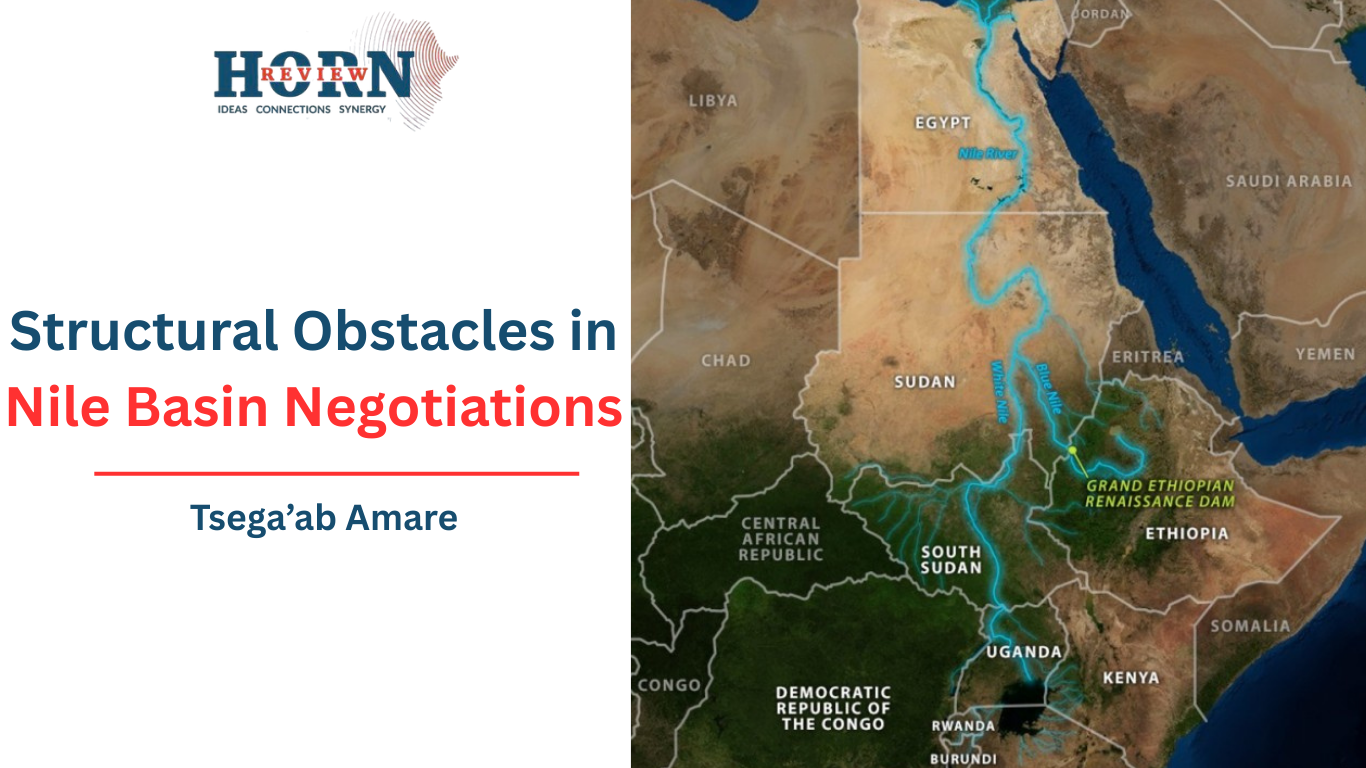
The hydropolitics of the Nile Basin have long represented an anomaly in the history of contemporary international relations. Despite the contest on the Grand Ethiopian Renaissance Dam (GERD) being legally addressable through established international norms, and hydrologically manageable through coordinated reservoir operations, it remains politically stagnant. However, the impasse does not arise from technical, legal, or hydrological complexities, but rather from the structural contradiction between the legacy of the colonial era and the emerging post-colonial reality.
The central claim of this analysis is that the principal obstacle to resolution is not dam safety, hydrology, or data sharing, but Egypt’s continued reliance on colonial-era arrangements and its refusal to accept a balanced post-colonial water-sharing framework.
In this context, Ethiopia’s position is developmental, sovereignty-based, and aligned with the principles of contemporary international water law, which emphasizes the interdependence of riparian states. On the other hand, Egypt has expanded the dispute beyond the hydropolitics of the Nile Basin, employing regional, diplomatic, security, and reputational instruments to constrain Ethiopia.
Any attempt at negotiations that does not address the issue of Egypt’s structural dependence on the colonial legacy is bound to fail, as Ethiopia would reject any arrangement that entrenches hydropolitical asymmetry.
The legal architecture that Egypt advances as the natural and historic status quo is based on the exclusionary treaties of the colonial era. The 1929 Anglo-Egyptian Agreement, which was an exchange of notes between the British government and the Egyptian authorities, granted Egypt 48 billion cubic meters annually, including an effective veto power over any projects in the upstream states. Britain, which acted as the colonial power in Sudan and East African territories, claimed to represent the interests of the entire Nile Basin, yet Ethiopia, which is the principal source of the Nile water, was neither consulted nor included.
Following the independence of Sudan, the 1959 Agreement for the Full Utilization of the Nile Waters was signed between Egypt and Sudan. This bilateral agreement divides the Nile water into a specific ratio, in which Egypt would receive 55.5 billion cubic meters of water, and Sudan would receive 18.5 billion cubic meters of water, accounting for the entirety of the Nile’s estimated annual flow at the time. This agreement essentially establishes duopolistic control over the Nile River, in which both nations are obligated to put up a united front against any claims by upstream riparian states. Egypt further disputes aspects of the 1902 treaty with Ethiopia, asserting that border demarcations are inseparable from alleged water obligations that Cairo interprets as a veto.
Egypt’s actions in the Nile River dispute are oblivious to the changing principles of sovereign equality in the contemporary era of international law. Under the Nyerere Doctrine, newly independent African states asserted that colonial treaties concluded without their consent were not legally binding. On the other hand, Ethiopia asserts that it has no obligation to comply with treaties in which it was never a party in the first place, invoking the res inter alios acta principle.
In the contemporary era of water law, the principle of absolute sovereignty has been replaced by the principle of equitable and reasonable utilization of water resources. Egypt’s selective legalism, invoking international law to enforce no-harm obligations while rejecting it when colonial privileges are challenged, remains a primary driver of the current deadlock.
Egypt’s self-perception as the principal custodian of the Nile is deeply embedded in national identity, where the river is framed as an existential issue rather than a shared resource. They consider the Nile River an existential issue for the Egyptian people, rather than merely a water resource. This essentially securitizes the Nile dispute, portraying upstream development as a threat to biological survival. Essentially transforming the Nile water dispute into a matter of national security, which constrains the space for compromise.
International Water Law and Ethiopia’s Legal Position
Ethiopia’s legal position is based on the evolution of customary and conventional principles of international water law, specifically the UN Watercourse Convention of 1997. Although neither Egypt nor Ethiopia is a party to the Convention, its core principles are widely regarded as reflective of customary international law. These principles include equitable and reasonable utilization and the obligation not to cause significant harm.
The GERD is a non-consumptive dam, i.e., it will generate electricity without permanently diverting water. Ethiopia argues that the dam provides downstream benefits by regulating flow, reducing sedimentation, and mitigating flood risks in Sudan. Sudanese technical experts and institutions have previously acknowledged the benefits of the dam, such as improved reliability of irrigation and increased dam safety.
Ethiopia has been quite clear and transparent about its red lines, as follows:
- No permanent colonial allocations, rejecting the 1959 agreement as a basis for negotiation.
- No veto power over any sovereign development projects that would prevent future development in the upstream.
- An equity-based framework, rather than clinging to the past, is based on modern principles of international law.
In March 2015, the three states, Egypt, Ethiopia, and Sudan, signed the Declaration of Principles in Sudan, outlining commitments to cooperation, development, and the obligation not to cause significant harm. After this agreement, however, divergent interpretations started to emerge, with Egypt claiming Ethiopia’s actions are a violation of the cooperative principles, and Ethiopia claiming its action as technically necessary and in conformity with the agreement, which does not grant veto authority.
From Hydropolitics to Grand Strategy
Egypt has increasingly expanded the GERD dispute, moving beyond water governance to a strategic contest. By raising the GERD dispute to the United Nations Security Council, Egypt portrays the dam as a threat to stability in the region, transforming a developmental issue into a security issue in order to justify international diplomatic intervention in the dispute.
Between 2024 and 2025, Egypt reinforced this approach through regional security alignments. Its August 2024 defense agreement with Somalia, following military shipments to Mogadishu, came soon after Ethiopia’s MoU with Somaliland. Cairo presents such moves as stabilization efforts, yet their timing and geography signal strategic messaging toward Addis Ababa, blending diplomacy with coercive leverage.
Egypt has also attempted to obtain political support in the Nile dispute from the Arab world. GCC statements linking Egyptian and Sudanese water security to Arab national security reposition the Nile dispute within a Middle Eastern geopolitical frame, diluting African-led mediation.
Western diplomatic efforts in the Nile dispute have been ineffective due to the equal weight accorded to the upstream and downstream concerns, failing to account for the historical inequalities in the Nile Basin, inherited from the colonial era. In fact, the 2020 U.S.-facilitated talks, followed by the suspension of aid, only strengthened Ethiopia’s position in the dispute.
With the Cooperative Framework Agreement (CFA) now in force, Ethiopia is operating within a basin-wide legal framework that minimizes the risk of external influence and limits the vulnerability to unbalanced agreements imposed from outside the region.
What a Viable Path Forward Looks Like
The way forward will depend on Egypt’s willingness to accept the post-colonial legal framework set forth in the CFA. This means moving beyond the rhetoric of “acquired rights” and engaging constructively within the NRBC framework. The essential elements of a viable way forward include the transparency of data through the sharing of real-time information between dams in the basin, cooperative drought risk mitigation strategies that respect the sovereignty of each state, and regional energy cooperation that seeks to leverage the hydroelectric potential of the GERD to drive basin-wide economic growth.
Conclusion: The Real Choice Facing the Nile Basin
The Nile negotiations remain stalled not because of hydrological complexity, but because Egypt remains anchored to an untenable historical position. Reliance on colonial-era entitlements fails to account for demographic, political, and legal transformations across the basin. Ethiopia’s position reflects a modern assertion of sovereign rights grounded in international law.
Mediation that avoids confronting colonial asymmetry perpetuates deadlock. The CFA’s entry into force and the establishment of the NRBC represent a structural shift that dismantles downstream veto claims. The central choice facing Nile Basin states is whether to remain bound by nineteenth-century legacies or to pursue a cooperative future grounded in equity and shared resilience. Ultimately, the Nile will test whether Africa’s shared resources are governed by contemporary legal norms or inherited colonial privilege.
By Tsega’ab Amare, Researcher, Horn Review