Sudan’s ongoing war is not a confrontation between a legitimate state and a rogue militia, but a struggle between two militarized actors who lack constitutional and democratic legitimacy, namely the Sudanese Armed Forces (SAF) led by Abdul Fattah al-Burhan and the paramilitary Rapid Support Forces (RSF) led by Mohamed Hamdan Dagalo.
The war’s dynamics illustrate the danger of conflating power with legitimacy. SAF’s claim to statehood rests largely on institutional continuity and control of formal state structures, while RSF relies on territorial dominance, former regime safeguards, and its control over Sudan’s gold resource, but neither SAF nor RSF possesses legal-rational legitimacy.What they have is coercive control rather than legitimate governance.
The December 2018 uprising began as an economic protest but quickly transformed into a nationwide pro-democracy movement demanding the end of Omar al-Bashir’s three-decade brutal rule. In April 2019, the Sudanese armed forces with the backing of the Rapid Support Forces, removed Omar al-Bashir. While many Sudanese celebrated his fall, the military takeover alarmed the Sudanese Civil society and the wider public. As tensions escalated, regional and international actors intervened. The African Union suspended Sudan and demanded a civilian-led transition. The United Nations, The AU, The U.S. and Ethiopia pressured both sides to reach a compromise. The result was the 2019 constitutional declaration and a joint civilian-military Sovereign transitional council, a fragile power-sharing arrangement that grants the military a first 21 month power stay and the civilian side the following 18 months.
By October 2021, tensions culminated when the military and the RSF staged a coup, detaining Prime Minister Abdalla Hamdok, dissolving the Sovereign council, and declaring a State of Emergency. The move came amid tensions over civilian demands for military reform, and impending transfer of power from the military to civilian hands. The coup entirely violates the 2019 transitional charters power sharing deal among the military and civilians and represents a major setback on the democratic transition that the Sudanese people have been striving for, and most importantly undermines the only source of legitimacy in post-Bashir Sudan- The 2019 constitutional declaration.
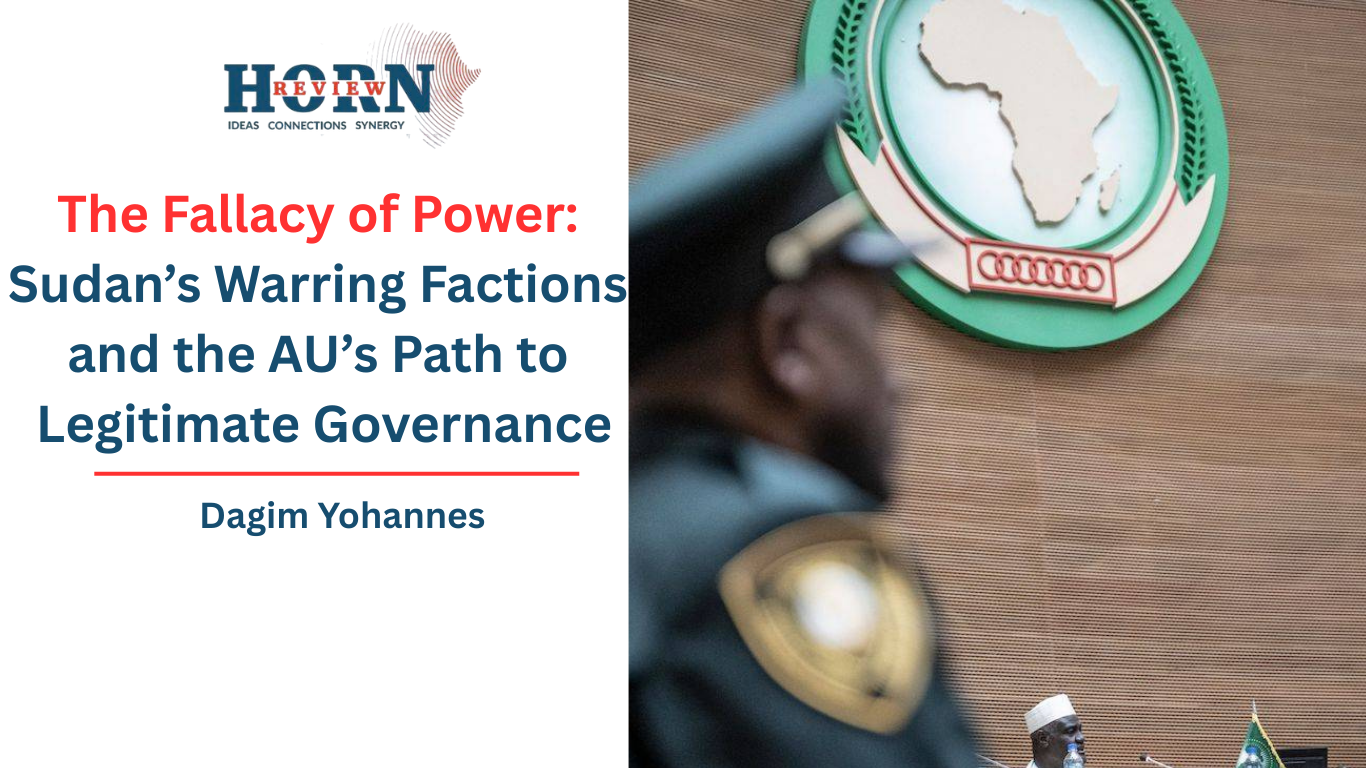
Following the Coup, the African union peace and security council strongly condemned the military’s seizure of power and the dissolution of the Sudan’s transitional government as an unconstitutional change of government and decided to suspend Sudan from all AU activities until the effective restoration of civilian-led transitional authority.
After the war, which began in April 2023, apart from military confrontation, both sides intensified the political contest for recognition and legitimacy. SAF has adopted a strategy focused on projecting de jure continuity. The transitional sovereign council retains Sudan’s UN seat, and is recognized by the Arab League, and recently it returned to the regional block IGAD, after returning to Khartoum, SAF established the so-called “Hope Government” and appointed Kamil Idris to lead. Unlike SAF’s reliance on institutional continuity, the RSF has grounded its strategy in territorial control. Across swaths of territories in Darfur and Kordofan, it is attempting to convert military dominance into political authority. In February 2025 the founding charter of Tasis alliance was signed in Nairobi, Kenya by RSF and allied political and armed groups, laying the groundwork for the “Government of Peace and Unity” headquartered in Nyala, South Darfur.
The African Union Peace and Security council has rejected the initiative, warning that parallel structures risk deepening fragmentation and pushing Sudan toward partition. The AU guided by the Lomé Declaration and reinforced by the African Charter on Democracy, Elections and Governance suspended Sudan following the October 2021 coup, classifying it as an unconstitutional change of Government. This decision reflects The AU’s normative commitment to legal-rational legitimacy, which both RSF and SAF lacks, during The 39th Session of The AU summit, the SAFled government requested the suspension on Sudan to be lifted, but the union maintained its suspension, affirming that reinstatement is conditional upon the restoration of a civilian-led constitutional framework.
For The AU reinstating Sudan under a military-led authority amid ongoing conflict would risk legitimizing coercive power and weakening The AU’s normative stance against unconstitutional changes of government. By upholding the suspension, The AU reinforces the principle that territorial control and institutional continuity cannot substitute for constitutional legitimacy.
The trajectory of Sudan’s conflict demonstrates that neither side possesses constitutional or democratic legitimacy. Both actors operate within a legitimacy vacuum shaped by coercion rather than constitutional authority. In these context regional and international actors must exercise normative consistency by refraining from political engagement that confers implicit recognition upon either side. Diplomatic normalization absent constitutional restoration risks entrenching the principle that sovereignty ultimately resides in the people of Sudan.
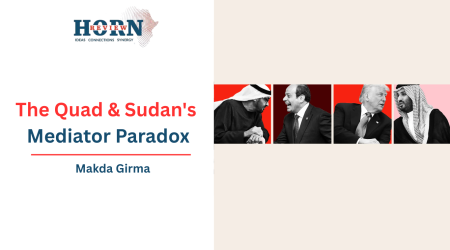
While national interest inevitably shapes foreign policy decisions, external actors should prioritize stability rooted in civilian authority rather than short term strategic convenience. The Muslim brotherhood insurgence in SAF led government shall restrain nations like the U.S and the Quad members engagement with the faction, Similarly the RSF has multiple allegations on its back, this shall alarm nations on their engagement with the Paramilitary group. The sustainable path forward for Sudan lies on the African unions roadmap that outlines inclusive civilian-led transitional process that can restore constitutional order and legitimacy in the War-torn nation.
By Dagim Yohannes, Researcher, Horn review