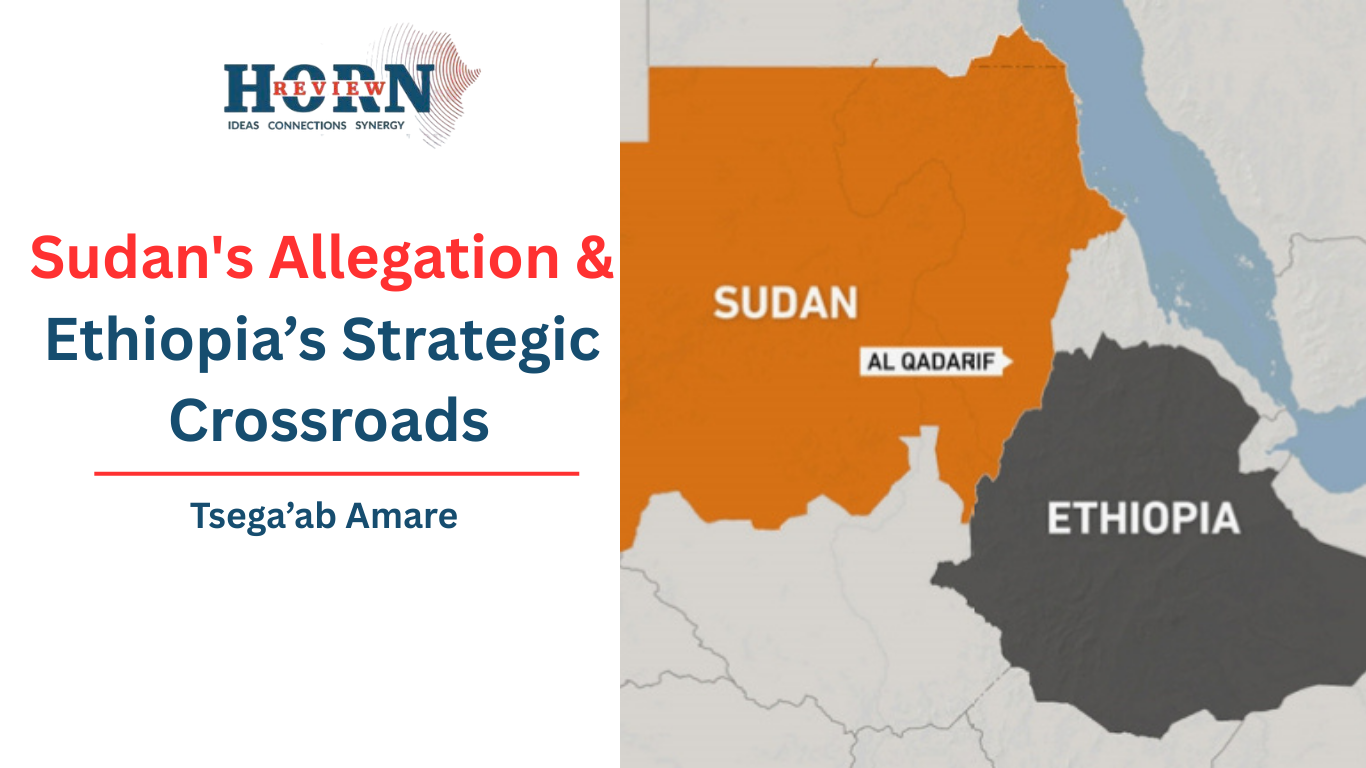
The relationship between Addis Ababa and Khartoum, already tense due to sustained friction over issues related to the Grand Ethiopian Renaissance Dam and the border conflict over Al-Fashaga, has entered a new phase of turbulence. On 2nd March 2026, Sudan’s Ministry of Foreign Affairs accused Ethiopia of allowing Unmanned Aerial Vehicles (UAVs) to use its airspace. According to them, drone strikes carried out near Kurmuk, in Blue Nile State, were made possible from Ethiopian territory.
This is not mere rhetoric; these are attempts to rewrite the boundaries of internal conflict. As the Sudanese Armed Forces and the Rapid Support Forces vie for supremacy, these accusations of cross-border complicity have significant strategic value. However, it is essential to separate utility from reality.
Kurmuk is a strategic location in the Blue Nile State, bordering Ethiopia’s Benishangul-Gumuz region, making it an obvious flashpoint. In addition, Drone warfare is undoubtedly increasing across Sudan, with hundreds of strikes recorded nationwide since the war’s outbreak and mounting civilian casualties.
However, it is essential to remember that the fact that conflict is taking place near a border is not evidence of cross-border complicity. Drone warfare is becoming more prevalent globally, and new generations of drones have ranges that do not require a cross-border sanctuary. Sudan’s battlefield has already demonstrated the internal acquisition and deployment of increasingly sophisticated aerial systems by both belligerents. Without any evidence of radar data, wreckage analysis, and satellite imagery, it is impossible to assert whether Ethiopian soil is indeed being used for drone strikes. Conflict is often filled with information warfare, and these accusations might be attempts at diplomatic pressure rather than actual reality.
The proposition that Addis Ababa would deliberately facilitate RSF operations appears strategically inconsistent. Ethiopia’s core national interest lies in border stability. A destabilized Blue Nile directly threatens western Ethiopia with refugee inflows, arms proliferation, and potential insurgent spillover. Facilitating one faction in Sudan’s civil war would invite reciprocal retaliation, a scenario that Ethiopia, while managing domestic security pressures in Amhara and Tigray, can ill afford.
Ethiopia’s economic and political interests are centered on conflict de-escalation rather than entanglement. The GERD, its flagship national development project, is at a critical juncture of regional diplomatic engagement. Being accused of belligerent intent would risk consolidating Sudanese Nile policy along with Egypt, thus bolstering rather than undermining any chance of negotiation. In other words, Ethiopia stands accused of actions that would not only damage its bilateral relationship with Khartoum but could potentially create additional leverage for Egypt in its Nile basin disagreement, thus complicating an already volatile diplomatic equation.
Ethiopia’s traditional stance regarding Sudan’s crisis has been one of judicious engagement. Although Addis Ababa hosts and accommodates refugees and supports a multilateral framework for conflict resolution, it has avoided taking sides with any of the warring parties. This approach leaves room for engagement with any party that might consolidate power in Khartoum. While emphasizing and working towards preserving the unity of Sudan. Undermining any of these efforts through covert facilitation would run counter to Ethiopia’s traditional strategic approach.
It is conceivable that rogue actors, private networks, or informal armed groups could exploit porous border areas without formal state sanctions. Border regions in the Horn of Africa have historically been fluid and difficult to police comprehensively. However, sporadic or unsanctioned activity does not equate to state policy. Ethiopia maintains both the institutional incentive and the security rationale to prevent its territory from being used as a platform for cross-border military operations. To conflate potential irregular activity with deliberate state facilitation risks analytical overreach.
The drone accusations must also be viewed through the prism of Al-Fashaga. By portraying Ethiopia as a violator of Sudanese sovereignty, the Sudanese Armed Forces create a plausible scenario that can be used to justify their hot pursuit or preemptive securitization of the border under international law. However, international law requires a very high standard of proof to retaliate against another state in a border conflict. Sovereignty claims based on unverified drone activities run the risk of escalating a local conflict to a bilateral one. For Sudan, this will mean additional pressure on its overstretched military resources. For Ethiopia, this will add another security front to its existing conflicts. Neither state stands to benefit from such a trajectory.
Another point of issue, Sudan’s war has escalated to a technologically enabled conflict in which perception plays a major role in determining success on the battlefield. Accusations of foreign support, whether targeting Ethiopia, Egypt, or other foreign actors, serve to internationalize blame and generate diplomatic pressure. In this context, Ethiopia serves as a convenient narrative target. Its border adjacency, its unresolved disputes with Sudan, and its centrality in Nile geopolitics make it susceptible to rhetorical linkage. Narrative proximity, however, should not be conflated with operational complicity.
The humanitarian consequences of the drone attacks in Blue Nile are obvious and undeniable. The reported cases of displacement and drone-related damage emphasize the need to de-escalate the situation as quickly as possible. Evidence-based attribution is necessary and should not be replaced with escalation rhetoric. If there is concrete and credible proof, it should be presented through official diplomatic or international channels.
Addis Ababa would be well served to invite third-party technical verification or joint border monitoring mechanisms to ensure transparency and reinforce its stated neutrality. Such confidence-building measures would reduce ambiguity while signaling commitment to regional stability.
Ethiopia stands at a sensitive geopolitical juncture. Its western border intersects with an active civil war. Its flagship infrastructure project remains diplomatically contested. Its domestic landscape requires sustained stabilization. In such an environment, the rational course is containment, not entanglement.
The drones themselves are precision weapons, while the accusations against them can be strategically imprecise in their application and use. Ethiopia must move away from factional warfare and towards protecting itself against it while maintaining transparency and deterrence.
In a region where wars do not remain confined to the borders drawn on the maps that started them, strategic restraint is not weakness. It is statecraft.
By Tsega’ab Amare, Researcher, Horn Review