The “Red Sea Arab Lake” Doctrine, also described as the “Arab Sea” or “Arab Lake” concept, represents a geopolitical approach adopted by some Arab states, notably Egypt and Saudi Arabia, which treats the Red Sea as an area exclusively under the influence of Arab littoral nations. This approach stresses collective Arab stewardship over the waterway’s security, resources, and governance, often drawing on historical, cultural, and strategic rationales to legitimize and reinforce that dominance. It draws parallels to historical concepts like the Roman “Mare Nostrum” in the Mediterranean, where a dominant power or coalition treats a sea as an internal lake under its influence. In this case, the doctrine is not a formally codified policy but a discursive framework advanced through diplomatic rhetoric, alliances, and regional forums, aimed at sidelining non-Arab actors like Ethiopia from asserting sovereign claims or military footholds along the Red Sea coast.
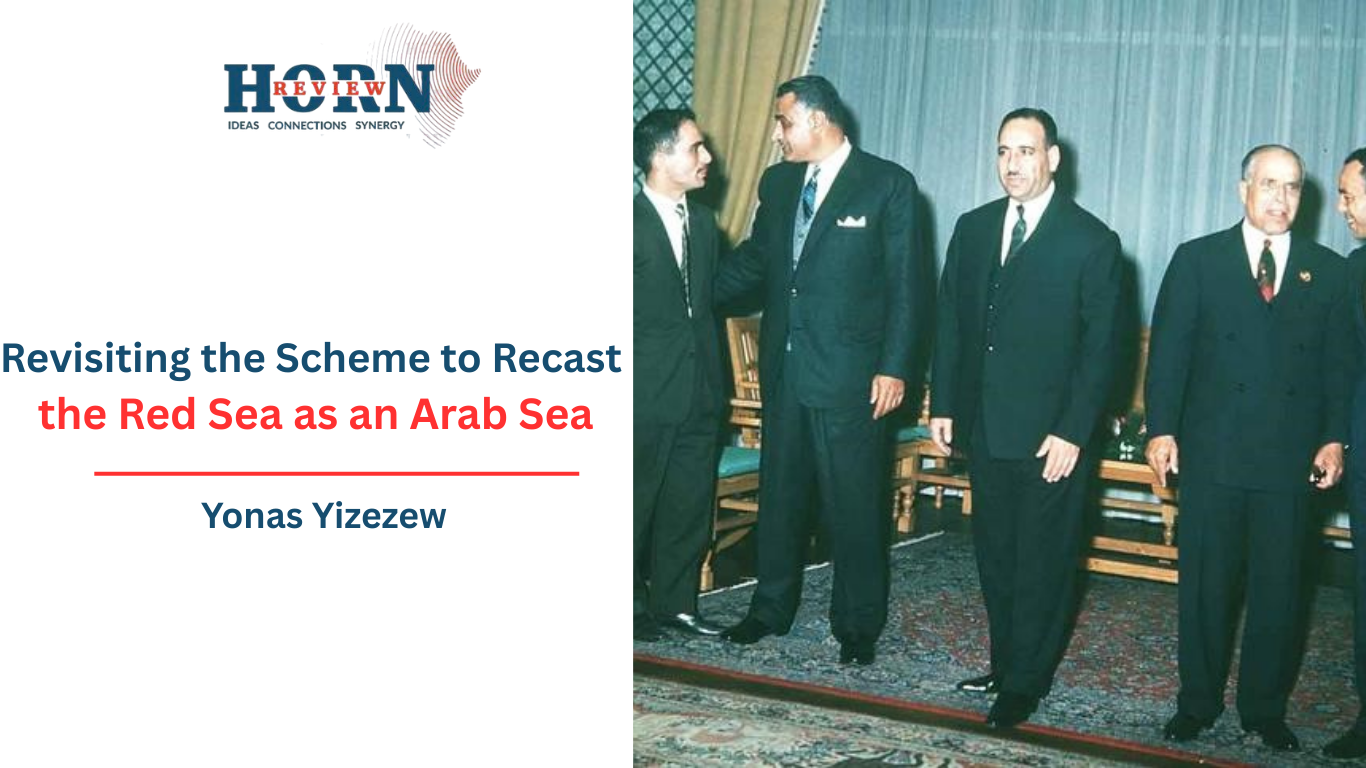
Mohammed Hassanein Haikal captured the mindset of a moment when power and place were being rewritten along a vital maritime corridor. In a 1971 dispatch he put the idea plainly:
“The domination of the Red Sea has always been an important Egyptian policy from Thutmose III to the days of Gamal Abdel Nasser. Since all the states surrounding the Red Sea are Arab States, this sea would have to be considered an Arab Lake. To that end, a naval command should be established to help its complete Arabization.”
Even though these assumptions have their flaws, they reveal the narrative that Egypt seeks to advance regarding the Red Sea. That line reads less like nostalgic history and more like a foreign policy thesis. It tells us that for some capitals, the Red Sea was not merely a route for commerce but a strategic arena to be shaped by politics, identity, and influence.
The comment made by Haikal, a former editor of the Egyptian daily newspaper, Al-Ahram and once an advisor for Gamal Abdel Nasser, helps explain why the phrase carries both literary flourish and political weight.
Geographically, the Red Sea is a tightly bounded corridor as Bab el‑Mandeb links it to the Indian Ocean in the south; in the north it forks into the Gulfs of Aqaba and Suez, with Sinai between, and via Suez to the Mediterranean. Whoever dominates these choke points dominates a vital artery of global trade and energy.
Historians continue to debate whether President Nasser’s plan to turn the Red Sea into an Egyptian lake was a genuine expression of pan-Arab policy or a form of Egyptian nationalism cloaked in pan-Arab rhetoric. Nasser’s (and initially Neguib’s) first step toward achieving “Arab unity” and control over the Red Sea was an effort to persuade Sudan to join a progressive union with Egypt based on shared culture, destiny, and economic interdependence. When Sudan opted for independence in 1956, Egypt publicly accepted the decision but covertly encouraged rebellion. The subsequent Suez Crisis further shifted priorities, and Sudanese unity became secondary to the broader vision of a united and powerful Arab nation controlling strategic assets such as the Suez Canal, Bab el-Mandeb, and a significant portion of the world’s proven oil reserves. In practical terms, this strategy effectively aimed to turn the Red Sea into an Arab lake.
Within this framework, Eritrea’s secessionist movement became a tool. From 1960s, the Eritrean Liberation Front’s Muslim, Arab‑oriented turn made it attractive to Arab governments. Supporting Eritrean secession promised two dividends, transferring Eritrea’s entire long coastline to the Arab camp and weakening Ethiopia internally by triggering a chain reaction of fragmentation. Egyptian and Arab advocacy of Eritrea as an “Arab state” was less about solidarity than about extending the Arab maritime belt.
Before Eritrea’s independence, Arab League members already controlled about 81 percent of the Red Sea coastline. Only Ethiopia and Israel, together holding the remaining 19 percent, lay outside this Arab ring. Turning the sea into an “Arab lake” meant erasing those non‑Arab coastal footholds.
From the 1970s onward, Arab discourse reframed the Red Sea as a collective Arab‑Muslim space for three intersecting reasons. First, religious solidarity provided a unifying framework, emphasizing the Red Sea as a shared space only for the Arab and Muslim world.
Second, confrontation with Israel took a maritime dimension as closure, the threat of closure, or control of navigation in the Red Sea became instruments to pressure Israel, especially after the wars of 1967 and 1973, serving as a strategic lever to force concessions on Palestine. Suez, Bab el‑Mandeb, and associated routes were imagined as Arab strategic assets to be wielded as tools of coercive diplomacy.
Third is regional hegemony: Egypt, and to a growing extent Saudi Arabia, sought to anchor their leadership by promoting the Arabization of littoral societies such as Eritrea’s and by embedding the Red Sea in broader Arab political and cultural projects. Whether Nasser’s vision for the Red Sea was driven by sincere Pan-Arab ideals or by Egyptian nationalism dressed in universalist rhetoric, the practical outcome was largely the same, a consolidation of Arab influence over the seascape and a corresponding marginalization of Ethiopian agency.
Prince (later King) Fahd of Saudi Arabia spelled out the security framing when he stated;
“The present Ethiopia policy constitutes an open aggression against arab nationalism. Therefore, we in the Kingdom call for coordination and cooperation between the Arab and Muslim states bordering the Red Sea, especially between Sudan, Somalia, and the three Eritrean Liberation Movements. They should unite in order that a strong alignment is established to ward off the danger.”
Here, Ethiopia itself is cast as the problem to be contained so that an Arab‑Islamic maritime space can be consolidated. Saudi Arabia’s posture can be read within the broader Cold War setting. In the 1960s and 1970s, the Red Sea was increasingly militarized. Soviet naval access through South Yemen and Ethiopian alignment with Moscow heightened Saudi threat perceptions. Saudi Arabia, as a Western ally, sought to counter the Soviet Union’s expanding presence and influence in the region and to preserve its strategic leverage in the Red Sea. In this sense, The Arab Lake project was as much a Cold War phenomenon as it was a regional contestation.
Eritrea’s independence fundamentally reshaped the coastline map. Egypt and Saudi Arabia became the main beneficiaries, no longer having to contend with an Ethiopian coastline and thus freer to project influence along two of the longest Red Sea shores. The idea of the Red Sea as an Arab lake, once partly aspirational, was now supported by facts on the ground: the sole sub‑Saharan non‑Arab state with direct Red Sea frontage had been pushed inland.
This was not an accidental by‑product of decolonization but the culmination of a long political and ideological campaign and conspiracy. From the 1950s, Arab governments gradually realized that an ELF victory could both Arabize a critical stretch of coast and open a flank against Israel and Ethiopia. In this calculus, Ethiopian territorial integrity and future maritime sovereignty were acceptable collateral damage.
In recent years, these older ambitions have found new institutional forms. The Red Sea Forum (RSF), created in 2018, brings together Arab and other coastal states to coordinate security and political approaches to the Red Sea and Gulf of Aden. Ethiopia, the most populous country in the Horn of Africa and a central player in Nile and Red Sea politics, was conspicuously excluded.
A delve into the forum highlights the Red Sea as a regional security complex marked by asymmetrical power, persistent alignment‑realignment, and a clear pattern: coastal Arab states and their external partners consolidating a maritime security regime in which landlocked Ethiopia is treated as a secondary, if not expendable, stakeholder.
For Ethiopia, exclusion from the forum is not a mere diplomatic slight but a strategic vulnerability. The forum could, in crisis scenarios, legitimize port shutdowns, naval blockades, or coordinated pressure on alternative port arrangements, tightening the noose around Ethiopia’s already constrained access to sea lanes. At the same time, inclusion could offer benefits: neutralizing Egyptian subversive activities, facilitating energy and investment, enhancing naval and technical know‑how, and improving the safety of Ethiopian shipments crossing the Red Sea. Maritime governance frameworks are being shaped without Ethiopia, even though they directly and significantly affect its economic and strategic lifelines.
Contemporary Egypt has consistently invoked the Red Sea as an exclusively littoral issue in response to Ethiopia’s assertions of sovereign access. Across various international forums and bilateral engagements, Cairo frames the sea this way to sideline Ethiopia’s maritime ambitions, presenting the matter as one that concerns only the states directly on its shores.
Egypt continues to see the Red Sea, Suez Canal, and Bab el‑Mandeb as strategic pillars of its national security and regional influence, and actively works to prevent any Ethiopian foothold along these critical maritime corridors. The rhetoric of the Red Sea as an Arab or Egyptian lake may be less explicit than in Haikal’s day, but the underlying intent remains: to dominate maritime transit, seize control of strategic islands and facilities, and manipulate regional diplomacy to bend Red Sea governance entirely to Egyptian interests.
By Yonas Yizezew, Researcher, Horn Review