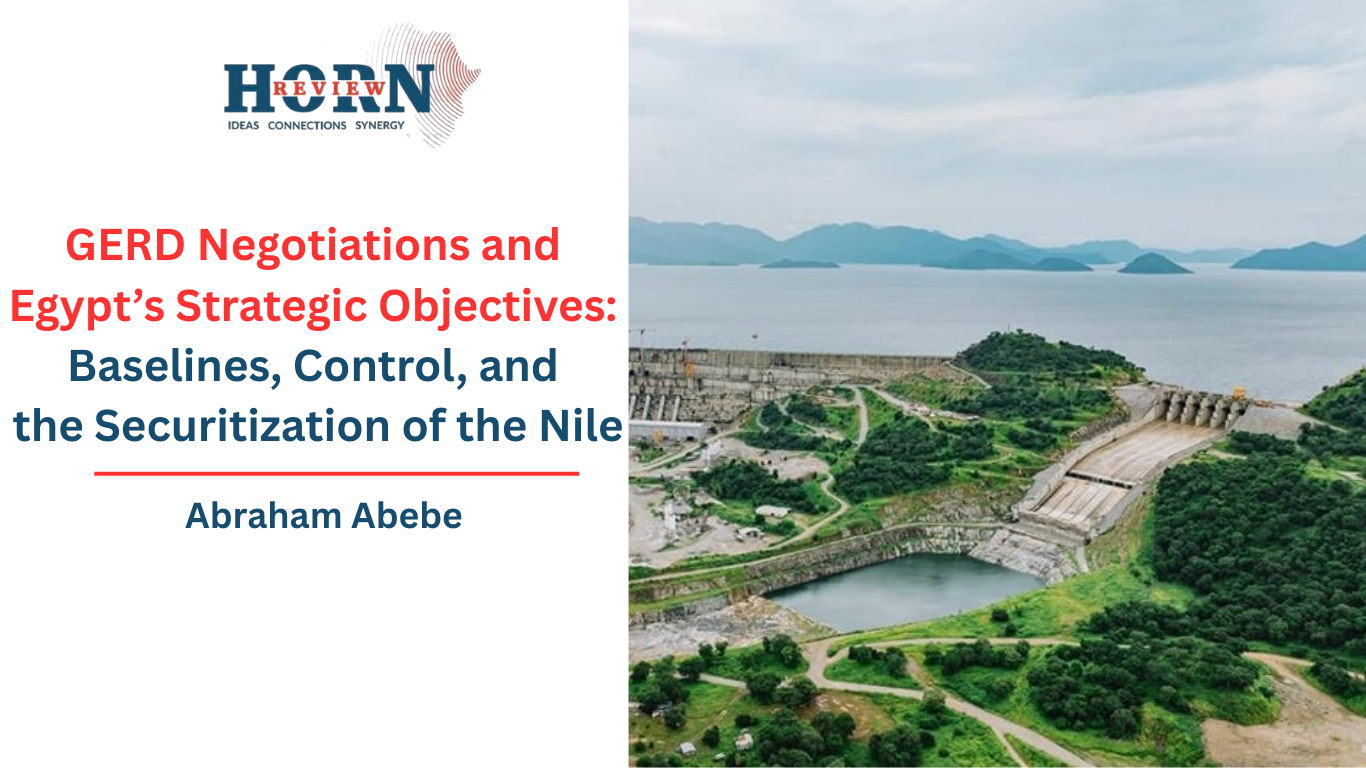
Since the launch of the Grand Ethiopian Renaissance Dam (GERD), negotiations among Ethiopia, Egypt, and Sudan have often been presented internationally as a technical dispute over hydrology, dam safety, and downstream water security. While politically expedient, this portrayal diverts attention from the core political realities driving the negotiations. Across more than a decade of talks, Egypt’s negotiating behavior reflects a consistent strategic objective: preserving downstream dominance over Nile governance by constraining Ethiopia’s sovereign control over the Blue Nile. The GERD dispute is therefore less about water management than about power, hierarchy, and authority in the Nile Basin.
From the outset, Egypt’s preferred objective was to prevent the dam’s construction altogether. In the period immediately before and after Ethiopia’s announcement of GERD, Cairo relied on diplomatic pressure, securitized rhetoric, and internationalization to delegitimize the project. The assumption underpinning this approach was that large-scale upstream storage infrastructure on the Blue Nile remained politically reversible. From Egypt’s perspective, GERD challenged a hydro-political order built on downstream predictability and inherited privilege. Ethiopia’s framing of the dam as a sovereign development project, coupled with domestic mobilization and irreversible construction progress, ultimately rendered this strategy untenable.
When prevention failed, Egypt recalibrated. The shift was not toward accommodation, but toward control without ownership. This transition defined the second phase of the negotiations, most visibly during the International Panel of Experts (IPoE) process. Technical scrutiny was increasingly deployed as a means of delay and design containment. Egypt’s negotiating posture focused on narrowing GERD’s scale and significance by questioning its height, storage capacity, and power generation potential. Ethiopia, by contrast, accepted technical review while sustaining construction momentum, thereby neutralizing technical assessment as a blocking instrument.
The Declaration of Principles (DoP), signed in Khartoum in 2015, marked a structural turning point that Egypt neither anticipated nor fully embraced. By signing the DoP, Egypt formally recognized GERD as an Ethiopian project, positioning itself as an external stakeholder rather than a co-owner. More importantly, the agreement anchored the negotiations in the principle of equitable and reasonable utilization, shifting the legal framework away from absolute no-harm doctrines and exclusive historical claims. This development challenged Egypt’s long-standing narrative of unilateral Nile ownership. While Cairo viewed the DoP as a stabilizing arrangement, its legal implications proved more consequential than anticipated.
Subsequent negotiations between 2015 and 2017 moved into technical committees and national consultations to implement the DoP. During this phase, Egypt sought to convert recognition into leverage by embedding baseline protections and strict downstream safeguards within technical rules. Agreement was reached on several technical parameters, but progress consistently stalled when discussions turned to legal commitments. The impasse did not reflect technical disagreement; it reflected Egypt’s refusal to separate operational arrangements from historical allocation claims.
This pattern became explicit in 2018, when a five-member scientific committee was tasked with resolving outstanding issues. According to the report, scientific convergence was achieved on key elements, only for Egypt to withhold endorsement once it became clear that predetermined historical baselines would not be incorporated. The collapse of this phase highlighted the limits of expert-driven processes in the absence of political willingness to revise inherited privilege. Negotiations did not fail because of technical disagreement; they reached an impasse when Egypt refused to move beyond historical baseline and guaranteed release demands, leveraging procedural engagement to maintain downstream control while avoiding binding legal commitments.
At the center of Egypt’s negotiating posture lies the demand for guaranteed water release. Cairo has consistently insisted on a fixed annual release of approximately 40 billion cubic meters, regardless of hydrological variability, drought, or climate uncertainty. Under this framework, even marginal shortfalls would constitute legal violations. These demands effectively reject risk-sharing and prioritize absolute certainty for Egypt over Ethiopia’s interests. To legitimize these claims, Egypt has persistently framed the Nile as an existential life or death issue. This narrative functions less as hydrological assessment than as political instrument, designed to justify exceptional claims and override established principles of international water law.
Closely linked to guaranteed releases is Egypt’s insistence on preserving historical allocation baselines; 55.5 billion cubic meters for Egypt, 18.5 billion for Sudan, and zero allocation for Ethiopia. These figures originate from the 1959 Nile Waters Agreement concluded between the British colonial authorities administering Egypt and Sudan. Ethiopia was neither a party nor a participant. As a non-signatory upstream state, Ethiopia is not legally bound by the agreement and has formally rejected all colonial-era water arrangements. In this context, historical rights function not as law, but as political narrative. Baselines serve as a proxy for colonial-era privilege, effectively transforming historical imperial-era consumption into claims of permanent entitlement.
The implications for GERD are profound. Acceptance of baseline logic would reduce the dam’s role to a largely symbolic function, stripped of operational autonomy and developmental value. Ethiopia would retain ownership while relinquishing control, effectively transforming GERD into a flow-regulating facility primarily serving downstream interests. Egypt’s preference for multiple release outlets, rigid operational constraints, and extensive control mechanisms would effectively bring GERD under operational control aligned with Egypt’s hydraulic priorities. Cooperation, under such terms, becomes indistinguishable from subordination.
These dynamics intensified during the U.S.-World Bank–facilitated the Washington process between 2019 and 2020. Egyptian demands escalated to include joint management of GERD, priority filling of the Aswan High Dam during droughts, and operational veto authority. The Washington Draft institutionalized Egypt’s historical allocation and imposed constraints that disproportionately limited Ethiopia’s operational flexibility. Negotiations became politicized, moving from technical water ministries to the U.S. Treasury, where they were influenced by broader regional agendas. Ethiopia’s rejection of the Washington Draft reflected not intransigence, but resistance to the legalization of control.
Following the collapse of the Washington process, negotiations shifted to an African Union–led framework. Egypt pursued internationalization via the UN Security Council, portraying Ethiopia’s filling of GERD as unilateral and destabilizing. While AU-led talks emphasized African solutions, Egypt’s insistence on baseline guarantees persisted. External pressure amplified diplomatic noise but did not alter the substantive bargaining positions. Informal talks in Abu Dhabi, leader-level meetings in Cairo and Addis Ababa, and later engagement phases maintained procedural continuity but achieved no substantive progress.
Institutional arrangements further illuminate the strategic divergence between the parties. In Ethiopia, negotiations are led by civilian technical institutions, with diplomacy playing a coordinating role. In Egypt, substantive authority rests with Egypt’s General Intelligence Service (GIS, Muhabrat Alhane). Water governance is treated as a strategic security file rather than a developmental or technical domain. Civilian water institutions function largely as administrative facades. This securitization is embedded institutionally rather than merely rhetorical, underscoring Egypt’s perception of the Nile as a strategic asset to be defended and controlled, rather than a shared resource to be managed.
Any assessment of GERD that ignores its domestic political economy is analytically incomplete. The project is uniquely financed through popular mobilization and domestic contributions, rather than external lending. For Ethiopians, GERD embodies collective sacrifice, development autonomy, and sovereign equality, often framed as a modern echo of historical resistance, most notably the victory at Adwa. This asymmetry lies at the heart of the dispute: Ethiopia bears the financial and political costs of development, while Egypt seeks guaranteed benefits without shared risk or contribution.
GERD is therefore not merely a dam. For Ethiopia, it represents sovereign agency and a structural rebalancing of Nile Basin politics. For Egypt, it symbolizes the erosion of a hydro-political order long anchored in unilateral control. Egypt’s broader posture in the Horn of Africa, including efforts to constrain Ethiopia’s strategic space and oppose its pursuit of diversified economic and strategic access to the sea, cannot be separated from its approach to GERD. The dam thus functions as both symbol and substance of a deeper regional contest.
Egypt’s GERD negotiation strategy is best understood not as an effort to secure water, but as an attempt to preserve a collapsing order. Guaranteed releases, historical baselines, joint management demands, and securitized narratives are not instruments of cooperation; they are mechanisms of control. GERD marks a structural shift in Nile Basin politics. Egypt’s resistance reflects not simply concerns over water security, but the gradual erosion of unilateral authority over a river system that no longer conforms to colonial-era assumptions.
By Abraham Abebe, Researcher, Horn Review