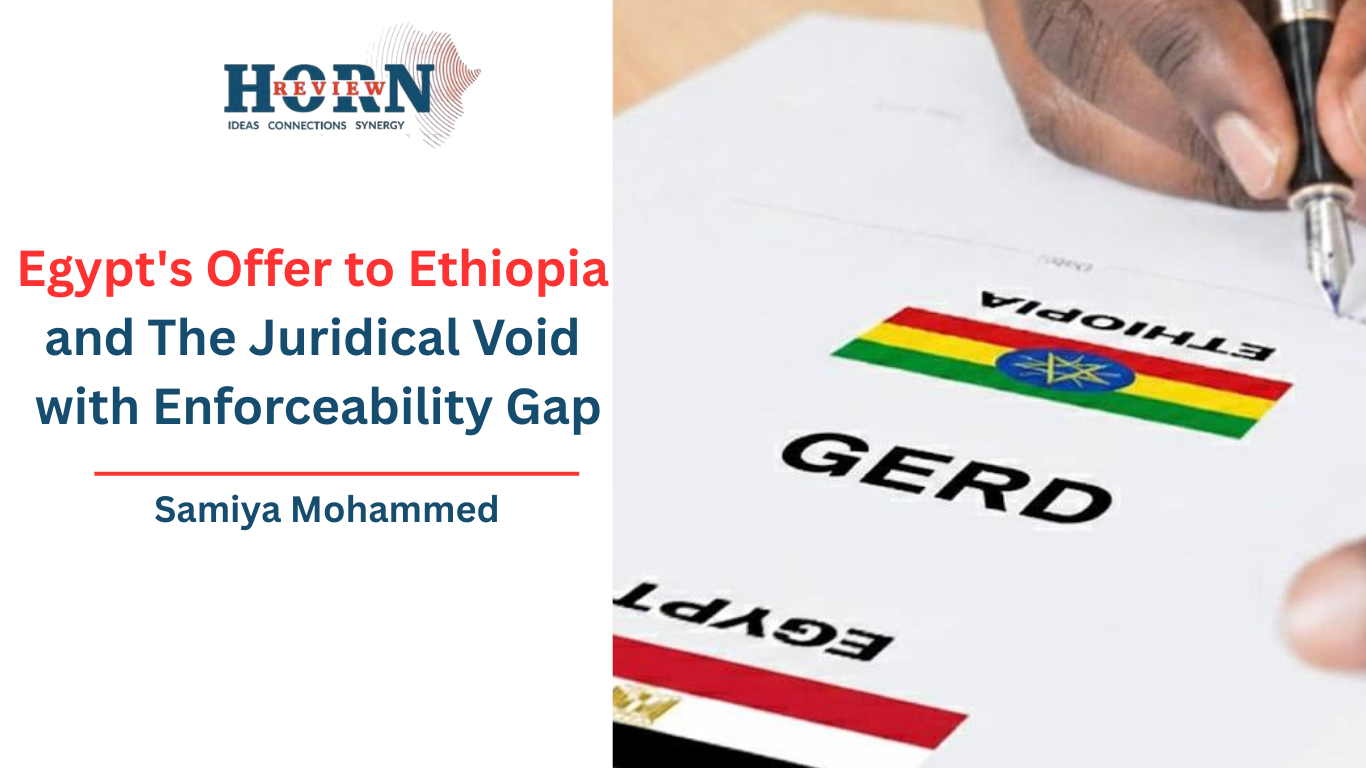
For over a decade the diplomacy of Egypt over the Grand Ethiopian Renaissance Dam has followed a familiar pattern with rounds of negotiations, appeals to international law and accusations of bad faith. But a new variable has recently entered this equation with one that alters the nature of the discourse and demands rigorous scrutiny. Recent reports indicate that Egypt has motioned a willingness to assist Ethiopia in securing access to Red Sea ports ostensibly as a quid pro quo for Ethiopian flexibility on Nile water arrangements. On its surface this might appear as constructive regional bargaining. Under the surface however lies a proposition so structurally unsound, so legally fragile and so asymmetrical in its risk allocation that it cannot be regarded as diplomacy in good faith. It is rather a sophisticated form of coercive bargaining dressed in the language of cooperation.
To understand why this proposed exchange is fundamentally untenable one must first interrogate the legal nature of what each party is being asked to surrender. Egypt demands of Ethiopia legally binding commitments regarding the management of the Nile’s waters commitments enforceable through arbitration, compliance mechanisms and the entire apparatus of international water law. This is not a request for vague assurances or expressions of goodwill. It is a demand that Ethiopia submit its most vital resource the hydrological engine of its development to a regime of enforceable constraints. Ethiopia’s Blue Nile together with its other river systems generates approximately seventy percent of the country’s renewable surface water and contributes an estimated eighty six percent of the Nile’s annual flow. To cede control over this system through binding legal instruments is to place the very sinews of national development within a policy ultimately subject to the jurisdiction of third party dispute resolution.
What does Egypt offer in exchange for this monumental concession is offers to help Ethiopia secure access to the sea. This is not a binding commitment. It is not a treaty obligation. It is not a deliverable. It is at best a promise to exert influence ,a promise to make phone calls to convey political messages, to engage in lobbying to reach understandings that can be disavowed tomorrow with no legal consequence whatsoever. The distinction here is not semantic however is existential. One party is being asked to sign a contract. The other offers a letter of intent and a non binding one at that.
The legal asymmetry could scarcely be more obvious. International water law as codified in instruments such as the UN Watercourses Convention creates genuine obligations like the principle of equitable and reasonable utilization, the duty not to cause harm, the requirement of prior notification for planned measures. These are not aspirational statements but norms that ground claims, support arbitration and form the basis for diplomatic pressure campaigns. A binding agreement on GERD would give Egypt precisely such hooks legal space from which to mount future challenges, demand compliance and invoke international fora when Ethiopian actions deviate from agreed parameters. Ethiopia would be bound. Egypt would have standing to enforce.
What hooks does Ethiopia receive in return is None. Egypt’s help on port access rests on no comparable legal foundation. Egypt cannot sign a treaty on behalf of Djibouti, Eritrea or Somalia. It cannot contractually obligate sovereign states to grant Ethiopia maritime access. It can promise to use its influence and influence however substantial is not ownership. It is not control. It is not a right that can be assigned or a performance that can be compelled. The Egyptian offer stripped of diplomatic euphemism is simply this which is to Enter into binding constraints regarding your waters, and I will attempt to persuade others to grant you what is rightfully yours as a matter of regional equity.
If Ethiopia signs binding commitments and Egypt’s promised help fails to materialize and if the phone calls go unreturned, if the lobbying proves ineffective, if the understandings dissolve under political pressure Ethiopia remains bound. Its water management is constrained. Its development road is subject to external oversight. But it still lacks sea access. If conversely Ethiopia declines the bargain and Egypt follows through on its implicit threat to withdraw cooperation, Egypt loses nothing of permanent value. It has just declined to exert influence it never had a legal duty to exert in the first place. The asymmetry is total. The downside risk is Ethiopia’s alone to bear.
This brings us to the deeper structural issue with what precisely is being offered and what precisely is being demanded. The Egyptian proposal as reported includes an implicit warning that Cairo could use its political and military influence in Sudan, Somalia and Djibouti, as well as its naval presence in the southern Red Sea to restrict Ethiopia’s access to ports should the proposal be rejected. Read plainly this is not an offer of assistance. It is an offer to cease obstruction. It is the diplomatic equivalent of a protection racket with Pay me and I won’t block you. The language of help masks a reality of extortion concessions demanded in exchange for non interference with Ethiopia’s fundamental economic lifelines.
The recent agreements between Egypt and both Eritrea and Djibouti to upgrade the ports of Assab and Doraleh including provisions for military contingents and warship access must be understood in this context. These are not neutral commercial arrangements. They are encirclement. Doraleh handles the majority of Ethiopia’s trade. For Egypt to position military assets at the throat of Ethiopia’s commerce while simultaneously offering to help with sea access is a display of coercive diplomacy so naked that it scarcely requires commentary. One does not offer to stop choking someone in exchange for their most valuable possessions and call it mutual assistance.The Ethiopian government’s framing of its sea access aspirations reflects an awareness of these dynamics. Official statements emphasize that Ethiopia’s quest for maritime access is pursued peacefully and that many international partners acknowledge its validity.
What Egypt’s proposal ultimately reveals is a misunderstanding of what constitutes legitimate bargaining in international affairs. A binding water agreement and a non binding promise of diplomatic assistance are not commensurate goods. They cannot be traded because they do not occupy the same legal or practical plane. One creates enforceable obligations and the other creates at most a political expectation. One subjects a state to external oversight of its most vital resources and the other offers no comparable constraint on the offering party. One is a contract and the other is a suggestion.
The deeper issue however transcends legal formalism. Egypt’s offer implicitly rests on the premise that Ethiopia’s access to the sea is Egypt’s to grant that Cairo holds the keys to the Red Sea and may distribute access as it sees fit. This premise is false. The Red Sea is not Egyptian property. Its ports are not Egyptian assets to allocate. The idea that Ethiopia must bargain with Egypt for what is, in truth a matter for bilateral negotiation with Djibouti, Eritrea and Somalia is itself a form of subordination. It accepts the framing that Egypt is the gatekeeper of the region that Ethiopian aspirations must pass through Cairo for approval.
Ethiopia cannot accept this without accepting permanent dependency. To tie binding water commitments to Egyptian goodwill on port access is to create a structural linkage that ensures perpetual vulnerability. Even if Egypt’s help materialized today what prevents its withdrawal tomorrow and What binds future Egyptian governments to continue facilitating Ethiopian trade. The asymmetry is not just legal but temporal. Egypt’s obligation to the extent it exists at all is a one-time intervention. Ethiopia’s obligation would be perpetual.
The proposed bargain also misapprehends the nature of the goods. Water from the Nile is not a fungible commodity that can be exchanged for political favors. It is the foundation of Ethiopian agriculture, energy production and economic transformation. The GERD presents not just a piece of infrastructure but an assertion of sovereignty and the principle that upstream states have rights to develop their resources for the benefit of their populations. To trade that principle for an uncertain promise of assistance is to sacrifice the permanent for the contingent, the concrete for the speculative.
What Ethiopia requires is not Egypt’s help but Egypt’s acceptance, an acceptance that upstream development is legitimate, that the Nile’s waters can support multiple riparian, that the old era of hydrological monopoly has passed. This acceptance cannot be purchased through concessions because it is not Egypt’s to sell. It is recognition of legal reality of the principles of equitable utilization that govern international watercourses. Ethiopia’s rights to develop its water resources do not derive from Egyptian consent and should not be exchanged for Egyptian promises.
Ethiopia’s position articulated consistently in diplomatic engagements reflects this understanding with equitable water use, fair rights to development and peaceful pursuit of national interests. The aspiration for sea access is not a bargaining chip to be traded away but a legitimate national objective to be pursued through bilateral and multilateral engagement with littoral states. It is not Egypt’s to grant and it should not be Egypt’s to withhold.
The proposed linkage between Nile waters and Red Sea access thus emerges as what it truly is with an attempt to extract binding concessions in exchange for non-binding assurances to trade the real for the illusory, to secure permanent constraints for temporary favors. Ethiopia’s rejection of this framing is not intransigence but prudence recognition that sound policy cannot rest on promises that lack legal foundation, that national development cannot be mortgaged for political goodwill that may evaporate with the next diplomatic breeze.
In the end the Egyptian offer reveals more about Egyptian assumptions than about Ethiopian interests. It assumes that Ethiopia’s need for sea access creates vulnerability that can be exploited. It assumes that Egypt’s regional influence is a form of property that can be exchanged. It assumes that non-binding promises are equivalent to binding obligations. All of these assumptions are false. The sooner they are abandoned, the sooner the region can move toward genuine cooperation based on mutual respect and legal certainty rather than on asymmetrical bargains that serve only to perpetuate the very conflicts they purport to resolve.
By Samiya Mohammed, Researcher, Horn Review