The Billion Dollar Question, Whose Port, Whose Peace?
The Horn occupies a position where the necessity of maritime access confronts the inviolability of territorial sovereignty. When Turkish President Recep Tayyip Erdoğan arrived in Addis Ababa on February 17, 2026 which is his first visit in eleven years the ceremony commemorating a century of diplomatic relations between Türkiye and Ethiopia masked the intensive negotiations occurring coincidently. Prime Minister Abiy Ahmed’s direct request for Turkish diplomatic support regarding Ethiopia’s pursuit of sea access extends far off bilateral dialogue to test regional alignments.
The Ankara Declaration facilitated through Turkish mediation established new parameters for Ethiopia’s maritime objectives. Ethiopia and Somalia jointly affirmed their respect and commitment to one another’s sovereignty, unity, independence and territorial integrity while consenting to initiate technical discussions regarding commercial sea access arrangements that preserve Somali territorial jurisdiction.
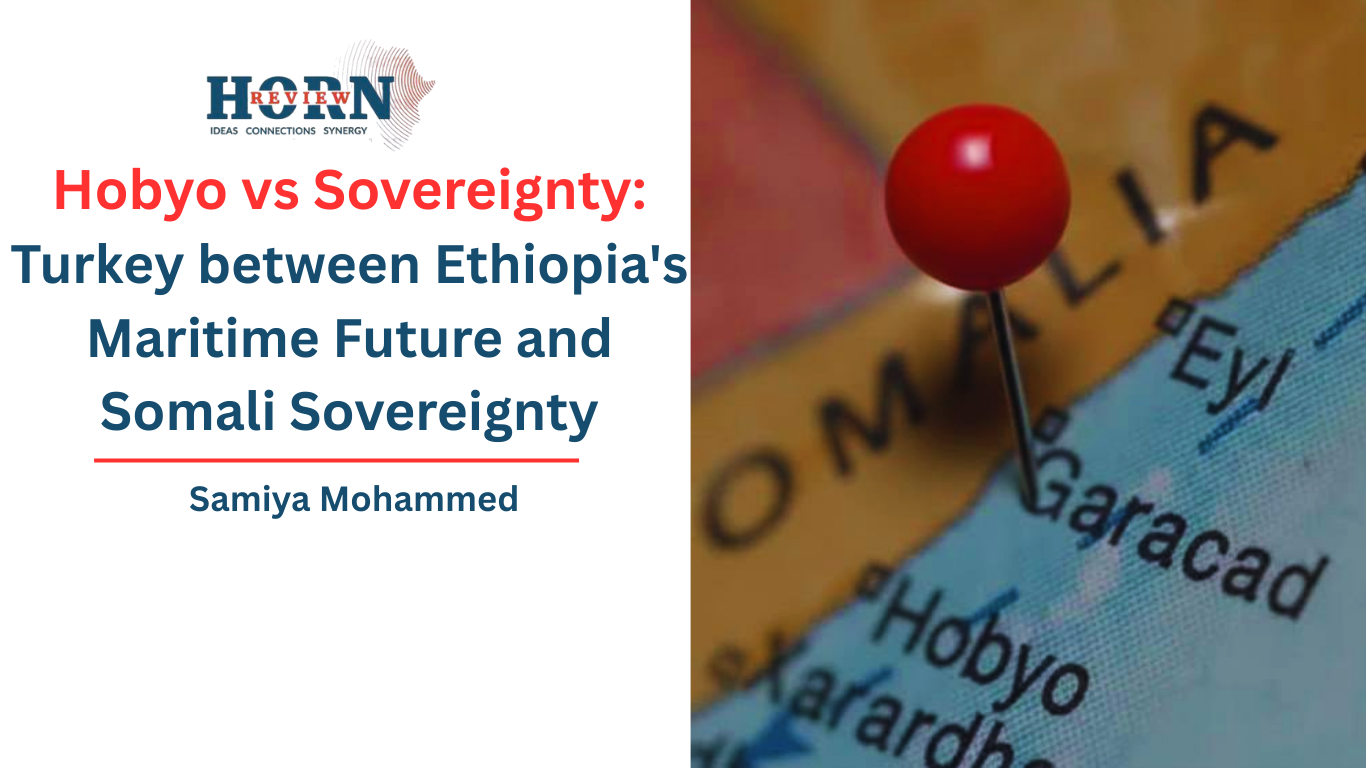
During preliminary negotiations Somalia’s position evolved to propose commercial rather than sovereign access to multiple ports under federal jurisdiction. Mogadishu port operated since 2014 by Turkish company Albayrak Group under a twenty year concession constituted one available option. The more consequential proposal however centred on Hobyo a coastal settlement in the Galmudug region approximately 700 kilometres northeast of Mogadishu. Hobyo lies within Somalia’s internationally recognised borders providing a legally unassailable foundation for any access agreement.
The Hobyo proposal while compelling from the standpoint of preserving Somali sovereignty confronts the hard constraints of infrastructure economics and regional security. Turkish firm Metag Holding in partnership with Hobyo Investment Company has committed an initial $70 million to develop the port, with construction commencing and operational capability expected within three years. This investment constitutes the preliminary phase of a more extensive undertaking.
Transforming Hobyo into a viable commercial gateway for Ethiopian trade requires expenditure far off this initial outlay. The port’s current infrastructure remains rudimentary, serving a local population of approximately 11,800 rather than functioning as a regional trans shipment space. Comprehensive development necessitates dredging deeper channels to accommodate larger vessels, constructing warehousing facilities with adequate cargo handling equipment, establishing customs and inspection infrastructure and building highway connections to Ethiopia’s interior. Preliminary estimates suggest that a fully functional port capable of handling Ethiopian cargo volumes would require investment between $1 billion and $2 billion depending on the scope of associated infrastructure development.
The security dimension compounds these financial challenges. Hobyo’s location in Galmudug places it within proximity to areas where Al-Shabaab retains operational capacity. Any major infrastructure investment must incorporate substantial security provisions including perimeter fortification, maritime patrol capabilities and potentially dedicated security forces. These requirements add both financial costs and operational complexity to an already demanding project.
Unlike Western powers or Gulf states, Türkiye presents itself as a NATO member with NATO-standard military capabilities that nonetheless maintains diplomatic accessibility to Global South nations. This positioning has enabled Turkish diplomats to navigate between Ethiopia and Mogadishu with credibility that other actors cannot muster. Türkiye’s involvement reaches far off mediation to commercial interests with its defence industry emerging as a supplier to both parties in regional conflicts. The question of Turkish endorsement for Ethiopia’s sea access intentions cannot be isolated from broader regional implications. Should Türkiye unequivocally support Ethiopia’s sea access aspirations Cairo’s response would likely intensify. Egypt has already cultivated security relations with Mogadishu, supplying military aircraft and weapons to Somalia.
The Hobyo alternative while preserving sovereignty necessarily entails enhanced Turkish involvement in Somali infrastructure and potentially Somali security. Turkey already operates Mogadishu port and maintains military training programmes expanding this trace to Hobyo would deepen Turkish participation in Somalia’s maritime sector. For a federal government exercising authority over constituent members including Puntland and Jubaland this dependency on Turkish support carries both opportunities and risks.
President Erdoğan’s visit coinciding with the centenary of Turkish-Ethiopian diplomatic relations provided a platform for Ethiopia to articulate its sea access requirements. Prime Minister Abiy’s explicit request for Turkish diplomatic support confirms that Ethiopia views Ankara as the essential intermediary capable of translating Somali offers into operational reality. The joint press conference following their meeting revealed parameters of potential Turkish endorsement. Erdoğan emphasised that regional countries should develop solutions to regional problems warning against turning the Horn into an arena of struggle for foreign powers.
This formulation rebukes Egyptian militarisation while endorsing the Ankara process as the appropriate framework for resolving Ethiopia-Somalia differences. Erdoğan’s rejection of Israel’s Somaliland recognition which he characterise as benefiting neither Somaliland nor the region demonstrates Türkiye’s commitment to Somali territorial integrity as the foundation of any access arrangement. This position aligns with the Ankara Declaration’s emphasis on sovereignty while leaving space for commercial access negotiations that could include Hobyo or other ports under federal jurisdiction.
Ethiopia’s quest for sea access derives from demographic, economic, and historical imperatives. A population exceeding 120 million, economic growth requiring efficient trade corridors and historical experience of maritime connectivity combine to ensure that no Ethiopian government can abandon this objective. The inquiry is not whether Ethiopia will secure reliable port access but through what mechanism and at what cost to regional stability. The Hobyo alternative offers a path that reconciles Ethiopian access with Somali sovereignty but only if accompanied by investment commensurate with the infrastructure challenge.
The pattern of Turkish engagement across Africa combining humanitarian diplomacy, infrastructure investment and defence industry exports reflects an approach that serves Ankara’s interests while addressing African requirements. Whether this constitutes genuine partnership or opportunism depends on the durability of the arrangements being negotiated. The February visit may present not a conclusion but a commencement. The security dimension requires cooperation that transcends bilateral suspicion. Regional repercussions from Cairo to Asmara require management that tests Turkish diplomatic capacity. In this configuration Hobyo rises as the compromise, access over ownership, commerce over sovereignty, partnership over rivalry. Except it does still a rudimentary fishing hamlet needing billions and bullet proofing far from the gateway Ethiopia actually requires. Nice theory but terrible reality.
By Samiya Mohammed, Researcher, Horn Review