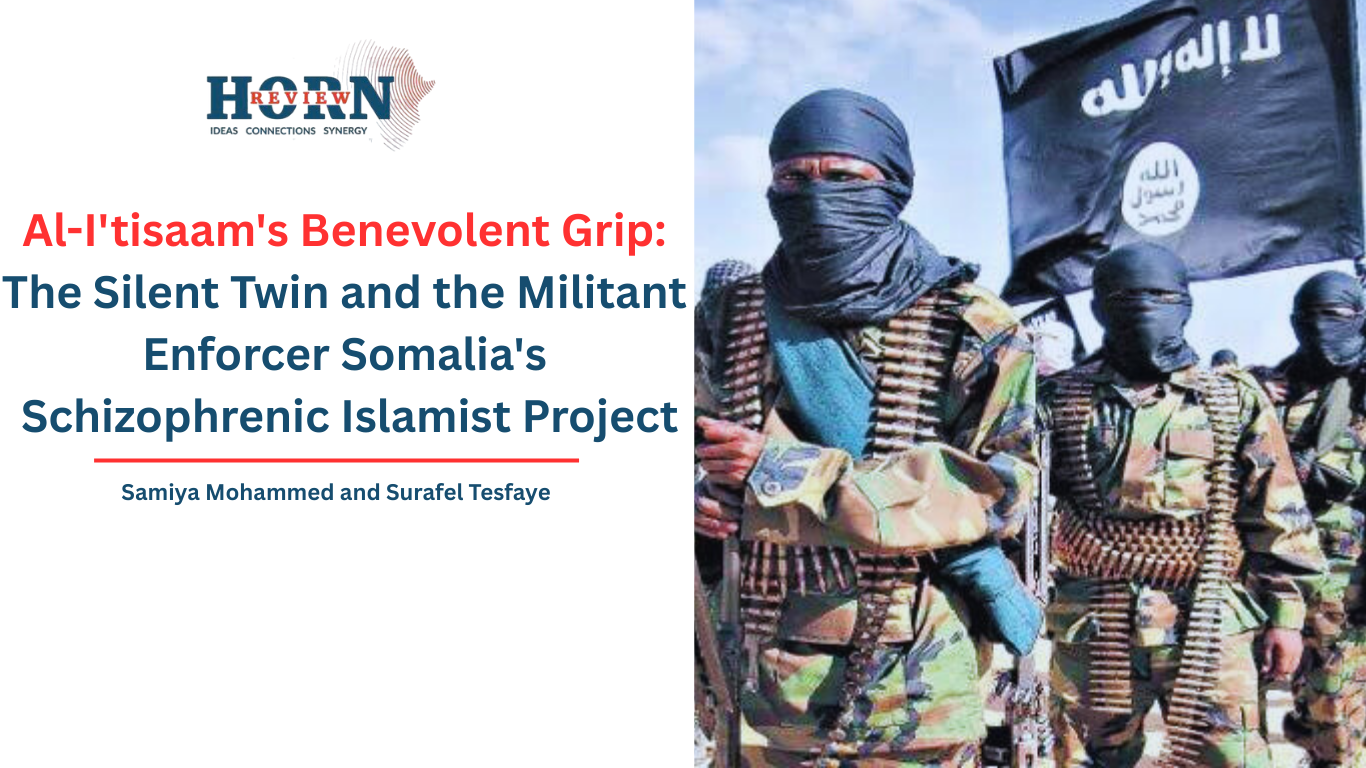
In Somali Islamism the world fixates on Al-Shabaab’s suicide bombings, its grisly beheadings and its theatrical claims of responsibility. However a more quiet force has been methodically plaiting itself into of Somali society. This force builds universities where Al-Shabaab builds bombs. It mediates tribal feuds where its militant sibling sows division. It sits on government boards and chambers of commerce while its ideological twin attacks the very same institutions. It is Al-I’tisaam bil-Kitab Wa-Sunna the silent twin of Somali jihadism and its story may ultimately prove more consequential to Somalia’s future than all the violence Al-Shabaab can muster. The relationship between these two groups defies simple categorization. They are at once siblings and rivals, collaborators and competitors, two sides of a single coin minted in the Somalia’s collapse.
The story begins in the 1980s. The Iranian Revolution had sent waves through the region where the Afghan jihad was drawing idealistic young Muslims to its battlefields and in Egypt the prisons housed intellectuals whose writings would shape Islamist thought for generations. It was in this context that Somalia’s first home grown Salafi-jihadist group emerged. Al-Itihaad al-Islamiya (AIAI; Arabic: الاتحاد الإسلامي, formed in 1983 as an underground movement presented a fusion of two powerful currents like the puritanical Salafism flowing from Saudi Arabia and the revolutionary Qutbist ideology emanating from Egypt’s Muslim Brotherhood.
The collapse of Siad Barre’s military regime in 1991 thrust AIAI from the shadows into the open. For a brief period it seemed possible that the organization might fill the space left by the state’s disintegration. But by the mid-1990s AIAI had suffered catastrophic defeats at the hands of clan militias, rival warlords. The dream of establishing an Islamic emirate through armed struggle lay in ruins.
From this wreckage come out two distinct trajectories. One faction chastened by military defeat, concluded that Somalia required preparation society needed to be educated, purified and made receptive to true Islamic governance before the sword could be drawn. This faction institutionalized itself as Al-I’tisaam dedicating itself to proselytization and religious education. The other faction, composed of hardened ideologues, drew the opposite lesson they had not fought hard enough, had not been sufficiently ruthless. This group would eventually re-emerge as Harakat al-Islah (meaning “reform”) is the Somali branch of the Muslim Brotherhood Unlike other extremist groups in Somalia such as al-Qaeda affiliate al-Shabab or Islamist militant group al-Ittihad al-Islamiya, Al-Islah claims to eschew violence in its efforts to establish an Islamic state.
The Muslim Brotherhood’s fingerprints are visible everywhere in this genealogy. Somalia’s official Brotherhood branch al-Islah, had advocated a gradualist approach to Islamization working within existing structures, building institutions, transforming society from the bottom up. While Al-I’tisaam would develop its own distinctive character, this gradualist DNA runs through its veins. Even the name Al-Shabaab meaning the youth screams the Brotherhood’s historic emphasis on youth mobilization as an engine of change.
What emerged from AIAI’s fragments was not a clean break but a division of labor by alternating grammars of a shared project. Al-I’tisaam and Al-Shabaab represent parallel strategies oriented toward a common horizon with the purification and reordering of Somali society according to their interpretation of Islamic law. One seeks to accelerate this horizon through violent force the other to normalize it through social depth.
The divergence is fundamentally one of repertoire rather than destination. Al-I’tisaam invested in what might be called the infrastructure of influence , madrassas and universities, mosque councils, zakat committees, NGOs, and commercial ventures. Through these institutions, it accumulated something perhaps more valuable than territory with legitimacy. Its sway extends from Hargeisa to Garowe, from Mogadishu to Nairobi wherever Somalis gather, conduct business, or seek education, Al-I’tisaam’s presence can be felt.
Al-Shabaab by contrast, pursued the path of insurgency. It controls territory, imposes taxation, administers justice, and projects power through violence. Even here, the group has developed a civilian façade running schools, providing dispute resolution, maintaining order in the chaos of war-torn Somalia. For many Somalis living under Al-Shabaab’s shadow, the group’s harsh but predictable governance compares favorably to the corruption of official state institutions.
The two movements have at times coexisted, overlapped, and even cooperated most notably during the Islamic Courts Union period of the mid-2000s, when a coalition of Islamist actors briefly challenged both the warlord order and At the request of the TFG, Ethiopia interfere Somalia and ousted the ICU from the capital in December. But their relationship has also carried the seeds of rivalry. In the early 2010s, Al-Shabaab assassinated several prominent Al-I’tisaam scholars a violence that accelerated Al-I’tisaam’s pragmatic alignment with formal authorities across the Somali Horn. Yet this alignment did not constitute a theological rupture. Al-I’tisaam has never explicitly renounced the principle of armed struggle; it has merely argued for sequence, prudence, and societal preparation.
It is Al-I’tisaam’s civilian facade that demands closest scrutiny, for it is here that the group has achieved its most enduring victories. The movement’s investments in education are particularly revealing. Universities bearing its imprimatur dot the Somali landscape East Africa University in Bosaso, various institutions in Mogadishu and elsewhere. These institutions produce graduates who staff government ministries, run businesses, and shape public discourse.
But what curriculum do these institutions teach? Critics argue that beneath the veneer of educational philanthropy lies a project of Salafi indoctrination one that sows division under a civilian smile. The schools build capacity, yes, but they also shape consciousness. They produce graduates steeped in a worldview that delegitimizes Somalia’s historical tradition of Sufi-influenced Islam, that views the federal project with suspicion, that sees secular governance as fundamentally illegitimate.
The pattern extends beyond education. Al-I’tisaam-affiliated charities deliver services where the state cannot or will not. Its business enterprises dominate profitable sectors banking, telecommunications, real estate, money transfer companies. Its religious scholars sit on government-affiliated councils, shaping policy from within. This is not merely coexistence with the state; it is colonization of the state.
The movement’s discourse frequently mirrors, albeit in a different register, the delegitimation of the existing order advanced by Al-Shabaab. Where Al-Shabaab denounces the state as irreligious and targets it through force, Al-I’tisaam contests the same state by colonizing the institutions that manufacture consent: schools and sermons, charities and chambers of commerce, municipal boards and moral publics. Both measure success by the same criterion: the degree to which their vision governs everyday life.
While Al-I’tisaam builds and infiltrates, Al-Shabaab conquers and controls. Yet even here, the civilian dimension remains crucial to understanding the group’s resilience. Al-Shabaab is not merely a terrorist organization; it is a proto-state, possessing substantial revenue, coercive capacity, and territorial administration. Its governance apparatus includes mobile courts that deliver legal services to citizens, often more efficiently and less corruptly than official state institutions. And yet, the “civilian” terror continues. The October 2017 truck bombing in Mogadishu the deadliest terrorist attack in Somali history killed more than 300 people. These spectacular atrocities coexist with the quotidian reality of governance.
The relationship between Al-I’tisaam and Al-Shabaab has evolved through phases of coexistence, competition, and conflict. Yet beneath the rivalry lies profound convergence. Both movements share roots in AIAI’s neo-Salafism. Both are fundamentally antithetical to constitutional democracy and federalism. Both aspire to a centralized Islamist state governed by their interpretation of Islamic law. Their disagreements are tactical rather than strategic questions of timing and method rather than ultimate destination.
This convergence creates the possibility of reconciliation under the right conditions. Qatari-mediated talks between the two movements during President Farmaajo’s tenure, while ultimately unsuccessful, demonstrated that dialogue is possible. In the event of state collapse or a negotiated settlement with Al-Shabaab, Al-I’tisaam is naturally positioned to serve as interlocutor and potential partner the respectable face that can deliver what the militant wing has fought for.
The “civilian” smile is not a mask behind which the true militant face hides; it is the face itself, engaged in a different but complementary project. The schools teach what the mosques preach and what the militants, when conditions allow, will enforce. The charities build relationships that the insurgency can exploit. The business networks generate resources that can flow, through channels both licit and illicit, to support the broader project.
For those seeking to understand Somalia’s trace, the implications are sobering. Military victories against Al-Shabaab, however necessary, address only the most visible manifestation of a deeper phenomenon. The ideology that animates both movements persists in schools and mosques, in charities and businesses, in the very institutions that shape Somali society. To defeat Al-Shabaab without addressing the environment that produces and sustains it is to treat symptoms while ignoring the disease. The silent twin is not silent because it has nothing to say, but because it has learned to speak through schools, markets, relief trucks, and neighborhood committees through the soft powers that purchase time and space. And as Somalia’s long night of conflict continues, it may yet prove that the quieter voice shapes the dawn.
By Samiya Mohammed and Surafel Tesfaye, Researchers, Horn Review