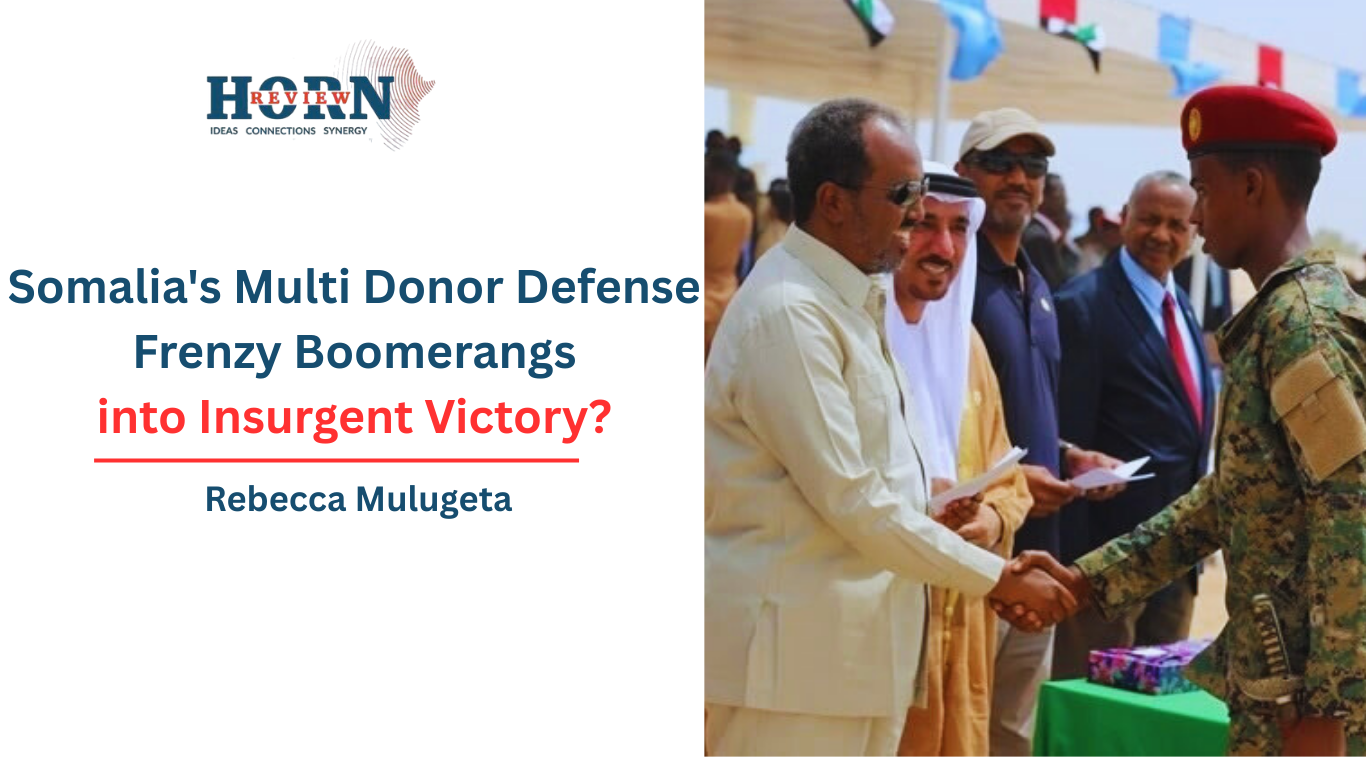
Somalia’s aggressive pursuit of over 18 bilateral military pacts ranging from Turkey’s maritime expansionism to Egypt’s strategic training initiatives and Eritrea’s opaque arms transfers appears, at first glance, to be a masterful consolidation of foreign power to safeguard a besieged administration. By stacking the deck against al-Shabaab with Turkish frigates patrolling the Indian Ocean, Qatari-funded elite academies, and a diverse influx of US-led Danab commandos, Serbian hardware, and Azerbaijani drone tech, Mogadishu is attempting to fill the vacuum left by the post-2024 ATMIS drawdown. This security pact, which pledges to professionalize a 50,000-strong Somali National Army and resurrect a dormant navy, represents a high-stakes effort to leverage international muscle and gear to seal porous borders and institutionalize a centralized command structure.
Yet al-Shabaab doesn’t just persist; it feasts. Raids on SNA bases yield hauls of captured Turkish G3s, Egyptian AKs flaunted in propaganda reels. Rural heartlands in Galmudug and Jubaland slip back under militant sway, suicide trucks ram checkpoints near the capital, and the group’s $24 million extortion racket taxing herders, merchants, and aid convoys buys Yemen IED precursors to even the odds. This isn’t a coincidence. It’s the toxic alchemy of clashing foreign appetites turning Somalia into a proxy coliseum, where one nation’s masterstroke spells another’s rout, and al-Shabaab picks up the scraps.
Somalia’s strategic path has transitioned from simple defense to a high-stakes “Protection-for-Access” bazaar, where Somalia is effectively leasing its sovereignty to counter Ethiopia’s regional ambitions and neutralize Ethiopia’s naval aspirations. The Turkey-Somalia Maritime Pact, ratified for a ten-year term, positions Turkey as the vanguard of the Red Sea; in exchange for rebuilding the Somali Navy and securing its exclusive economic zone (EEZ), Turkey gains a critical bridgehead to project power against Egyptian Suez dominance. Simultaneously, Qatar has decisively displaced the UAE as Somalia’s primary security patron. Following the abrupt collapse of Somalia-UAE ties in January 2026 triggered by reports of Emirati support for Israel’s recognition of Somaliland Doha has filled the vacuum with a series of bilateral defense agreements. These pacts use soft-influence funding and elite training coordination to erode Saudi and Emirati footprints, mirroring Qatar’s disruptive Sudan Institutional Capture, to centralize federal power and dismantle the “Recognition-by-Deed” doctrine that Somaliland continues to pursue.
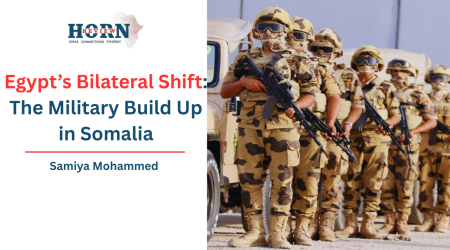
The UAE’s strategic blitz which saw the training of 10,000 Somali troops has functionally collapsed following the January 12 annulment of all bilateral defense pacts by Mogadishu. This rupture, triggered by the UAE’s perceived backing of Somaliland’s Recognition and its proximity to Israel. This vacuum has been aggressively filled by a “vengeful” Egyptian presence. Nursing long-standing grievances over the Grand Ethiopian Renaissance Dam (GERD) and Nile water security, Cairo has deployed over 1,000 mechanized troops to Mogadishu as of February 2026, with plans for a 10,000-strong contingent under a dual-track AU-bilateral mandate. By embedding officers in Hirshabelle and Jubaland, Egypt is explicitly weaponizing “Somali Unity” as a strategic lever against Ethiopian national interests, effectively reviving 1960s-era irredentist pressures over the Ogaden to create a multi-front distraction on Ethiopia’s eastern flank.
Eritrea, Asmara’s revanchist engine, slips arms southwards, weaponizing old Badme scars to encircle Ethiopia from two frontsa dagger pointed at Afar and Somali regions. Jordan and Pakistan are part of Budget trainers that fill gaps, but their Sunni pipelines clash with secular Turkish models. Even neutrals like the U.S. and EU, focused on counterterror, feed a machine warped by these feuds.
These antagonisms don’t simmer in the background, they detonate inside the SNA, birthing a Frankenstein force riddled with loyalty fractures. Imagine a brigade where Turkish-trained marines, drilled in NATO-ish maritime ops, share foxholes with Egyptian phalanx infantry loyal to Cairo’s anti-Ethiopia briefings, while foreign trained squads run spec-ops under clan elders eyeing Qatar cash. Doctrines collide: one unit pivots on joint patrols, another on static defense, a third on clan hit-squad raids.
Desertions skyrocket as paychecks flow through other pipelines, with foreign nations slashing mutinies in 2024 handing al-Shabaab intact platoons and armories. Clan math worsens it: Hawiye militias like Ma’awisley powered 2023 gains in central Somalia, but Darod or Rahanweyn groups in the south withhold, their weapons flipping when federal neglect bites. SNA inherits 200-plus forward bases on fumes no fuel, no meds, no resupply perfect for al-Shabaab’s guerrilla ballet: melt away from offensives, ambush stragglers, drone-spot weak points, and reclaim turf via shadow courts offering swift “justice” where Mogadishu delivers nothing.
Al-Shabaab’s genius lies in exploiting this self-sabotage, evolving from ragged jihadists to hybrid overlords who turn foreign aid inside out. Captured hauls aren’t anomalies rather they’re systemic, with black-market flips officers hawking money funding the militants’ arsenal growth. The group’s financial web, raking $2 million monthly from rural taxes, buys black-market foreign kit or Houthi smuggling routes, matching SNA volume if not tech. Ideologically, they weaponize the proxy path Turks, Qataris, Pharaoh Egyptians. Their shadow state zakat collection, dispute arbitration fills governance black holes the SNA ignores, legitimizing control over 40% of territory. Novel angle here: call it the “mirror failure” effect, where donors’ blind spots reflect Somalia’s fractures.
Somalia’s security landscape has devolved into a high-stakes geopolitical boomerang where the erratic shifting of foreign patrons evidenced by the termination of UAE defense pacts and the subsequent scramble by Egypt and Turkey to fill the vacuum is inadvertently fueling al-Shabaab’s long-term insurgency. As the UAE withdraws its elite training brigades, leaving behind a demoralized and unmonitored force ripe for militant infiltration, Turkey’s maritime-focused strategy allows insurgents to burrow deeper into the uncontested interior. This systemic mirror failure is further exacerbated by a multilateral encirclement of Ethiopia. The deployment of Egyptian mechanized forces and attack helicopters to the borderlands (ostensibly under the AUSSOM mandate) provides a sovereign cover for Cairo to revive irredentism, priming regions like Jubaland and Gedo for cross-border provocations. For Ethiopia, this isn’t a mere diplomatic friction but a structural threat, as the combination of Egyptian-Eritrean naval alignment, and al-Shabaab’s opportunistic raids creates a pincer effect designed to choke Ethiopia’s strategic lifelines and export instability directly into the Ethiopian Somali Region.
Somalia’s proxy trap has evolved into a high-stakes “one-country failure” contagion, where the subcontracting of statehood to competing donors has birthed a fragmented security architecture that mirrors the warlord era of 1991. The influx of bilateral pacts has created ideological and doctrinal silos pitting foreign trained secularists against Gulf-backed units and Egyptian-aligned nationalists effectively eroding the federal glue and inviting the very sectarian strife al-Shabaab weaponizes in its recruitment. With the 2023 lifting of the arms embargo now fueling a deluge of untracked hardware, the vacuum left forces is being rapidly filled by clan-based “militant superstates” and jihadist franchises rather than a unified national force.
Somalia’s survival depends on a radical Sovereign Reset that prioritizes institutional depth over its current, chaotic deal-spree. To escape the proxy trap, Mogadishu must replace its habit of subcontracting statehood with a unified national security framework, none that harmonizes training under a single Somali-led doctrine rather than relying on fickle foreign logistics cash. Crucially, this security architecture must not be weaponized as a tool for regional obstruction; the obsession with blocking Somaliland’s recognition and denying Ethiopia’s existential requirement for maritime access only invites further fragmentation.
By Rebecca Mulugeta, Researcher, Horn Review