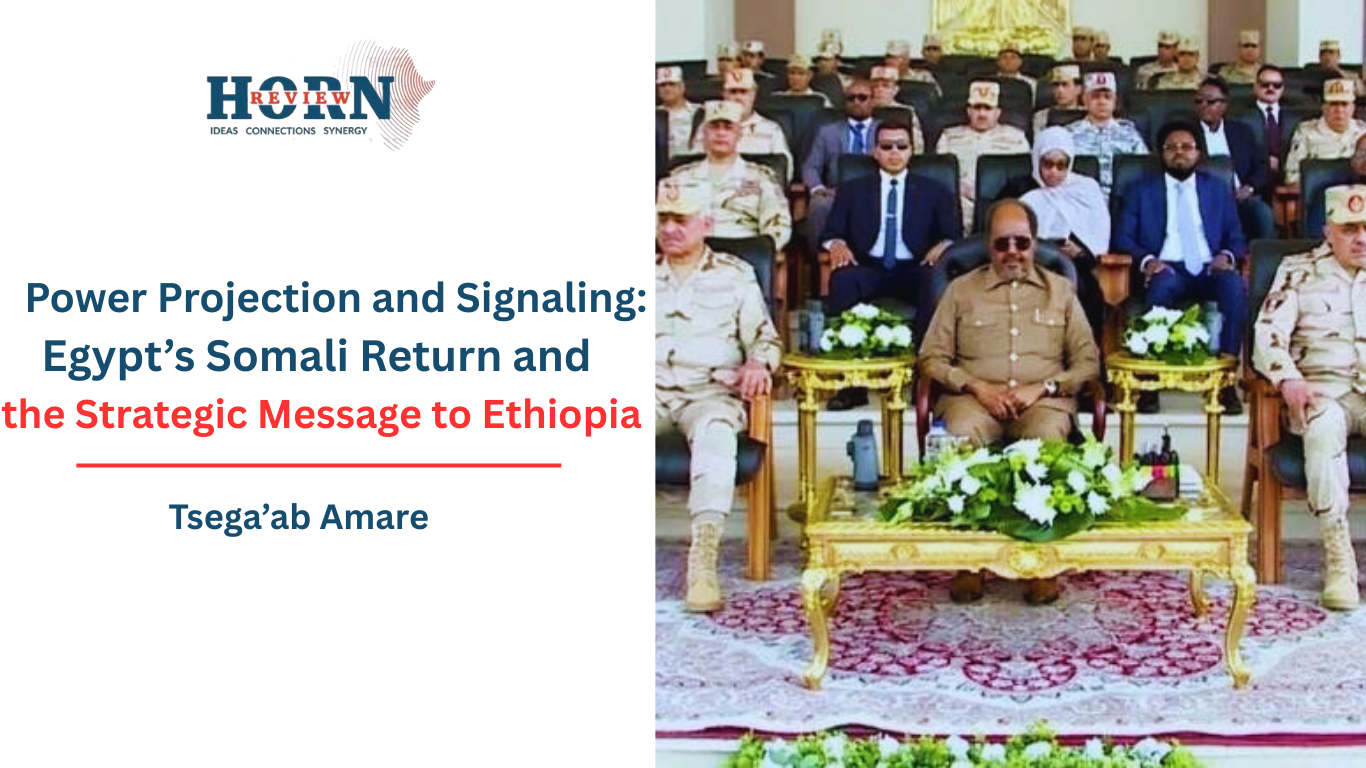
The military parade in Cairo on February 8, 2026, was more than a formal reception for Somali President Hassan Sheikh Mohamud; it must be viewed as an intentional demonstration of Egypt’s capabilities of power projection intended toward the regional audience. The display of Egypt’s military strength as President Hassan Sheikh reviewed mechanized units and specialized air assets as part of the military parade was intentionally symbolic. This development is significant because it represents a shift in the developing security architecture of the Horn of Africa and marks the first time since the late 1970s that Egypt will be deploying military hardware into Somalia.
Egypt’s history provides a basis for understanding its current posture. In the 1970s, Egypt provided major military backing to the Siad Barre government, providing both weapons and advisory support during Somalia’s invasion of Ethiopia. Egypt’s motivation in the 1970s, as well as today, is heavily influenced by its strategic interest in Nile hydro-politics. A strategically vulnerable Ethiopia would be less able to establish itself as a long-term player in the control of the Blue Nile when it is engaged in fighting on its eastern border.
Therefore, the parade may also be viewed as an expression of the same strategic thinking as in the 1970s. Egypt is revitalizing defense relationships, which have been relatively inactive for nearly four decades, to signal its intent to reclaim its ability to maneuver within the Horn, especially given the continued tensions between Egypt and Ethiopia regarding the GERD.
The Egyptian presence is not only symbolic, but it is structured from a legal and operational standpoint. The Egyptian force package is officially characterized as a contribution to the African Union Support and Stabilization Mission in Somalia (AUSSOM), although it appears to follow a dual track model. According to reports, Egypt has committed approximately 10,000 personnel to AUSSOM, with half of them being part of the AU mission, and the remaining half operating under a bilateral defense agreement that Egypt and Somalia signed in August 2024.
This arrangement produces a layered command environment. While one component operates within a multilateral mandate, the bilateral track provides Cairo with greater operational flexibility, limiting dependence on AU command constraints and allowing national security priorities to be pursued alongside stabilization objectives. The result is not a breach of the AU framework, but a bilateral overlay that expands Egypt’s strategic discretion within Somalia.
The associated assets, including AT-802U light attack aircraft, Mi-24 helicopters, and Mi-17 transports, are well-suited to counter-insurgency operations against Al-Shabaab. Yet their utility extends beyond basic stabilization tasks. These platforms support persistent surveillance, rapid strike capacity, and operational reach that enhances situational awareness across border-adjacent regions such as Gedo and Hiraan. From a strategic perspective, this broadens Egypt’s ability to shape the security environment, even if its formal mandate remains focused on counterterrorism.
President Hassan Sheikh Mohamud’s participation in the Cairo parade reflects a pragmatic and politically risky balancing strategy. Since the January 2024 Ethiopia–Somaliland Memorandum of Understanding, which Mogadishu views as an infringement on sovereignty, Somalia’s leadership has sought security partnerships with actors capable of strengthening the Federal Government’s position.
This does not amount to rigid alignment. In parallel, the Somali President has engaged in periodic diplomatic thawing with Ethiopia, including numerous visits to Addis Ababa bilaterally and within Turkish-mediated negotiations under the Ankara Process. This dual-track diplomacy has generated domestic backlash. Symbolic gestures of military proximity to Ethiopia during official visits have drawn criticism from Somali opposition figures who question the coherence and reliability of Mogadishu’s external alignments.
Internal political dynamics further complicate Egypt’s role. Federal Member States such as Puntland and Jubaland have expressed skepticism toward the presence of Egyptian forces, viewing Ethiopia’s long-standing security involvement as a familiar, if imperfect, stabilizing factor. These regions fear that an externally strengthened Federal Government could use new military backing to influence internal political balances.
President Abdel Fattah el-Sisi’s articulation of an exclusive responsibility doctrine, which holds that Red Sea and Gulf of Aden security should remain in the hands of littoral states, reflects this outlook. The doctrine implicitly challenges the maritime ambitions of landlocked Ethiopia and supplies a political rationale for Egypt’s security presence near Somalia’s northern and southern gateways. Through alignment with Mogadishu, Cairo positions itself as a central Arab security actor in the Red Sea arena while framing Ethiopia’s expanding maritime role as external to the natural littoral order.
Despite the symbolism of Egyptian aircraft and personnel in Somalia, Ethiopia’s official posture has remained measured. Statements from Ethiopian officials emphasize vigilance without escalation, indicating that Addis Ababa is attentive to developments but does not frame them as an immediate military confrontation.
This restraint reflects calculation rather than indifference. Ethiopia’s broader approach, which links Nile and Red Sea interests through economic integration and regional interdependence, favors diplomatic management over direct military response. At the same time, the environment remains volatile. The introduction of additional military materiel into fragmented security spaces raises risks of diversion, proxy competition, and unintended escalation among local actors.
For Addis Ababa, the central challenge is not immediate confrontation but long-term strategic management. Engagement with Mogadishu through dialogue mechanisms such as the Ankara Process, combined with careful monitoring of the evolving bilateral overlay within AUSSOM, will be essential. The presence of Egyptian forces in Somalia represents a structural development in the regional order. The Horn is no longer peripheral to Nile politics. It is becoming one of the arenas in which that contest is quietly unfolding, requiring responses grounded in diplomacy, transparency, and cooperative security rather than reactive militarization.
By Tsega’ab Amare, Researcher, Horn Review