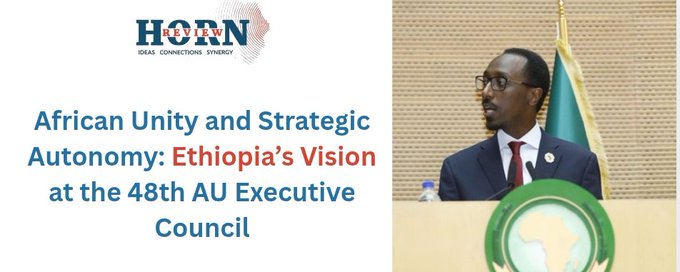
At the 48th Ordinary Session of the African Union Executive Council in Addis Ababa, Ethiopia’s Foreign Minister, Dr. Gedion Timothewos, delivered a speech that was as much a reflection on Africa’s achievements as it was a call to action. The address underscored the urgent need for African unity, strategic autonomy, and stronger continental leadership, framing these priorities within the broader context of global power competition and regional security, issues with particular resonance for the Horn of Africa.
The Foreign Minister highlighted Africa’s successes over the past year, including coordinated positions on UNSC reform, climate justice, and financial architecture, as well as progress in regional integration through Agenda 2063 and the African Continental Free Trade Area. The re-admission of Guinea and Gabon after restoring constitutional order was cited as a positive example of the AU’s role in upholding governance norms. Yet, the speech did not shy away from Africa’s persistent challenges: unconstitutional changes of government, fragile democracies, and uneven implementation of continental frameworks continue to test the AU’s credibility.
A striking element of the speech was its focus on Africa’s position within a competitive and often predatory global system. FM Gedion warned that external powers increasingly view the continent as a site for domination, extraction, and influence, with strategic competition over minerals, technology, and logistics routes intensifying. For countries in the Horn of Africa – whose ports, corridors, and waterways are central to international trade and security – these observations are not abstract. The region is both a strategic gateway and a testing ground for Africa’s ability to assert sovereignty and leverage continental unity in the face of external pressures.
The Foreign Minister also framed African unity as the foundation for meaningful partnerships. He stressed that development assistance, trade, and cooperation should not be dependent on goodwill alone but on strength derived from collective agency. This message resonates strongly in the Horn, where foreign powers have historically leveraged local divisions to advance their interests, from the Red Sea corridor to the Nile Basin. The AU, he argued, must be capable of defending African interests while negotiating on equal terms with global actors.
The speech also emphasized Africa’s role in shaping global governance, including reforms to the UN Security Council, climate negotiations, global health governance, and international economic forums. Ethiopia’s upcoming hosting of COP32 was highlighted as an opportunity for the continent to lead discussions on climate justice, sustainable water, and sanitation. By invoking the principle of UBUNTU in managing shared resources, Dr. Timothewos reinforced a vision of Africa that prioritizes equity, cooperation, and regional responsibility – principles that are particularly relevant to the Horn’s transboundary rivers and fragile ecosystems.
The Foreign Minister’s address positioned Africa as a proactive actor, capable of defending its interests, shaping policy, and driving development according to its own priorities. For the Horn of Africa, the speech is a reminder that regional stability, water security, and economic integration are inseparable from continental solidarity and strategic autonomy. Ethiopia’s vision underscores that African unity is not an idealistic aspiration but a practical necessity in navigating both local challenges and global competition.
Ethiopia’s message was clear: Africa must speak with one voice, act with one purpose, and lead with strength. For the Horn, the stakes are immediate, and the roadmap he outlined is as much a blueprint for the continent as it is for the region’s fragile and strategic landscapes.
By Horn Review Editorial