Over the past couple of years, Somalia has moved to the center of an increasingly complex regional contest shaped by Red Sea geopolitics, Gulf rivalries, and the unresolved tensions in the Horn of Africa. These dynamics have intensified following Israel’s decision to recognize Somaliland, an act that accelerated pre-existing fault lines and pushed regional actors into more explicit alignment. What is unfolding currently is not a series of isolated diplomatic gestures but a layered process in which Somalia’s internal fragility intersects with external rivalries, producing outcomes that have significant implications not only for Somalia itself but also for its immediate neighbors.
The recognition of Somaliland by Israel gave new momentum to an emerging axis involving the United Arab Emirates, Israel, and Somaliland, an alignment rooted in maritime access, security cooperation, and influence along the Red Sea corridor. This move did not occur in a vacuum. It unfolded as the Saudi-Emirati rift in Yemen was intensifying, which gradually spilled over into the Horn of Africa. As Saudi Arabia and the UAE recalibrated their regional strategies, Somalia and its federal member states once again became a contested arena rather than a sovereign actor with consolidated agency.
In response, a counter alignment began to take shape. Saudi Arabia, Egypt, Turkey and Qatar deepened their engagement with Mogadishu, while Eritrea with the support of Egypt quietly gravitated toward this grouping as tensions with Ethiopia resurfaced. Somalia’s federal government under President Hassan Sheikh Mohamud increasingly positioned itself within this axis, partly out of strategic calculation and partly out of necessity. However, this alignment has come at a moment when Somalia’s internal cohesion is under strain, making the country more vulnerable to external influence.
Egypt’s role in this process deserves particular attention. Long before the latest diplomatic realignments, Cairo had already identified Somalia as an important pressure point in its broader strategy toward Ethiopia and now on the ongoing axis politics. As disputes over the Nile, the Red Sea and regional influence intensified, Egypt strengthened its security relationship with Somalia, including deployment of weapons and expanded military cooperation. This engagement was framed as support for Somali sovereignty and counterterrorism efforts, yet its timing and scale reflected Cairo’s larger objective of countering Ethiopia’s regional posture and to diminish its role in Somalia.
Despite this external backing and signing defense agreements with multiple countries such as Saudi Arabia, Qatar, Egypt, Turkey and others, Somalia’s security situation has continued to deteriorate. The African Union Support and Stabilization Mission in Somalia has not significantly strengthened its operational capacity, while Al Shabaab has demonstrated growing resilience and adaptability. The gap between diplomatic engagement and on the ground security outcomes has become increasingly visible. This raises questions about whether Somalia’s expanding network of partnerships is translating into genuine state consolidation or merely deepening dependency.
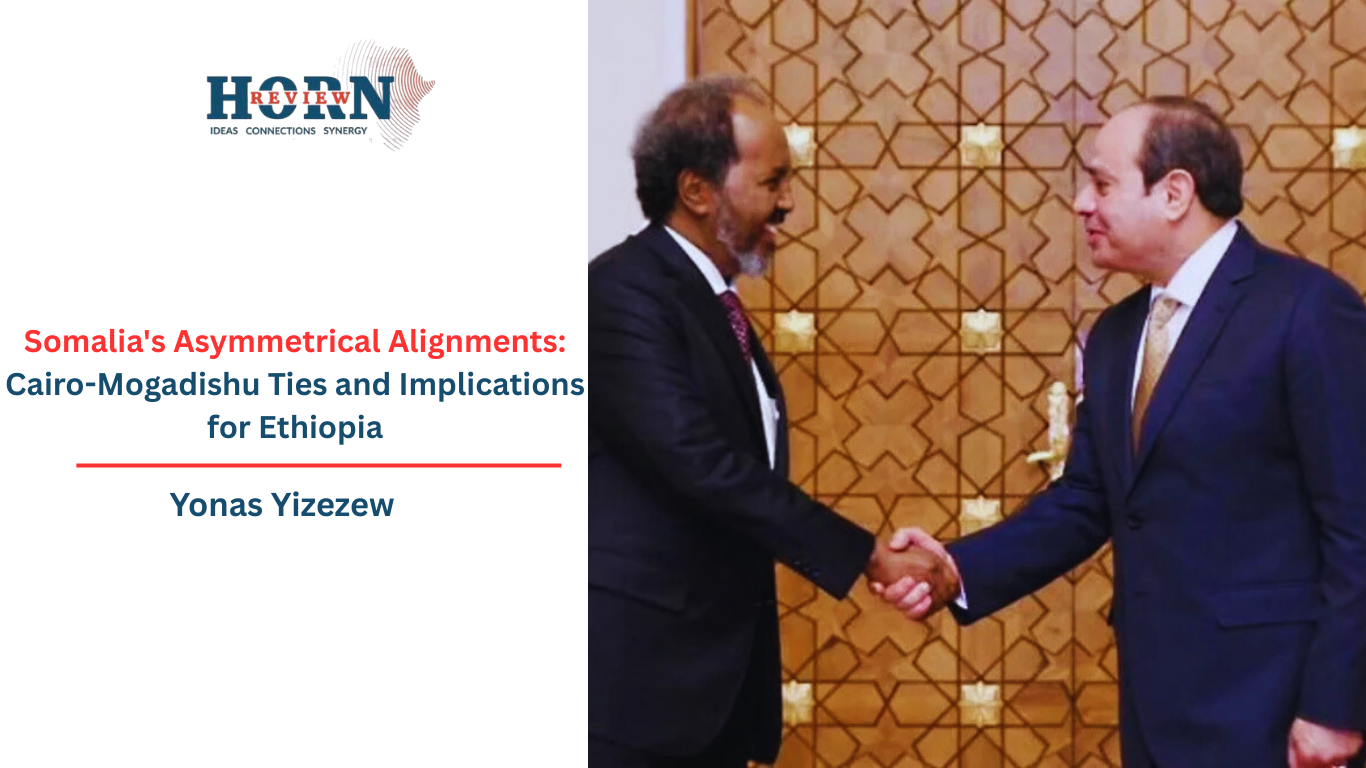
The emerging axis politics have further complicated matters. As Saudi Arabia, Egypt, Qatar, Turkey and Somalia, coalesced in opposition to the UAE, Israel, Somaliland alignment, Somalia’s leadership found itself navigating a delicate and often contradictory diplomatic path. Recent meetings between President Hassan Sheikh Mohamud and President Abdel Fattah el Sisi highlighted both cooperation and underlying tension.
During the meeting, Cairo and Mogadishu issued statements emphasizing that only littoral states should be responsible for Red Sea security and governance. This formulation can be interpreted as a direct message to Ethiopia, which has openly sought sovereign access to the Red Sea. The statement signaled Somalia’s willingness to align with Egypt on one of Addis Ababa’s most sensitive strategic priorities. Yet only weeks earlier, President HSM had been in Ethiopia alongside Djibouti’s President Ismail Omar Guelleh and Prime Minister Abiy Ahmed, projecting a message of regional dialogue and cooperation, a telling diplomatic irony.
One recent episode exposed the underlying asymmetry in Cairo–Mogadishu relations. During a joint press conference with Hassan Sheikh Mohamud, President al-Sisi publicly described Somalia as a ‘textbook failed state,’ presenting it as a cautionary example for Egyptian audiences. The remark reinforced Egypt’s self-positioning as a patron rather than a partner. The moment continues to resonate, demonstrating the hierarchical nature of the relationship and the extent to which Somalia is framed within a dependency paradigm rather than a framework of sovereign equality.
The current pattern of Somalia’s foreign policy, characterized by rapid diplomatic pivots between rival regional blocs, represents a significant strategic miscalculation that undermines its own long-term interests. While hedging is a common tactic in international relations, its effectiveness is contingent upon a stable domestic foundation and a coherent strategic vision—both of which are presently absent in Mogadishu.
This approach, far from securing Somalia’s sovereignty, actively erodes it. By inviting and leveraging the direct involvement of external powers in its internal disputes, the federal government is mortgaging its political autonomy. Each high-level meeting in Cairo, Doha, Ankara or Riyadh does not simply secure a temporary ally but deepens the dependency and grants that external patron greater influence over Somalia’s security apparatus, political negotiations, and economic future. The result is not a balanced, independent foreign policy but a fragmented state whose different factions become proxies for foreign agendas. When a federal member state looks to one Gulf power and the central government to another, the nation’s internal divisions are not merely mirrored internationally but are institutionalized and weaponized by outsiders.
Furthermore, this strategy dangerously conflates immediate tactical gains with enduring national security. Alienating a contiguous neighbor like Ethiopia, which shares a long border and deep social, security and economic ties with Somalia, in exchange for the distant support of Egypt, is geopolitically myopic. In 2025, Somalia’s rejection of Ethiopian naval participation in a coastal military drill was widely viewed as a politically motivated decision rather than a technical one. On multiple occasions, Mogadishu has taken positions that directly challenge Ethiopian interests, even as it continues to engage Addis Ababa diplomatically. These moves have contributed to a climate of mistrust at a time when regional cooperation is already under strain.
The tangible threats to Somalia’s stability—principally Al-Shabaab’s insurgency and internal constitutional crises—are not issues that can be resolved by Cairo, Riyadh, Ankara or Abu Dhabi. They require focused, regional cooperation and stable borders. Antagonizing Ethiopia through exclusionary statements on Red Sea access or military drills may garner favor in one capital, but it simultaneously destabilizes the very regional environment Somalia depends upon for collective security and trade. It is a move that secures a headline of support while potentially closing doors essential for long-term peace and development.
At the same time, reports indicate that Egypt has been encouraging closer ties between Saudi Arabia and Eritrea. Such efforts cannot be separated from the broader context of renewed tension between Ethiopia and Eritrea. The possibility that Cairo is seeking to reactivate or reshape the earlier tripartite understanding among Egypt, Eritrea, and Somalia adds another layer of uncertainty. While that alliance appeared to recede in recent years, the current escalation of regional rivalries suggests it may not be fully dormant.
In these sense, these developments point to a troubling trend. Somalia is becoming more deeply enmeshed in external power struggles while its internal foundations remain weak. President Hassan Sheikh Mohamud’s diplomatic activism increasingly appears reactive, driven by short term pressures rather than a coherent long term strategy. As regional actors pursue their own agendas, Somalia risks becoming a venue for proxy competition rather than a beneficiary of strategic partnerships.
For the Horn of Africa, this trajectory carries significant implications. The intersection of Red Sea geopolitics, Gulf rivalries, and unresolved inter-state tensions is creating a volatile environment. Somalia’s current course, marked by oscillation between rival camps and deepening external involvement, is contributing to that volatility. Without greater internal consensus and a more balanced regional approach, Somalia’s moves may ultimately undermine not only its own stability but also the prospects for durable cooperation in the Horn.
For Ethiopia, Somalia’s growing fragility and its susceptibility to influence from states adversarial to Ethiopian interests create a volatile southern flank. The instrumentalization of Somalia in the Red Sea exclusivity debate directly contests a core Ethiopian national priority. Furthermore, the potential for Somalia to serve as a logistical or political node in a wider alliance network involving Egypt and Eritrea presents a significant strategic challenge. Addis Ababa must therefore navigate a landscape where its neighbor’s internal weaknesses are exploited by external powers, transforming the security crises into conduits for geopolitical competition.
By Yonas Yizezew, Researcher, Horn Review