
7
Feb
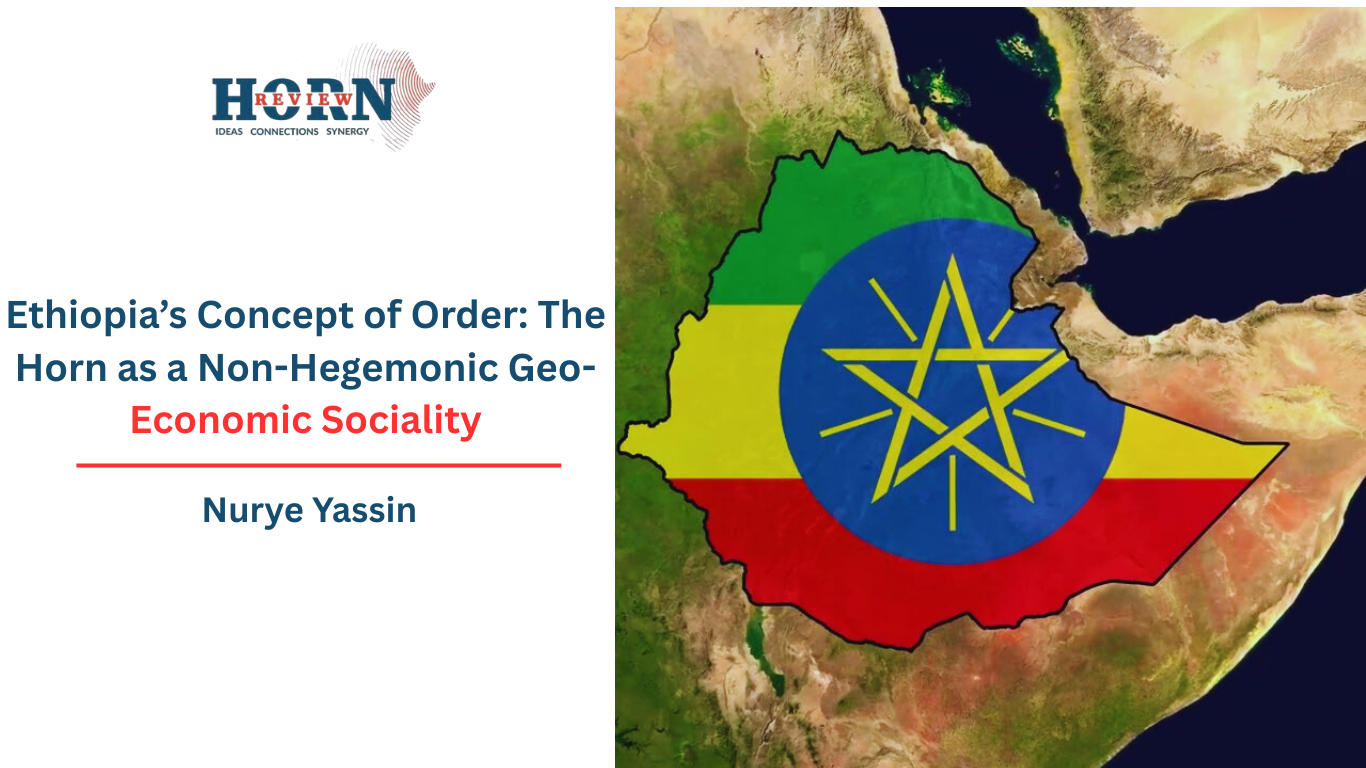
Ethiopia’s Concept of Order: The Horn as a Non-Hegemonic Geo-Economic Sociality
Geo-Economy Remapping the Global Geography
In a contested and less collaborative world, we are heading into a new period of uncertainty, witnessing a retreat to economic tribalism, a contest for control of ports and arteries for global trade and power, and militarization of international policy. Trade is seen as war. Interdependence is viewed as vulnerability.
Geo-economy as the economics of geopolitics becomes a macro-trend capturing the new turn to economic nationalism, technological sovereignty and dominance over critical sea lanes as pathways for regional and global primacy. It is in this regard that geo-economy emerges to remap the global geography and remake the international distribution of power.
Geo-economics as the continuation of war by the methods of commerce is an all-encompassing subject incorporating critical technologies and minerals, land and maritime transportation routes and chokepoints, as well as financial instruments ranging from currency to payment systems to export controls.
Geo-economics is the new frontline where the intensified contest for world primacy plays out causing disruption of maritime corridors, geopolitical tensions, geo-economic shocks, and global development emergency.
Control of Economic Geography Decides the Future of Power
Control of global economic geography is set to determine the future of international balance of power. We see shades of this global power rebalancing in the form of emerging wars of straits, corridors, land routes, and sea lanes in vital and strategic regions of the world.
In addition to major powers, middle powers and regional actors taking advantage of the global power rebalancing and having freedom of maneuver fiercely compete in strategic regions of the world for control of sea and land routes, commercial and military bases, oil and gas, water resources, critical minerals, farmlands, food, fodder, water resources, strategic resources and markets.
Nowhere is this more apparent than in the Horn of Africa or the African side of the Red Sea, Gulf of Aden and Indian Ocean. The struggle over economic geography makes the Horn of Africa a chessboard for the power play of regional and extra-regional actors in addition to global powers.
This emergent situation has exacerbated the unresolved and ongoing wars in the Horn, created new fault lines, and derailed geo-economic cooperation and integration efforts championed by regional economic communities, including the Intergovernmental Authority on Development (IGAD).
The regional and middle powers consider the Horn an arena to project power for influence, leadership, and accumulation of wealth. This conception for external predations sees the Horn as a people-less and state-less space that can be penetrated and exploited to satisfy the wishes and whims of these same external powers deliberately omitting the indigenous geographic agency and home-grown ideas for a regional order.
Simply put, the Horn of Africa endowed with all possibilities for geographic essentiality and geo-economic centrality becomes a battle space where others compete to amass power and resources. The African side of the Red Sea exhibits wars over ports, coastlines, straits and corridors, making the Horn a central theatre in contest for global control of arteries of trade.
Moreover, the littoral spaces of the Horn function as channels for regional, middle and major power militarised expansionism, making the Horn a central theatre for geopoliticised confrontation. The littoral spaces being an extension of the geostrategic designs of rival external actors, geography is weaponised endangering the Horn.
The weaponsiation of geography could potentially impose maritime entrapment on essential countries of the Horn, including Ethiopia. The crises, conflicts and proxy politics are entry points for regional actors to experiment their geostrategic designs in a bid to re-order the extensive territorial waters of the Horn.
Eritrea carved out of Ethiopia’s territory for colonial conquest and erasure of Ethiopia from Red Sea is now being repurposed as a proxy for Egypt’s encirclement policy. The regime in Asmara is used to divide Ethiopia from the Horn, Red Sea and Nile Basins; sever its strategic arteries; make it sail without coast; and envisage a Nile Basin without Addis Ababa.
The alignment between Eritrea and Egypt shows the fact that the Horn is a staging ground for rival blocs that attempt to rewire the land and sea routes pulling the countries of the Horn into their conflicting and contending camps. Such actions of forming a front with and providing a foothold to external regional powers have internationalized the local wars and crises as well as globalized the Horn as a site for global rivalry.
Under all this sea change, the countries of the Horn seem to be unprepared in seizing the opportunities and responding to the risks arising from the geo-economic showdown, big and middle power maneuvering, and polarized geopolitical rivalry centered on critical sea lanes. The region cannot afford to be a battleground as it would again lead itself into a hellish zone of non-being in a toxic geopolitical situation.
Reframing the Horn as a Decentralized System of Collective State Sovereignty
To overcome its subaltern position and convert its geography into a strategic asset, the Horn needs to unleash the power of native intelligence as the borrowed modes of epistemology and thought are in a state of exhaustion and irrelevance unable to make sense of the new situation and explain the disordered world.
This indigenous mode of epistemology putting a premium on independent thought is capable of creating a space for another enabling thought, reason and logic that is open and free for a new way of understanding, organizing, empowering, and regionalizing the Horn and Red Sea regions.
Bringing the scholars and practitioners from this part of the world is of strategic significance as their ideas contain experiential knowledge taking seriously the lived experience of the people of the region. An Ethiopian scholar and diplomat, Professor Negussay Ayele imparted transformative ideas that could help the region generate ideas and practices that could take it towards a new regional future.
Professor Negussay, enunciated that the peoples of Northeast Africa “will either be destined to survive and maybe even thrive together or be doomed to self-destruct together, not separately,” articulated a new concept of a regional order for the Horn, that is, a form of association known as a “decentralized system of collective state sovereignty” and a “loose rather than a rigid form of political association.” These ideas emphasize functional interactions (geo-economic and geo-cultural bonding) have emancipatory possibilities over structural formalities.
The ideas of Professor Negussay stressing the need to explore this functional and collective state sovereignty as some of it have been part of the region’s past underscore that this way of understanding and re-ordering of the region could help it redefine its geography, overcome the perils of this momentous era, serve as a site for global geo-economic cooperation.
The countries of the Horn should heed the wisdom of Professor Negussay and explore the possibility of this option–collective state sovereignty–to launch the future of the Horn capable of delivering geostrategic autonomy and geo-economic independence.
Applying these ideas in the new situation might seem so difficult. The numerous schemes hatched at making the Horn a subservient region should compel the countries of the Horn to strengthen coordination in order to stand up to the existential challenges and stay afloat in the evolving geopolitical power shifts.
It is a critical time for the elites of Horn to demonstrate mega-courage, unity, solidarity relevance, and regional leadership to own and lead the redrawing of the map of the Horn and Red Sea according to rules and designs of their own making.
Ethiopia’s Concept of Order: Regional Strategic Autonomy and Geo-Economic Openness
Similarly, Foreign Minister Gedion Timothewos who has recently put forward Ethiopia’s concept of a regional order, underlines the need to make a shift from the logic of “manichean conceptions of sovereignty” to that of a collaborative and shared interests of the Horn as a whole to calmly respond to the crises, position the region as a rule maker, and emerge as a key geo-economic hub connecting Africa, Europe and Asia.
Foreign Minister Gedion introduces concepts such as strategic autonomy and geo-economic openness as now forming the ideational basis for a regional order that facilitates the birth of the Horn as a shared geo-economic sociality grounded on non-hegemonic stability and mutual enablement.
What does regional strategic autonomy mean for the countries of the Horn? It is for the countries of the Horn to run the affairs of the Horn and the African side of the Red Sea, Gulf of Aden and Indian Ocean while committing them to end their role as a platform for destabilization of the region.
That means external and middle powers have no role in managing the affairs of the Horn and Red Sea while welcoming like-minded and cooperative partners who can work in concert with the countries of the Horn in turning geography into a strategic advantage for all and securing maritime and land routes for global trade and connectivity.
A geo-economic openness is another important concept unveiled by Minister Gedion for a regional order that advances enabling paradigms, including trust, mutual respect, and inclusion. This is indicative of the fact that Ethiopia advocates for the promotion of open geo-economic regionalism grounded on rules through dialogue over exclusion and rules by few.
This open geo-economic regionalism avoids foreign and native hegemonism and bloc politics, mainstreaming negotiation, coordination and open regionalism as elements of regional integration for the creation of a self-reliant and empowered community of the Horn. The Horn finding itself at the crossroads of the three continents is open for talent, innovation, capital, ideas, people and goods.
Geo-economic openness is not about looking inward. It is about widening the horizon of strategic space. It is about expanding and diversifying economic partnerships with growth poles as well as other regions. The Horn and Gulf regions as one interconnected space can be a starting point to harness their strategic location centered on Red Sea into a global hub for geo-economic processes. It is an attempt to make the Horn an open region that leverages the best of the West and East for growth.
Going forward, the countries of the Horn should privilege strategic autonomy, geo-economic openness and complex balancing to instrumentalise these critical water ways, coastlines, corridors, ports, and chokepoint as enablers for the building of a geo-economic sociality.
The challenge is regional and requires a regional approach to the polarized geo-economic warfare fought over land and sea routes for existence, influence and power. This is so existential for Ethiopia given its maritime, strategic and security vulnerabilities.
This ontological challenge cannot be addressed by conventional nationalist imaginaries and practices of sovereignty. The geopolitical power shifts require a new vocabulary and grammar to rise to the occasion of geo-economic martial arts implicating the jugular of a regional enabling power-Ethiopia-with no durable and sustainable access to the sea.
Ethiopia lays groundwork for the strategic autonomy and geo-economization of the region investing on physical, technological and financial connectivity while knitting the region together with policy, digital, energy, green, aviation, trade, logistical, food, water, and infrastructural corridors.
The countries of the Horn should play their cards well to emerge as a an autonomous and unified regional economic and security zone that will play a strategic bridging and stabilizing role in a world of geo-economic contradictions.
By Nurye Yassin, An Independent Researcher on Horn-Gulf Relations

RELATED
Posts

24
Feb
Egypt's Offer to Ethiopia and The Juridical Void with Enforceability Gap
For over a decade the diplomacy of Egypt over the...
24
Feb
Ethiopia's Ascendancy: Inspiring Kenya's Leap Forward While Eritrea Languishes in Stagnation
In a policy address focused on East Africa’s development priorities...

24
Feb
Federation as Shield: How Eritrea’s Re-Union with Ethiopia Protected It from the United Kingdom’s Partition Scheme
In the aftermath of World War II, Eritrea found itself...
21
Feb
Ethiopia’s Modern Diplomacy: Insights in to Its Strategic Engagement in the Middle East and Asia
Over the past eight years, Ethiopia has fundamentally reoriented its...
19
Feb
Containment or Co-Development? Navigating Egypt’s Strategic Encirclement of Ethiopia
Egypt is not merely reacting to the GERD. It is...
19
Feb
Hobyo vs Sovereignty: Turkey between Ethiopia's Maritime Future and Somali Sovereignty
The Billion Dollar Question, Whose Port, Whose Peace?
The Horn...
18
Feb
Recep Tayyip Erdoğan’s strategic visit to Addis Ababa
President Recep Tayyip Erdoğan’s one-day visit to Addis Ababa on...
18
Feb
As Ethiopia and Eritrea Drift Towards Catastrophe, Mediation Remains Elusive
The deteriorating relationship between Ethiopia and Eritrea appears to have...
16
Feb
Ethiopia’s Recaliberated Foreign Policy Approach: Resource Optimization and Burden Sharing
The Grand Ethiopian Renaissance Dam (GERD) with an installed generation...