The demand made by Egypt’s Minister of Water Resources and Irrigation, Hany Sewilam, for Ethiopia to compensate Egypt and Sudan for supposed damages caused by the Grand Ethiopian Renaissance Dam (GERD) is absurd. Sewilam claims that Egypt has been denied 38 billion cubic meters of its alleged historic allocation of 55.5 billion cubic meters during the dam’s filling. He also pointed to costs incurred for water recycling and treatment needed to address scarcity.
Citing the 2015 Declaration of Principles on avoiding significant harm, Egypt presents the GERD as an unprecedented imposition. However, this perspective misrepresents the basin’s hydrological realities and historical context. Ethiopia is not the one that owes restitution; it is the aggrieved party that deserves compensation for centuries of unrecognized contributions to the Nile’s flow, sediment control, and long-term sustainability. These services have supported Egyptian development while Ethiopia has shouldered the environmental and economic burdens.
Ethiopia’s counter-claim is rooted in the pioneering hydrology of Sir Harold Edwin Hurst, the British engineer who studied the Nile for over sixty years from 1906 to 1968. In his important works, including “The Nile: A General Account of the River and the Utilization of Its Waters,” published by Constable in 1952, Hurst introduced the concept of “Century Storage” to manage the river’s extreme fluctuations. He advocated for reservoirs that could hold water over multiple years.
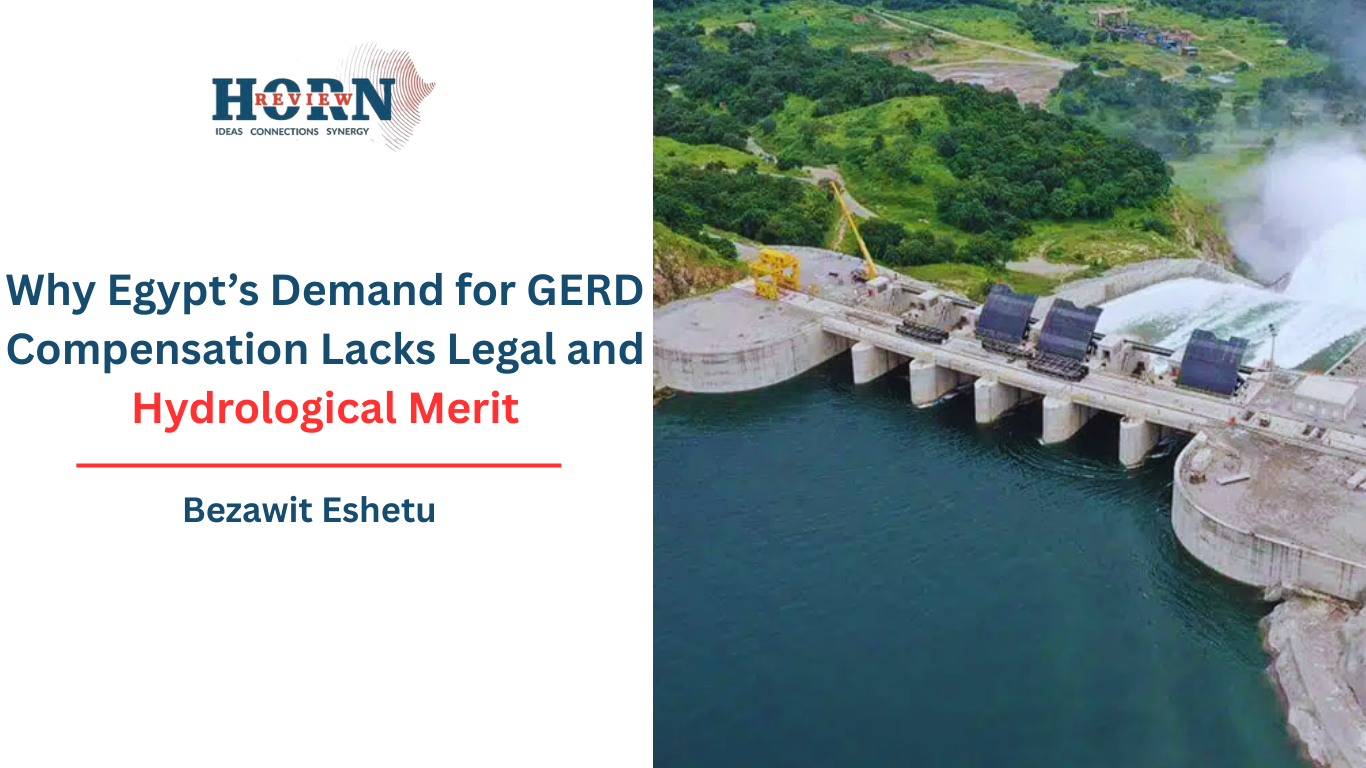
His thorough analysis, based on more than 800 years of Nile flood records, concluded that the best storage locations are in the deep gorges of the Ethiopian highlands, where cooler temperatures and narrower surfaces reduce evaporation. The GERD perfectly aligns with this vision, utilizing the Blue Nile’s source in Ethiopia’s highlands to create a reservoir at 640 meters above sea level, which is far superior to options downstream. This location takes advantage of natural geography to conserve water that might otherwise be lost, making Ethiopia’s highlands the most effective natural water regulator in the basin.
To understand this hydrological advantage, consider the evaporation differences highlighted in peer-reviewed studies. A 2019 report indicates that Lake Nasser behind Egypt’s Aswan High Dam loses 10 to 16 billion cubic meters annually to evaporation. This loss is worsened by its shallow average depth of 25 meters and its vast surface area of 5,250 square kilometers that face intense Saharan heat exceeding 40°C. The desert’s dry conditions speed up evaporation, leading to a waste of up to 20% of stored water each year, as confirmed by data from NASA’s Earth Observatory.
In contrast, the GERD’s reservoir, located in Ethiopia’s cooler highland gorges with average temperatures between 20-25°C, a deeper average of 60 meters, and a smaller surface area of 1,874 square kilometers, experiences losses of only 0.4 to 1.5 billion cubic meters per year, according to simulations. By storing water upstream in these deeper, cooler areas, Ethiopia prevents billions of cubic meters from evaporating in Egypt’s hot, shallow Sahara basin, providing significant water savings for downstream users that Egypt’s infrastructure wastes.
Moreover, Egypt’s claim of economic distress due to its water recycling efforts, asserting that it treats 23.2 billion cubic meters each year, misplaces the responsibility. These costs arise from Cairo’s internal policies and population pressures. The World Bank’s 2022 Nile Basin Initiative report outlines that Egypt’s water scarcity is exacerbated by a population exceeding 110 million and an agricultural sector that consumes 85% of its allocation through outdated flood irrigation, which loses 30-40% due to inefficiencies, as estimated by the FAO.
The GERD’s design does not divert water permanently; it generates hydropower while temporarily managing flow for electricity production, as noted in the International Panel of Experts’ report from 2013. Ethiopia, which contributes 86% of the Nile’s water through the Blue Nile according to USGS hydrological data, has never sought compensation for this natural contribution. Demanding payment for Egypt’s self-made inefficiencies overlooks the fact that upstream conservation has historically benefited downstream abundance, placing Ethiopia in the position of an unrecognized benefactor in an imbalanced hydrological economy.
It is ironic that Egypt criticizes “unilateral action” when examining the history of the Aswan High Dam, built from 1960 to 1970 without consent from upstream nations. Archival records from the United Nations’ Food and Agriculture Organization (FAO) show that Egypt proceeded despite Ethiopia’s protests, flooding 500 kilometers of Sudanese land and displacing 50,000 Nubians.
The 1959 Nile Waters Agreement allocated 55.5 billion cubic meters to Egypt and 18.5 billion cubic meters to Sudan, completely excluding Ethiopia despite its role as the water source. This treaty, rooted in colonial-era disparities, allowed Egypt to dominate the river, achieving 99% electrification by the 1980s according to International Energy Agency data, while Ethiopia remains below 50% access today. The GERD, built on Ethiopian territory without affecting long-term downstream volumes, reflects but seeks to correct this historical injustice, revealing Egypt’s selective use of cooperation as a means of maintaining hydro-hegemony.
The “significant harm” clause in the 2015 Declaration of Principles, signed by Egypt, Sudan, and Ethiopia as reported by the African Union, requires mitigation but does not permit unilateral vetoes. Ethiopia has cooperated by sharing data and filling the dam in phases, ensuring minimal harm. Conversely, Ethiopia’s unacknowledged ecosystem services deserve recognition.
For years, programs like the Ethiopian Ministry of Agriculture’s Sustainable Land Management Project, funded by the World Bank since 2008, have invested over $1 billion in reforestation and terracing, reducing soil erosion by 1.5 billion tons annually. This work limits the sediment that would accumulate in Lake Nasser, extending its lifespan and saving Egypt millions of dollars annually on dredging costs, as estimated by the U.S. Army Corps of Engineers in a 2018 Nile sediment report. Thus, Ethiopia’s highlands serve as the basin’s filter, a service that has been undervalued until recently.
In addition, Ethiopia suffers economically from downstream dominance, which strengthens the case for compensation. Blocked from World Bank loans for water projects due to Egyptian lobbying in the 1990s, according to declassified U.S. State Department cables, Ethiopia financed the $4.8 billion GERD through domestic bonds. This delay in development cost Ethiopia an estimated $29.94 billion in lost GDP from 2000-2020 based on projections from the African Development Bank.
The impact of this situation is compounded by poverty, with 50% of Ethiopians lacking access to electricity, as reported by the International Energy Agency. Egypt’s claims of “historic rights,” which have gone unchallenged until now, have caused generational damage, overshadowing Cairo’s recycling assertions and emphasizing Ethiopia’s moral claim for reparations.
The legal foundation lies in the 1997 UN Convention on the Law of the Non-Navigational Uses of International Watercourses, ratified by 37 countries, including those in the basin. This convention prioritizes fair and reasonable use over an absolute no-harm rule. Article 5, as discussed in the International Court of Justice’s precedents like the Gabčíkovo-Nagymaros case, considers factors such as geographic contributions, population needs, and available alternatives.
Ethiopia’s focus on hydropower, addressing energy poverty without consuming the river, benefits from strong support, as indicated by the World Commission on Dams’ report from 2000. Egypt’s colonial agreements, which are not binding on Ethiopia under the Vienna Convention on the Law of Treaties, cannot override this principle, making their demand for compensation legally weak.
The shift in diplomatic dynamics in early 2026, marked by renewed U.S. mediation under President Trump, opens a chance to move from these win-lose demands to a framework of shared benefits. However, such a framework cannot assume that the upstream provider owes a debt to the downstream user. If the Nile is to be managed as a unified system, the costs of that management must be shared. This includes the international principle of Payment for Ecosystem Services (PES), as outlined in the UN’s 2005 Millennium Ecosystem Assessment and applied in basins like the Mekong.
Under PES, downstream beneficiaries like Egypt and Sudan should compensate Ethiopia for the upstream conservation that maintains water quality, reduces flooding in parts of Sudan and minimizes evaporation through highland storage in deep, cool gorges, which are more effective than the shallow, hot Sahara. Ethiopia has already shouldered the multi-billion-dollar cost for the infrastructure that will regulate the river’s flow, lessen flooding in Sudan, and cut evaporation for Egypt. By demanding compensation on top of these already provided benefits, Egypt essentially asks Ethiopia to pay for the privilege of saving the Nile from Egyptian mismanagement.
Ultimately, Ethiopia’s stance goes beyond immediate geopolitical concerns. It advocates for a system where upstream stewardship is acknowledged and rewarded instead of penalized. By implementing Hurst’s highland storage in Ethiopia’s temperate gorges, saving water lost to Sahara-based waste, and providing sediment control worth millions, the GERD represents fair progress. This counters Egypt’s claims with a fundamental truth: the Nile’s future requires mutual respect, positioning Ethiopia not as a debtor but as a creditor in the shared water management of the basin.
By Bezawit Eshetu, Researcher, Horn Review