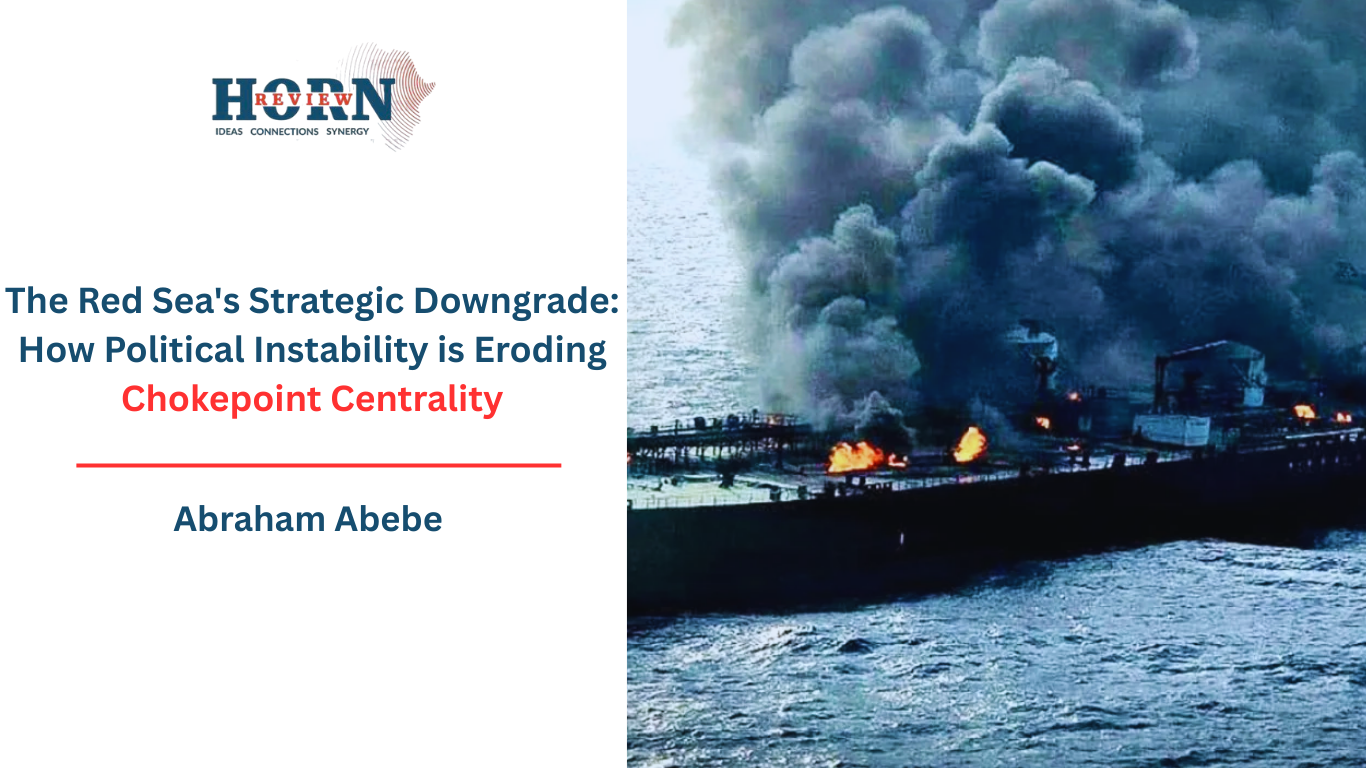
What makes the present Red Sea moment strategically significant is not the missile strikes or hijackings that dominated headlines at the height of the crisis, but the day-to-day decisions of major shipping companies. When a firm like CMA CGM (the largest container shipping company in the world) structures its network planning around continued caution in the Red Sea corridor, it is not reacting to headlines but planning on the assumption that insecurity is a persistent feature of the corridor, not a short-term disruption. That decision tells us more than a short-term drop in reported attacks.
The debate is misframed if it asks whether traffic is returning. The more relevant question is why leading carriers still treat the Suez-Bab el-Mandeb axis as a conditional route and why the Cape of Good Hope is being normalized from an emergency detour into a standing strategic alternative. This shift reveals that the Red Sea is increasingly viewed as a conditional passage, shaped by political and security risks. In effect, the Red Sea is shifting from a guaranteed corridor in global logistics to a conditional one.
CMA CGM’s posture illustrates three deeper realities about the unresolved nature of Red Sea insecurity. First, deterrence measures have not translated into stable political control. The decline in attacks reflects short-term military pressure and changes in tactics, rather than the removal of the armed networks or the political conditions that enabled maritime strikes in the first place. Non-state armed actors linked to regional conflicts have not disappeared; they have demonstrated that they can pause, recalibrate, and re-escalate. Insurance pricing, crew safety protocols, and routing algorithms, therefore, continue to treat the corridor as exposed to sudden risk.
Second, the underlying conflict geography around the corridor has not changed. The Bab el-Mandeb sits adjacent to overlapping instability zones: Yemen’s unresolved conflict environment, fragility along parts of the Horn of Africa, and intensifying Middle East confrontations that can externalize into maritime domains. The Horn of Africa dimension is particularly significant because it connects maritime insecurity to terrestrial political fragmentation. Somalia’s ongoing security challenges and Djibouti’s role as a military hub hosting bases create a competitive regional environment in which coastal control, port development, and naval access are intertwined with broader geopolitical rivalries.
These dynamics mean that Red Sea security cannot be separated from Horn of Africa state fragility, inter-state tensions, and the involvement of Gulf powers seeking strategic depth through port agreements and military facilities. No political settlement has stabilized these arenas. As long as coastal and near-coastal conflicts remain active, the sea lane that threads between them cannot be insulated, because naval patrols can intercept projectiles but cannot remove the political drivers that turn shipping into a lever of asymmetric pressure.
Third, external powers have increased military involvement without creating a lasting stability framework. The increase in external naval presence has created a layer of reactive security that is coalition-based, mission-specific, and politically contingent, depending on shifting mandates, domestic politics in contributing states, and evolving rules of engagement. For commercial planners, this translates into uncertain future protection rather than guaranteed long-term security architecture. A corridor secured by improvisation rather than a durable framework will always be rated as unstable.
Against this background, the Cape of Good Hope is being reinterpreted. It is slower and more expensive in terms of fuel and time, but it offers what the Red Sea currently cannot: predictability of risk. There are no comparable concentrations of conflict spillover, no narrow chokepoints within missile range of active war zones, and far less exposure to non-state actors seeking global visibility. The Red Sea route saves time, but exposes ships to higher security uncertainty.
This trade-off is reshaping corporate logic. Shipping lines operate on network reliability, not simply speed. A route that may be open today but closed tomorrow disrupts vessel rotations, port berthing windows, equipment repositioning, and contractual delivery guarantees, forcing planners to build buffers, duplicate contingencies, and maintain parallel routing strategies. The result is that the Cape option becomes embedded in baseline planning rather than reserved for crises. Once that normalization occurs, a psychological and structural shift has taken place such that Suez is no longer the default.
Rerouting around Africa absorbs global vessel capacity, lengthens round-trip cycles, tightens supply elasticity, and redistributes strategic maritime weight toward the South Atlantic and southern African sea lanes, reducing the Red Sea’s reliability as a primary artery. For Red Sea littoral states, this represents not only a security issue but an economic and geopolitical one; instability is gradually eroding the corridor’s centrality in global logistics calculations.
The implications for the Horn of Africa are particularly acute. The region’s states have historically leveraged geographic proximity to global shipping lanes to generate strategic rent through port fees, military basing agreements, and transit-related services. As the Red Sea’s reliability declines, this geographic advantage diminishes. Djibouti’s role as a commercial gatekeeper could weaken even as its function as a military logistics hub remains significant. Somalia’s port rehabilitation projects similarly depend on the corridor’s commercial viability. If shipping companies institutionalize Cape routing, Horn of Africa states lose not only port revenue but also the geopolitical leverage that comes from sitting astride a vital artery.
The absence of constant attacks has not restored trust. CMA CGM’s continued caution indicates that the company does not believe a threshold of durable safety has been crossed. What exists is a managed lull layered over unresolved conflict systems, not credible expectations about the future. The Red Sea has entered a phase of chronic insecurity: violence may fluctuate, but the underlying environment remains permissive for disruption. The Cape of Good Hope is not merely a detour; it is becoming a structural alternative against a corridor whose stability is politically determined.
The growing acceptance of Cape of Good Hope routing is reshaping the fundamental structure of global shipping. Maritime networks don’t simply snap back after a crisis ends; they transform gradually through changes in how vessels are deployed, alliances are scheduled, port rotations are designed, and reliability commitments are made. The Red Sea remains important, but now exists within a diversified risk strategy that prioritizes backup options over pure efficiency. The crisis, then, is not over; it has become a situation in which the decisive variable is no longer the frequency of attacks but whether political stabilization can transform the security environment from managed volatility to durable predictability. That level of stability has not yet been achieved. A major political settlement in Yemen or the emergence of a durable regional security framework could alter this trajectory, but neither appears imminent at present.
As long as the surrounding conflict landscape remains unsettled, the Red Sea will be considered a corridor exposed to sudden risk reactivation, and routing strategies will continue to reflect structural caution. The strategic consequence is clear: global trade is adapting to a world in which this chokepoint cannot be assumed secure by default. Restoring dependability will require coordinated action not only from external naval powers but also from regional institutions, including the African Union and other stakeholders, to address the drivers of instability. Political stability, not geography alone, now determines whether the route is dependable. Until that equation changes, the adaptations visible today will consolidate into enduring features of maritime order.
By Abraham Abebe, Researcher, Horn Review