
23
Jan
Trump, the Nile, and the Language of Power: How Should Ethiopia Engage?
By Blen Mamo
Donald Trump’s most recent pronouncements concerning Ethiopia’s Grand Ethiopian Renaissance Dam (GERD), Prime Minister Abiy Ahmed, and the Nile River constitute less a policy exposition than a study in the semiotics of power. Consistent with much of Trump’s foreign-policy rhetoric, the speech exhibits surface-level inconsistencies, a heightened emotional tenor, and strategic selectivity in the elements it elects to emphasize.
Trump’s characterization of Abiy Ahmed as a “strong leader” exemplifies this dynamic. In conventional diplomatic parlance, such a phrase might imply endorsement or ideological affinity. In Trumpian usage, however, it conveys a narrower, transactional understanding: a “strong leader” is one who exercises control over outcomes, resists external pressure, and commands recognition. Trump has applied this epithet to leaders with whom he fundamentally disagreed yet nevertheless respected and acknowledged as consequential actors. In the Ethiopian context, the designation signals recognition of authority rather than approbation of policy. It implies that Ethiopia, under Abiy, is not a passive participant in the Nile dispute but an active and decisive actor whose consent is indispensable to any resolution. This framing coheres with Trump’s broader worldview, in which international politics is less governed by norms or legal frameworks than by leverage and perception. By acknowledging Abiy’s strength, Trump implicitly repudiates any narrative in which Ethiopia might be coerced into concessions over GERD. Negotiation, in this calculus, becomes a necessity dictated not by principle but by power equilibrium.
President Trump also claimed that the United States financed Ethiopia’s Grand Renaissance Dam (GERD), which is inaccurate. The project, Africa’s largest hydroelectric initiative, was primarily funded through Ethiopian government resources, public bonds, and contributions from the diaspora, with no direct U.S. financing. Ethiopian officials and independent observers have consistently confirmed that the dam’s construction relied on domestic and select private funding, making claims of American financial involvement unsupported by the evidence.
The speech’s most striking tension arises from the ostensible paradox in Trump’s description of the Nile as a “small river” juxtaposed with the claim that Ethiopians have constructed a “big dam.” Hydrologically, this is plainly inaccurate: the Nile ranks among the world’s longest rivers and is integral to the livelihoods of multiple civilizations. Yet Trump’s intent is rhetorical rather than technical. By diminutivizing the river, he magnifies the perceptual stakes; by enlarging the dam linguistically, he dramatizes its impact. The narrative thus conveys a sense of structural imbalance: a colossal intervention imposed upon a constrained and fragile resource. It is a narrative designed to evoke urgency and anxiety, particularly among downstream stakeholders. This rhetorical strategy also serves a geopolitical purpose: it centers Egyptian concerns without overtly siding with Cairo. By depicting the Nile as susceptible and the dam as formidable, Trump constructs a scenario of heightened urgency that justifies external mediation. The implicit message is not that Ethiopia is culpable, but that the situation is inherently fraught and consequential.
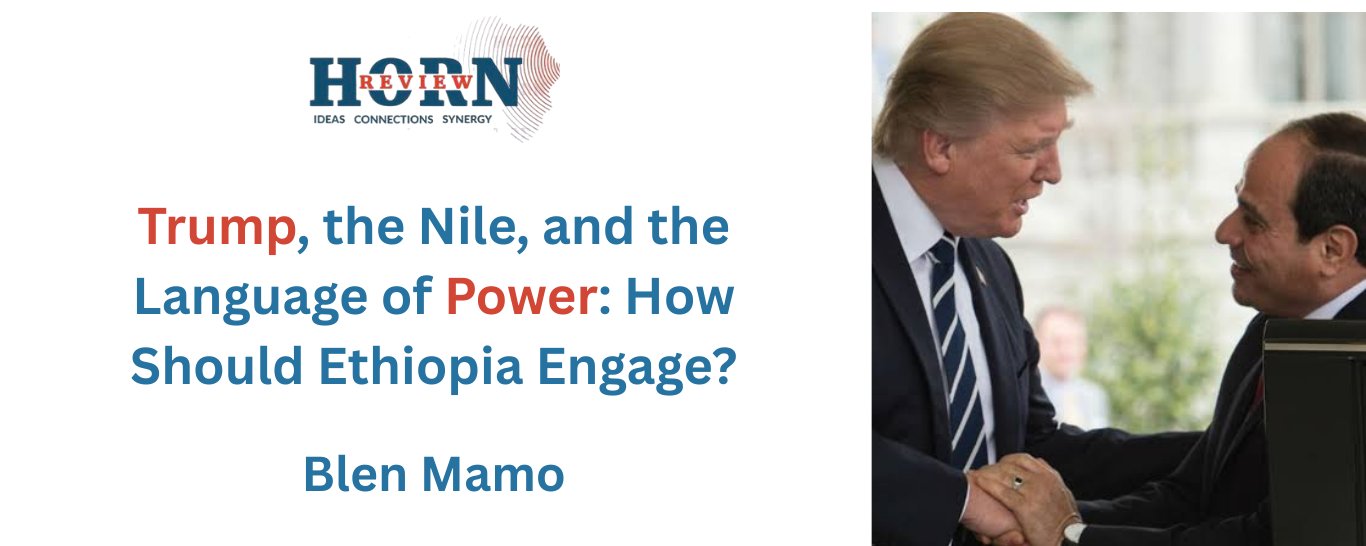
This posture cannot be disentangled from Trump’s enduring ties to Egypt, which are anchored in decades of Washington’s strategic engagement with Cairo. Egypt has historically been a linchpin of American policy in the Middle East, particularly with respect to Israeli security, regional stability, and Arab–Israeli diplomacy. Under President Abdel Fattah el-Sisi, Cairo played a pivotal role in the regional realignments culminating in the Abraham Accords – a diplomatic accomplishment Trump frequently cites as a hallmark of his legacy – and remains central to any Gaza Peace Plan and other broader stabilization initiative amid escalating regional tensions. This strategic relevance extends well beyond Trump himself. U.S.–Egypt defense and security cooperation is longstanding, institutional, and predates both the Trump administration and Al-Sisi’s regime, encompassing military aid, joint exercises, procurement relationships, and enduring engagement with American defense firms. At a personal level, however, Trump’s relationship with Sisi has been notably cordial. He has publicly lauded Sisi’s leadership, received Egypt’s highest honor, the Order of the Nile, and visited Cairo few months ago- gestures reflecting Cairo’s sustained investment in cultivating his attention and goodwill. During his first term, this alignment manifested in pronounced bias, most conspicuously when Trump publicly suggested that Egypt might “blow up” the GERD, a statement that significantly undermined Ethiopian confidence in his impartiality as a mediator. By contrast, Ethiopia has undertaken comparatively limited efforts to establish direct political or personal engagement with Trump, creating an asymmetry in access and influence that continues to shape perceptions of his role in the Nile dispute.
The speech’s broader pattern is emblematic of a familiar Trumpian strategy: hyperbolic juxtaposition to intensify tension, personalization of leadership over institutions, and a privileging of transactional deal-making over procedural rigor. Precision is subordinated to rhetorical effect, and consistency yields to narrative force. Audiences perceive the message differently. Ethiopians interpret the diminutive characterization of the Nile and exaggeration of the dam as minimizing their developmental achievements. Egyptians perceive affirmation of existential “concerns” regarding water security. Trump’s domestic audience, by contrast, is presented with a volatile international dispute requiring strong mediation and decisive leadership.
Trump’s statements, thus, reveal less about hydrology than about his conceptualization of global politics: power outweighs expertise, leaders supersede institutions, and language functions as an instrument to shape perception rather than convey technical detail. The apparent paradoxes are deliberate, designed to prioritize leverage and negotiation over clarity. In this respect, the speech is internally coherent. It frames the Nile as a locus of pressure rather than a river to be measured; GERD as a bargaining chip rather than an engineering project; and Abiy Ahmed not merely as a counterpart, but as a strong actor whose authority must be acknowledged as much as Al-Sisi’s, if not even more, prior to any negotiated resolution. That said, the salient question is how Ethiopia might engage Trump in a manner that advances its strategic objectives without compromising core national interests.
A nuanced approach to Donald Trump requires appreciation of the distinctive logic by which he navigates international affairs: he privileges leverage over legality, personal authority over institutional process, and predictability over technocratic precision. Engagement that is primarily reactive, moralistic, or overly technical is unlikely to command sustained attention; a calibrated strategy that signals strength, discipline, and strategic relevance is more likely to shape outcomes. One potentially effective avenue lies in engagement through actors Trump regards as reliable and consequential. Israel and the United Arab Emirates – given their personal rapport with Trump, their central role in the Abraham Accords and the Gaza Peace Plan, and their credibility within Washington – could serve as intermediaries capable of repositioning Ethiopia not as a peripheral disputant, but as a state whose stability and continuity intersect directly with U.S. and allied interests.
In parallel, Ethiopia, rather than allowing Trump’s remarks to go unanswered, would benefit from advancing a phased and structured negotiation framework that normalizes GERD as an operational fact and any future policy directions that might trigger Egypt’s disproportionate reaction. This would offer predictability rather than concession: confidence-building measures and mechanisms that can precede broader political discussions without reopening sovereign fundamentals. Communications should be framed in Trump’s preferred idiom – concise, visual, and deal-oriented – emphasizing risk management, stability, and mutually reinforcing gains rather than abstract legal or hydrological claims. Ethiopia should also avoid overreaction to rhetorical signaling, allowing time and continued operation of GERD to erode alarmist narratives, while privately articulating concerns regarding Egypt’s perception-shaping efforts as concrete strategic variables rather than political grievances.
Any effective engagement strategy must also foreground Ethiopia’s central role in regional security and the geostrategic value this role has historically produced – and could continue to produce – for the United States in the Horn of Africa. While Egypt has long positioned itself as a pillar of Middle Eastern order, Ethiopia functions as the strategic anchor of the Horn and a critical gateway to the African continent at large. Its geographic centrality, demographic weight, and sustained security cooperation with Washington – particularly in counterterrorism operations in Somalia since 9/11, including against Al-Qaeda affiliates and later Al-Shabaab – have made Ethiopia one of the most reliable partners of the U.S. security establishment in a volatile region adjoining the Red Sea corridor and the Gulf of Aden. It is therefore imperative that Ethiopia bring to the table, not as a grievance but as a strategic reality, Egypt’s longstanding encirclement strategy, including subversive activities conducted through Eritrea, and insist that the cessation of such destabilizing behavior constitute a prerequisite for any durable diplomatic arrangement. Cairo’s open declarations – most notably by its current foreign minister – that Ethiopia will not return to the Red Sea “until Judgment Day” amount to an unusually candid admission of a historical policy aimed at severing Ethiopia from its coastal access and the usage of its sovereign water resources through sabotage, coercion, and alliance-building against it.
Ethiopia should frame this not as a moral injustice, but as a strategic loss to the United States: the marginalization of a historically pro-American, security-reliable regional anchor in favor of a brittle balance sustained through exclusion and coercion. Finally, Ethiopia must recognize that Egypt’s concerns now extend beyond the Nile itself. With GERD operational and technical autonomy largely a settled reality, Cairo’s objectives are increasingly focused on constraining Ethiopia’s future dam development – seeking binding agreements that would grant Egypt leverage over GERD’s operationalization and preemptively limit Ethiopia’s ability to pursue additional hydraulic infrastructure. Recognizing and preempting this shift is essential if Ethiopia is to engage Washington – and Trump in particular – from a position of strategic clarity rather than defensive reaction.
Informal and ideologically salient networks – such as evangelical constituencies with longstanding ties to Ethiopia and discreet advisory channels associated with key figures such as Jared Kushner, Trump’s son-in-law, may further amplify Ethiopia’s positioning within Trump’s inner circle. A combination of restrained public messaging and active private diplomacy – especially focused intelligence and defense cooperation, complemented by measured openness to U.S. commercial engagement in sectors Trump instinctively values, can reinforce Ethiopia’s image as predictable, consequential, and pragmatic. Finally, symbolic initiatives such as an official state visit, coordinated through trusted intermediaries and framed against the backdrop of Red Sea security, regional counterterrorism, and great-power competition in Africa, could consolidate Ethiopia’s status as an indispensable strategic actor – shifting the dispute from confrontation toward managed coexistence, where negotiation concerns coordination rather than consent and power is exercised through continuity rather than reaction.
As Prime Minister Abiy has consistently affirmed, Ethiopia’s foreign policy is guided by the imperative to cultivate alliances while limiting adversaries; it requires no new foes, and certainly need not count the President of the United States among them. The stakes of this engagement are profound, demanding a measured, strategic, and statesman approach that accords the issue the seriousness and nuance it warrants.
Authors Bio
Blen Mamo is Executive Director of Horn Review and a researcher specializing in law, international security, and geopolitics in the Horn of Africa. She holds an LL.B and an M.Sc. in International Security and Global Governance.

RELATED
Posts
12
Feb
Abiy Ahmed Represents a State That Respects Itself, & Others
By Blen Mamo
In contemporary international relations, the proliferation of...
12
Feb
African Unity and Strategic Autonomy: Ethiopia’s Vision at the 48th AU Executive Council
At the 48th Ordinary Session of the African Union Executive...
12
Feb
Ethiopia's Recaliberated Foreign Policy Approach: Resources Optimisation and Burden Sharing
The Grand Ethiopian Renaissance Dam (GERD) is the largest hydro-power...
12
Feb
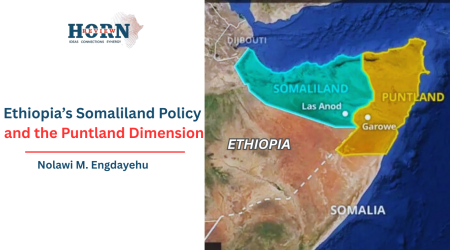
Ethiopia’s Somaliland Policy and the Puntland Dimension
By Nolawi M. Engdayehu
Recent counter-terrorism operations in Puntland have, without...

11
Feb
Ethiopia Weighing Saudi Overtures Amid Gulf Rivalry
Saudi Arabia’s invitation to Ethiopia’s foreign minister Gedion Timothewos for...

11
Feb
Ethiopia & the Emerging Saudi-UAE Axis Politics
The Red Sea is no longer governed by informal understandings...

11
Feb
Siad Barre's Water War: The Ogaden War as a Battle for Upstream Control
The Hidden Objective of the 1977 Somali Invasion
In July...
11
Feb
Red Sea Rebranding: From Ethiopian Herds to Djiboutian Certificates
The Hidden Cost of Livestock Trade
The Transboundary livestock trade...
9
Feb
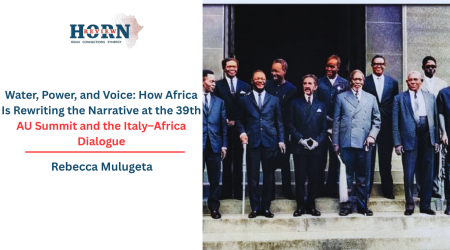
Water, Power, and Voice: How Africa Is Rewriting the Narrative at the 39th AU Summit and the Italy–Africa Dialogue
Addis Ababa rises at a historic moment. This year, it...