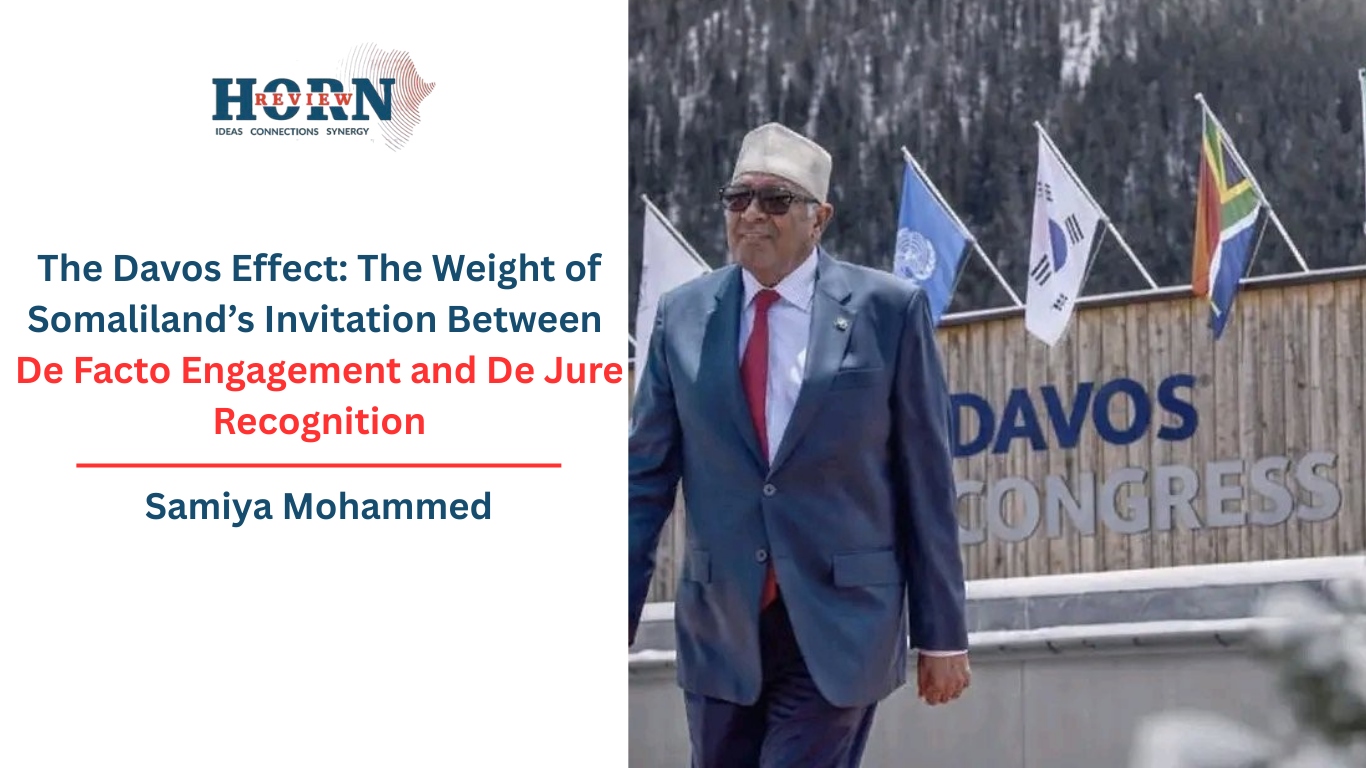
The invitation extended to President Abdirahman Mohamed Abdullahi Irro of Somaliland to attend the World Economic Forum Annual Meeting 2026 in Davos speaks for an inflection point in international relations concerning the Horn of Africa. The World Economic Forum Annual Meeting is a unique geopolitical and economic convocation. With over 2,500 attendees from business, government and civil society and it serve as a node for high level dialogue and agenda setting on global challenges. The 2026 meeting themed A Spirit of Dialogue gathered close to 65 heads of state and government alongside nearly 850 top CEOs and chairs marking one of the highest level gatherings in the Forum’s history.
An invitation to this forum is a calibrated decision. While the WEF is a non governmental organization and its invitations do not equate to formal diplomatic recognition by states they confer a distinct form of legitimacy and access. Participation places a leader within a network where capital flows are directed, security partnerships are discussed and global narratives are shaped. For an entity like Somaliland whose sovereign status is formally recognized by only one United Nations member state the invitation act for a subtle but potent form of validation. It signals to the international community that Somaliland is considered a credible stakeholder worthy of engagement on global issues irrespective of its unresolved legal status. This platform allows Hargeisa to shift its narrative from petitioning for basic recognition to participating in dialogues on economic integration and regional security as a de facto actor.
President Irro’s attendance cannot be divorced from the transformative event of December 2025 when Israel formally recognized the Republic of Somaliland as an independent and sovereign state. This recognition in the spirit of the Abraham Accords fundamentally altered Somaliland’s diplomatic position.
Within this environment the Davos invitation serves a dual purpose. it offers Somaliland a neutral, high profile venue to engage with global leaders beyond the bilateral framework with Israel mitigating the risk of isolation. And it also allows Somaliland to pragmatically advance its core strategic priorities economic development, security alliances, and regional integration.
A central aim for Somaliland is to signal its readiness for serious economic engagement. For over three decades, it has built a record of relative internal stability and democratic governance without access to international financial institutions. At Davos, the leadership can directly pitch key assets like the Port of Berbera as well as opportunities in logistics, renewable energy, and digital infrastructure to a concentrated audience of global decision makers.
Davos provides a discreet environment for diplomatic networking. Somaliland can use this setting to strengthen its integration into the security and economic framework where a critical patron with major investments in Berbera’s port and airport. Furthermore, it can hold quiet dialogues with other nations interested in Red Sea security and these interactions allow for alliance building without the diplomatic noise of formal state visits.
While the invitation is undoubtedly a milestone, its substantive impact should be critically examined. The World Economic Forum is a platform for dialogue not a decision making body. Attendance does not obligate states to alter their foreign policy. Most major powers including the United States, European Union members have publicly reaffirmed their support for Somalia’s territorial integrity following Israel’s recognition. Their representatives may engage with President Irro in Davos but this does not presage imminent diplomatic recognition.
Ultimately, the Davos invitation is a powerful tool of normative artfulness. It elevates Somaliland’s profile and provides a stage to demonstrate governance competence and strategic value. However, it operates in a parallel track to the formal, state centric system of international law and diplomacy. The invitation signifies that Somaliland has successfully cultivated a perception of being a capable actor but translating that perception into widespread legal recognition and unmaterialized investment remains a formidable challenge constrained by diplomatic positions and rivalries.
President Irro’s presence at the World Economic Forum Annual Meeting 2026 is a sophisticated diplomatic achievement for Somaliland. It reflects a deliberate strategy to leverage its de facto statehood and recent geopolitical alignment with Israel to gain access to elite global forums. The practical function of this meeting is to facilitate direct networking with economic and political power centers allowing Somaliland to advocate for its interests as a stakeholder rather than a supplicant.
Nevertheless, this development should be interpreted with analytical precision. The invitation is a symptom of Somaliland’s changing fortunes in politics particularly within the context of Red Sea security competitions and the Abraham Accords framework. It does not in itself constitute a break through in international law or a signal of impending widespread recognition. The track for Hargeisa will depend on its ability to manage the balance between capitalizing on new partnerships with Israel and global capital while navigating the opposition from Somalia and its allies and avoiding actions that could trigger a destabilizing regional conflict. The Spirit of Dialogue in Davos has provided Somaliland with a microphone on the global stage and the enduring challenge remains converting that audience’s attention into lasting institutionalized acceptance.
By Samiya Mohammed, Researcher, Horn Review