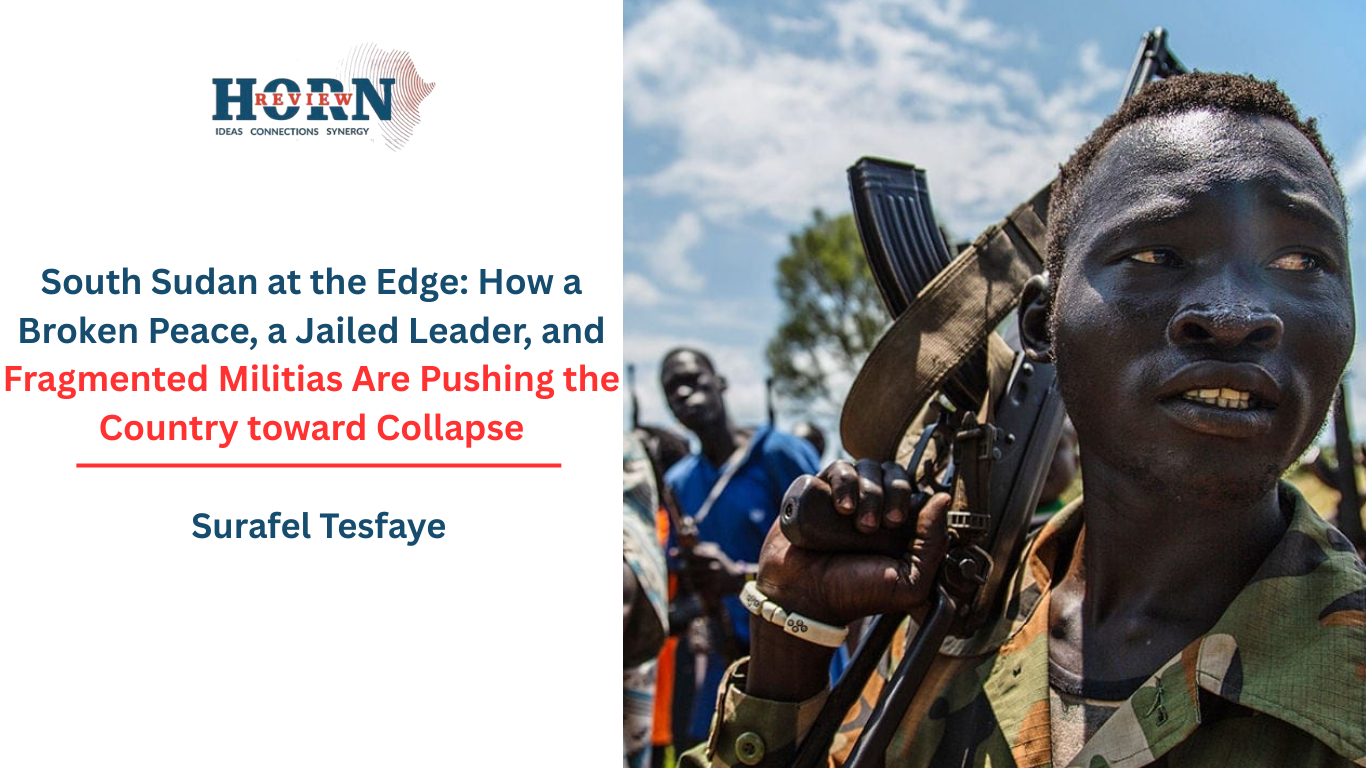
South Sudan is once again sliding toward a dangerous precipice. What was once described as a fragile but functioning peace has unraveled into something reality that is far more volatile: a conflict marked by fragmented authority, competing centers of power, with no credible mediation framework, and an increasingly autonomous militia landscape. As of January 2026, the country faces not just renewed violence, but a war without a unifying political or military command capable of negotiating, enforcing, or ending it. The country is drifting toward a high-intensity civil war that bears similarities to the catastrophe unfolding next door in Sudan.
One of the clearest indicators of this collapse is the growing displacement of communities associated with the White Army. Faced with sustained aerial bombardments, ground offensives by the Dinka-led South Sudan People’s Defence Forces (SSPDF), and escalating ethnic persecution, many have fled across the border into Ethiopia. These movements are not incidental. They reflect the complete breakdown of the 2018 Revitalized Peace Agreement and the return of raw, ethnically charged warfare.
At the same time, the opposition has openly shifted its posture. The SPLA-IO has now declared its intention to capture Juba, a statement that would have been unthinkable just a year earlier. Analysts increasingly warn that South Sudan’s war is beginning to mirror Sudan’s: fragmented command structures, competing militias, and violence that no longer answers cleanly to political authority. Groups like the White Army operate largely outside formal chains of command, driven more by local grievances and survival instincts than by negotiated political strategies.
At the center of this unraveling sits one man: Riek Machar. His detention and ongoing treason trial have become the single most destabilizing fault line in South Sudan’s politics. Whether Machar is released or remains behind bars carries radically different risks, and neither path offers an easy exit from the crisis.
Supporters of his release argue that Machar remains indispensable. Regional mediators and the SPLM-IO insist that without him, meaningful dialogue is impossible. His freedom, they say, could revive the stalled peace agreement, restore coherence to the opposition, and reassert control over disparate Nuer militias. Some even believe only Machar has the authority to persuade the White Army to halt its advance on Juba.
Yet the opposite scenario is just as dangerous. His return would likely alarm hardliners within President Salva Kiir’s inner circle, potentially triggering renewed power struggles or even a return to the kind of direct clashes that tore the country apart in 2013.
For now, however, Machar’s release appears unlikely. As of late January 2026, his trial for treason, murder, and crimes against humanity continues in a special court in Juba, repeatedly delayed and expected to drag on for months. At 73, Machar cannot face the death penalty, but a conviction could still result in life imprisonment and permanent disqualification from political office effectively removing him from the December 2026 elections. The government has made clear it intends to let the legal process run its course, despite mounting regional pressure.
To understand why the opposition waited so long before returning to war, one has to look back at the illusion of peace created in 2018. For seven years, Machar and the SPLM-IO chose political participation over renewed conflict. They entered the transitional government believing time was on their side. Oil revenues sustained elite networks on both sides. International legitimacy was preserved. Sanctions were avoided. Most critically, the opposition hoped the promised unification of forces would eventually level the military playing field.
That never happened. The integration of forces was systematically stalled, leaving opposition troops unpaid, under armed, and demoralized. Elections were repeatedly postponed first from 2022 to 2024, then again to December 2026. When Kiir approved constitutional amendments in late 2025 allowing elections without a permanent constitution, many in the opposition saw it as the final confirmation that the political route had been deliberately sabotaged.
The breaking point came in March 2025. Machar’s arrest effectively killed the peace deal. Almost simultaneously, Uganda intervened militarily after clashes in Nasir, launching aerial strikes against opposition positions. For the SPLM-IO, this external involvement erased any remaining belief in a negotiated transition. War was no longer a choice; it was, in their view, being imposed.
The regional environment has also shifted. The war in Sudan has altered old power balances, raising widespread suspicions that the South Sudanese opposition has gained new external patrons, possibly linked to the Sudanese Armed Forces or their allies. Meanwhile, grassroots militias like the White Army have become increasingly radicalized, driven by anger at government incursions, failed “buyout politics,” and years of unfulfilled promises.
Today, the opposition lacks a single, unified leader. The SPLM-IO itself has split into rival factions. Machar loyalists, led in the field by figures such as Oyet Nathaniel and Deputy Chief of Staff Wisley Welebe Samson, continue to recognize Machar as their legitimate leader. In contrast, a Juba-based interim faction led by Stephen Par Kuol has aligned itself with Kiir’s government a move loyalist openly describe as a political coup.
This fragmentation extends beyond party politics. The White Army does not answer to any single politician. Its loyalty lies instead with traditional elders, spiritual figures, and local war chiefs. Prophets like Makuach Tut Khor wield more influence over mobilization than any detained or co-opted elite in Juba.
If full-scale war continues, leadership will operate on three levels: Machar as the symbolic political figurehead, Wisley Welebe Samson as the operational military commander, and grassroots leaders as the true engines of mobilization. This structure makes negotiation extraordinarily difficult. Any deal signed in Juba risks being ignored on the ground if local fighters feel betrayed.
Paradoxically, this leadership vacuum makes the opposition weaker politically but more dangerous militarily. On January 19, 2026, despite Machar’s detention, SPLA-IO commanders ordered a coordinated march on Juba. Rebel forces have since captured towns like Pajut and Yuai, demonstrating their ability to operate independently. Without a credible negotiator, the opposition’s objective has shifted from reform to outright regime change a far more destructive trajectory.
President Kiir has exploited this chaos through a calculated strategy of co-optation. By recognizing interim opposition leaders, replacing Machar loyalists in parliament, and maintaining a legal façade of inclusivity, he can claim adherence to the peace agreement while sidelining its most powerful challenger. This divide-and-rule approach may secure short-term political control, but it has removed the last pressure valve for negotiation.
As of January 2026, the 2018 peace deal is effectively dead. What remains is a fragmented civil war, driven by autonomous militias, ethnic fear, and a leadership crisis that no single actor can resolve. South Sudan is not merely returning to war it is entering a more unpredictable and dangerous phase than before.
By Surafel Tesfaye, Researcher, Horn Review