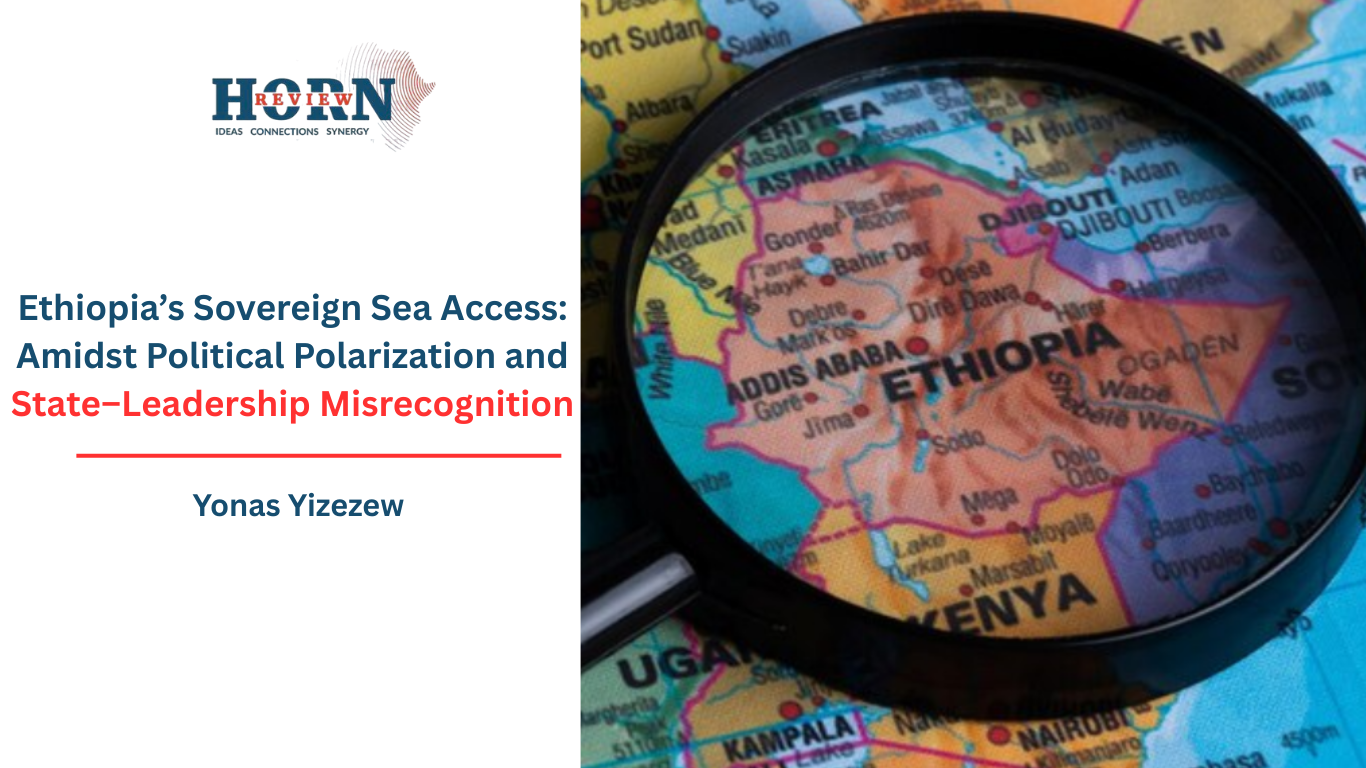
Ethiopia’s search for sovereign maritime access is widely recognized as a structural question of state survival rather than a routine policy choice. Even though it has gained broad acceptance after years of sustained effort and agenda-setting, some actors continue to oppose it, reflecting a political culture that still struggles to separate the government of the day from the enduring interests of the Ethiopian state. Ethiopia’s landlocked condition shows substantial economic, security, and diplomatic costs, and treats maritime access as a long‑term strategic necessity rather than a short‑term commercial issue. Landlockedness has raised port fees, heightened vulnerability to neighbors and foreign bases, and constrained Ethiopia’s regional role. Therefore securing diversified, sovereign outlets thus integrates with national security architecture, economic resilience, and regional agency, transcending any administration’s tenure.
Historically, access to ports and the Red Sea coastline was integral to Ethiopian statecraft, shaping the country’s security, trade, and regional influence. This makes the post-1991 acceptance of landlockedness an anomaly rather than a natural outcome. This shift, stemming from EPRDF elite bargains during the 1993 Eritrean referendum and the civil war transition, was not the result of historical inevitability or structural logic. It was a political decision that temporarily redefined national priorities, leaving a long-term strategic question unresolved.
Ethiopia’s quest for sovereign sea access stresses deep historical, legal, psychological, and geopolitical ties to the Red Sea–Gulf of Aden and presents renewed maritime ambition as an effort to correct that strategic rupture. From this perspective, raising the issue now is not only necessary but crucial, as cumulative demographic and economic pressures make prolonged landlockedness increasingly untenable for a large and growing state. The region’s over-militarization, security challenges, and strategic vulnerabilities further strengthen the imperative for Ethiopia to secure sovereign maritime access. Doing so is essential to safeguard the country’s long-term stability, economic resilience, and national security.
At the regional level, the 2016 Berbera port equity stake (19%), the Somaliland MoU, and the Ankara Declaration show that Ethiopia’s maritime moves are read through a securitized lens by neighbors, in part because of the wider militarization and external power presence in the Horn and rival actors influence. Yet Ethiopia’s vulnerability as a landlocked state, dependent on a few transit corridors under heavy foreign influence, is itself a structural security dilemma that any government in Addis Ababa must confront.
The Ethiopian politics manifests as an “unending dialectics” of identity, oscillating between pan-Ethiopian synthesis and ethno-nationalist fragmentation, impeding stable statehood. Successive regimes have mismanaged nationality questions and alternated between homogenizing nation‑building and radical ethnic autonomy, generating cycles of mistrust, conflict, and incomplete state‑building. Ethnic federalism institutionalized ethnicity as the primary axis of politics. While it recognized previously marginalized groups, it also entrenched ethnic competition and subordinated issue‑based, civic politics to identity claims. Over three decades, this has produced a political culture where elites routinely interpret any major national question—constitutional reform, federal design, security strategy—through the prism of group narratives and partisan advantage rather than long‑term state viability.
Studies of digital political communication after 2018 show how social media amplifies these dynamics. Ethno‑nationalist and unionist actors alike use online platforms to craft polarized narratives, with ethnic belonging dominating over civic citizenship. Identity‑based antagonisms, historical grievances, and power struggles are continuously reproduced and radicalized in the digital sphere, turning complex structural issues into emotionally charged culture‑war questions.
This has direct implications for the sea‑access debate. Attempts to revive a unifying language of national project and regional leadership sometimes face opposition, as different groups interpret them either as a return to assimilationist “Ethiopianism” or as a cover for partisan agendas. This makes even broadly important initiatives vulnerable to being framed through identity and political divides rather than long-term state interests. In this context, even an existential state priority like sovereign maritime access is easily reframed as the property of a governing party or leader, to be supported or opposed in line with broader struggles over legitimacy.
The blurring of state and regime is a long‑standing pattern. In Ethiopia’s nation-building and contemporary politics, competing nationalisms each portray the state either as an emancipatory project or as an instrument of domination, with little stable, shared understanding of the state as a neutral framework serving all citizens. This securitized mutual perception—where some see the central state primarily as a vehicle of rival elites—encourages tactical opposition to any initiative associated with the incumbent, regardless of its structural necessity. Diaspora politics, shaped by both historical grievances and party opposition, often follows this pattern, opposing or supporting strategic moves like sovereign sea access primarily as a referendum on the government’s legitimacy rather than on their long‑term state implications.
Ethiopia’s historiography and identity debates emphasizes how rival historical narratives—Ethio‑nationalist versus ethno‑nationalist—have become entangled with present political struggles, undermining national cohesion. The loss of the sea in 1991 is interpreted through these narratives either as a necessary recognition of Eritrean self‑determination or as a catastrophic elite betrayal of Ethiopia’s strategic foundations.
Analyses of post‑1991 leadership decisions stress that the issue of landlockedness was largely depoliticized domestically and treated as a manageable economic inconvenience rather than an existential strategic problem, despite its clear long‑term costs. Even raising the issue itself was discouraged or effectively forbidden within the political system. The reluctance to debate the question openly, for fear of reopening the Eritrea file or being accused of expansionism, is now widely criticized as a major mistake that only delayed an unavoidable strategic reckoning. The current and future generations must confront this legacy through diplomacy and law, and that continuing silence would deepen dependence and vulnerability. It is also important to recognize that, given its historical legitimacy and strategic necessity, a country cannot be faulted for asserting or pursuing sovereign sea access, and failing to raise the issue would be considered imprudent from a national interest perspective.
At the same time, delay carries its own costs. Growing external military presence, the strategic commercialization of littoral states, and intensifying great‑power competition around the Red Sea constrain Ethiopia’s options and make exclusive reliance on a single port increasingly risky. The longer the structural question is deferred, the less room there is for consensual, win‑win arrangements and the more any move will be read as revisionist or destabilizing.
Placed against this backdrop, opposition to the sea access imperative solely on the basis of hostility to the incumbent administration reflects a deeper problem: the conflation of state and party, the dominance of identity-driven polarization over issue-based evaluation, and the erosion of the ability to think across generational horizons. Ethiopia faces a structural maritime question whose implications will outlast all current actors, and while it confronts this challenge with political institutions, discourses, and historical narratives that have traditionally struggled to distinguish between partisan battles and the enduring interests of the state, these structures are now undergoing reform to better align politics with long-term national priorities. In this context, it is important to acknowledge the National Dialogue Commission for its efforts to foster inclusive political dialogue and strengthen consensus-building mechanisms.
In due course, Ethiopia’s pursuit of sovereign, diversified maritime access is a structural state imperative rooted in history, geography, security, and economic logic, not a routine partisan project. Yet a century‑long pattern of identity‑driven polarization, historiographical contestation, and state–party conflation means that this generational question is being processed through a polarized political culture that misreads it as just another front in domestic power struggles. Overcoming that misrecognition—inside Ethiopia and across its diaspora—requires rebuilding a distinction between regime and country, and placing the maritime question within a long‑term, inclusive vision of Ethiopian statehood and regional cooperation.
By Yonas Yizezew, Researcher, Horn Review